Welcome to the next stage of our journey into ESG. In our last lesson, we established a clear and structured understanding of what ESG is by breaking it down into its three pillars: Environmental, Social, and Governance. We now have a comprehensive map of the topics that fall under this framework.
Today, we will address the crucial question of why companies, and your future clients, should invest time and resources into this. This lesson focuses on the value proposition of ESG. We'll explore how strong ESG performance is no longer just a "nice-to-have" but a core driver of financial performance, risk mitigation, and long-term resilience. Understanding this business case is fundamental to your goal of offering ESG reporting as a service, as it forms the basis of the argument you will make to potential clients.
From "Doing Good" to Driving Value
Historically, many of the topics now under the ESG umbrella were seen as corporate philanthropy or simply the cost of compliance. The modern view, however, is that proactively managing ESG issues creates tangible shareholder value. A strong ESG strategy can open new markets, reduce costs, strengthen relationships with regulators, and attract top talent.
To start, let's watch a short video from McKinsey & Company that provides an excellent high-level overview of the five primary ways ESG initiatives translate into financial value.
This video concisely outlines how ESG levers can be used strategically to create shareholder value. It serves as a great framework for our discussion.
Please watch the entire video (ESG value creation). As you watch, take note of the five key areas the speaker identifies: Top-line growth Cost reductions Reduced regulatory and legal interventions Employee productivity uplift Investment and asset optimization
The five points from the video provide a powerful strategic lens. You can see direct parallels to your own experience. For example, "cost reductions" through energy and water efficiency are a fundamental principle in chemical engineering and production management. Similarly, managing supply chains for "reduced regulatory risk" is analogous to the supplier audits and compliance checks you performed for BRCGS standards. ESG simply expands the scope of these familiar business principles.
The Business Case for ESG Investment
Now, let's build on that framework with more detail. To effectively advise a company, you need to articulate the specific benefits of an ESG program and the risks of inaction. A well-structured argument will demonstrate that ESG is not a cost center, but a source of competitive advantage and resilience.
The following article from Thomson Reuters provides an excellent summary of the business case for ESG.
ESG and shareholder value: Making the case for investment
This article clearly outlines why ESG is a smart business decision and details the specific benefits and risks involved. This is the core argument for why a company should pursue ESG reporting.
Please read the following sections of the article: Start with The business case to understand the high-level argument. Next, read the section What are the benefits of sustainability? This provides a list of tangible advantages you can present to a client. Then, read about the Risks of ignoring ESG factors to understand the potential negative consequences of inaction. Finally, review the concluding section on long-term value creation to see how these elements combine.
As the article highlights, the drivers are multifaceted. Investors use ESG data to identify well-managed companies that are better prepared for future risks. Regulators are increasingly mandating disclosures. Customers, particularly younger generations, are directing their purchasing power toward sustainable brands. And employees want to work for mission-driven organizations. Failing to address ESG is no longer a neutral position; it actively exposes a company to reputational, regulatory, and market risks.
Quantifying the Value: Speaking the Language of Business
Making a compelling case requires more than just listing benefits. To secure investment and drive internal change, sustainability initiatives must be translated into the language of business: finance. Your future clients' leadership teams, especially the CFO, will want to see the financial returns on ESG investments.
This is where the concept of quantifying sustainability becomes critical. It's about moving from metrics like "tons of CO2 reduced" to "dollars saved" or "increase in enterprise value." This approach transforms the sustainability team from a cost center to a value-creation partner.
The consulting firm ERM provides an insightful perspective on this.
Quantifying Sustainability: Turning ESG into Business Value | ERM
This article explains the necessity of translating sustainability outcomes into financial metrics and provides real-world examples of the value unlocked.
Please read the following sections: First, read Why quantification matters to understand the pragmatic reason for this approach. Next, review the section The business case: discipline unlocks value. Pay close attention to the concrete examples of financial gains achieved by a hospitality group, a retail provider, and a food company. Finally, read Communication by numbers, which emphasizes using "CFO-grade financial metrics" like IRR (Internal Rate of Return) and NPV (Net Present Value).
The ability to build a business case using metrics like IRR and NPV—concepts familiar from your engineering background—is what elevates an ESG proposal from an ethical suggestion to a strategic investment. The examples in the article (e.g., the food company unlocking $4.9 million in incremental sales) provide powerful proof points for the value proposition.
Tying It All Together: Stakeholders and Value Creation
So far, we have largely focused on the financial value for the company and its shareholders. However, the underlying principle that makes ESG so powerful is that long-term financial success is inextricably linked to the value a company creates for all its stakeholders. This is the core idea of Stakeholder Theory.
This short video by R. Edward Freeman, a key originator of the theory, explains this concept well.
What is Stakeholder Theory? - R. Edward Freeman
This video explains the foundational idea that a successful business must create value for all its key stakeholders, not just financiers.
Please watch from the beginning until the end. The video argues that a business that ignores its customers, suppliers, employees, or community is a business in decline.
ESG provides a practical framework for managing the interconnected interests of all these stakeholders. By addressing environmental impacts, you serve the community and meet regulatory demands. By investing in your employees, you improve productivity and innovation. By ensuring ethical governance, you build trust with investors.
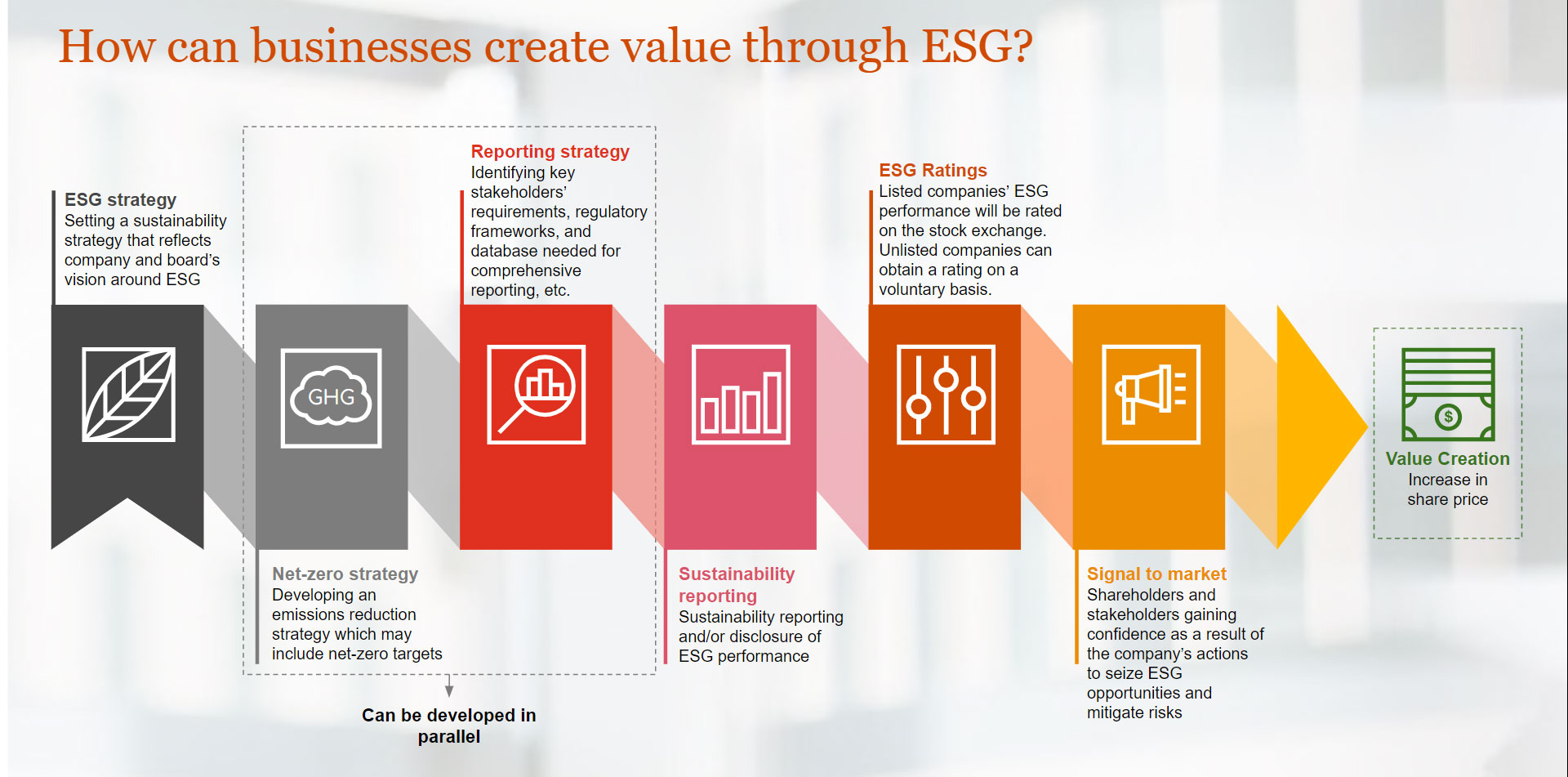
The image below from PwC provides a fantastic visual summary of this entire process, showing how a company’s ESG strategy and actions ultimately lead to tangible value creation.
Conclusion
In this lesson, we've established the compelling "why" behind ESG. It's not about sacrificing profit for principle; it's about recognizing that principles drive long-term, sustainable profit.
Key Takeaways:
- ESG Drives Financial Value: Strong ESG performance is linked to top-line growth, cost reductions, lower regulatory risk, higher productivity, and optimized investments.
- The Business Case is Multifaceted: Value is created by attracting customers, retaining talent, building resilient supply chains, and enhancing brand reputation.
- Quantification is Key: To gain support and resources, ESG benefits must be translated into financial metrics (e.g., cost savings, NPV, IRR) that resonate with business leaders.
- Stakeholder-Centric Approach: Long-term shareholder value is the result of creating value for all stakeholders—customers, employees, suppliers, and the community. ESG is the framework for managing these relationships.
- Inaction is a Risk: Ignoring ESG can lead to loss of market share, regulatory penalties, reputational damage, and difficulty attracting capital and talent.
Now that we firmly understand why ESG is a business imperative, we are ready to explore how companies report on it. In our next lesson, we will begin Module 2 by diving into the complex landscape of ESG reporting standards and frameworks, such as GRI, SASB, and the IFRS standards. This will be our first step into the technical mechanics of building an ESG report.