Hello! In our previous lesson, we established the powerful business case for ESG, clarifying why it has become a strategic imperative for modern companies. We saw that strong ESG performance isn't just about ethics; it's a direct driver of financial value and long-term resilience.
This lesson concludes our foundational module by sharpening our definitions. In the corporate world, you'll hear terms like "sustainability," "ESG," and "impact investing" used frequently, and sometimes interchangeably. For you as a future consultant, using this language with precision is critical for credibility. Today, we will differentiate these key concepts to ensure you can speak about them with clarity and authority. This will finalize our understanding of "what" we are dealing with before we move on to the "how" of reporting.
Sustainability: The Overarching Goal
Let's start with the broadest and most foundational term: sustainability. As we touched on in our first lesson, sustainability is about meeting the needs of the present without compromising the ability of future generations to meet their own needs. It is a holistic concept encompassing the long-term health and balance of our environmental, social, and economic systems.
Think of sustainability as the ultimate goal or the guiding philosophy for a business. It's the "north star."

The image above visually captures this relationship. Sustainability is the all-encompassing idea, and ESG provides a way to structure and measure the specific components within it.
ESG: The Measurement Framework
If sustainability is the goal, Environmental, Social, and Governance (ESG) is the framework used to measure progress towards that goal. ESG breaks down the broad concept of sustainability into a concrete set of factors that can be quantified, tracked, compared, and reported on.
This is where the concepts become highly relevant to your background. In your quality management roles, you didn't just aim for "good quality"; you used specific, auditable standards like BRCGS and measurable KPIs to define, control, and verify quality. ESG serves a similar function for sustainability. It translates the broad ambition of being a sustainable company into a practical, data-driven management and disclosure system that investors, regulators, and other stakeholders can use to assess performance.
To explore this distinction more deeply, let's turn to an article from Deutsche Bank that clearly separates the two concepts.
What is the difference between ESG and Sustainability
This article provides a clear and concise distinction between the broad concept of sustainability and the more specific framework of ESG.
Please read the first two main sections of the article. Start at the beginning and read the introduction, which defines both terms. Continue to the next section, "ESG: a tool for measuring", which explicitly frames ESG as a measurement tool within the broader sustainability framework.
As the article emphasizes, ESG is a tool for measuring a company's performance on specific dimensions, while sustainability is the broad framework for long-term viability. A company with a strong sustainability culture will likely perform well on ESG metrics, but the two are not identical.
For another clear explanation, watch this short segment from the video "What is the difference between ESG, CSR, sustainability, and Net Zero?".
What is the difference between ESG, CSR, sustainability, and Net Zero?
This video provides concise definitions that reinforce the distinction between the broad goal and the measurement tool.
Please watch the following two clips: First, the definition of Sustainability from this section. Then, the definition of ESG, which is presented as a more quantitative approach, from this part.
Impact Investing: A Proactive Strategy
Now let's introduce a third, related term: impact investing. While ESG is a framework for assessing companies, impact investing is an active investment strategy. The crucial difference is intent.
- ESG Investing often involves using ESG data to screen companies, either to avoid risks (negative screening) or to identify well-managed companies that are likely to outperform over the long term (positive screening). The primary goal is still financial return, enhanced by ESG analysis.
- Impact Investing, by contrast, involves making investments with the explicit intention of generating a positive, measurable social and environmental impact alongside a financial return. The impact is a core part of the investment thesis, not just a secondary consideration.
Let's clarify this with a reading from Moonfare, which compares these different investment philosophies.
Comparison of SRI, ESG, Sustainable and Impact Investing
This article clearly defines sustainable investing and impact investing, highlighting the targeted, intentional nature of the latter.
Please read the following sections: First, read "What is 'sustainable investing'?" to understand its broader context. Next, read the definition of "Impact investing", paying close attention to the GIIN definition and the focus on "positive, measurable" impact. Finally, review the comparison table at the end for a quick summary.
The video below from The Plain Bagel also does an excellent job of distinguishing ESG from impact investing from an individual investor's point of view.
E.S.G. Investing - What it Means and Its Pros/Cons
This video clarifies that while ESG investing seeks a balance between ethics and financial returns, impact investing often prioritizes the positive outcome more directly.
Watch the section from this point, where the narrator contrasts ESG investing with impact investing.
A Spectrum of Capital
To bring all these ideas together, it's helpful to view these approaches not as separate silos, but as a progression along a spectrum. Each step incorporates more non-financial considerations into the decision-making process.
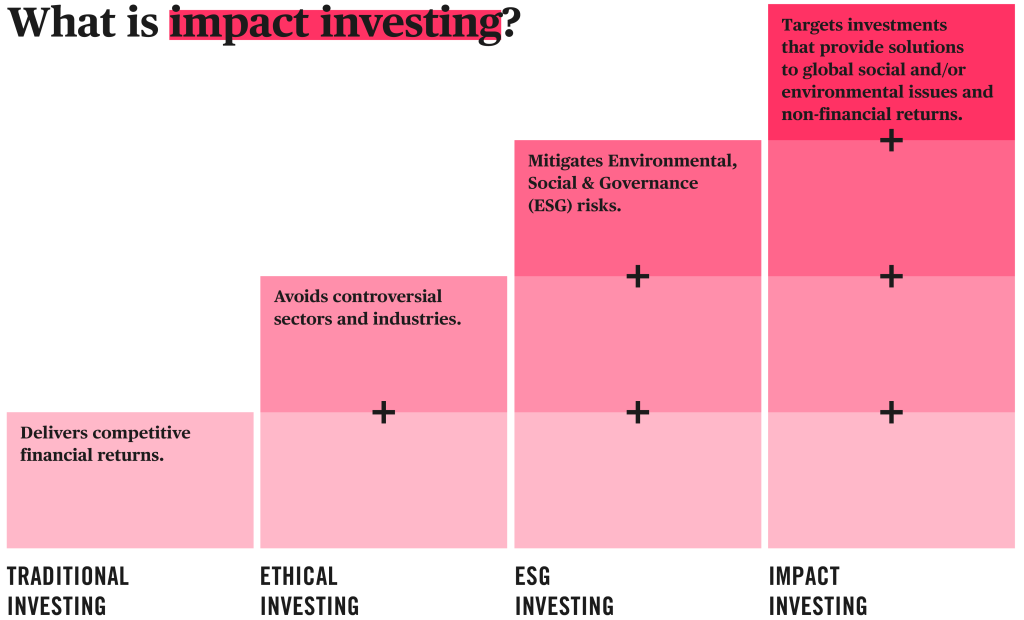
Let's walk through the chart:
- Traditional Investing: The focus is exclusively on financial risk and return. This is the baseline.
- Ethical Investing: This is an early form of responsible investing, primarily based on avoidance. It uses negative screening to exclude controversial sectors like tobacco or weapons.
- ESG Investing: This is a more sophisticated approach. It goes beyond simple exclusion and uses comprehensive ESG data to analyze risks and opportunities. The goal is to identify well-managed companies that are more resilient and likely to create sustainable long-term value.
- Impact Investing: This is the most proactive approach. The primary goal is to direct capital toward ventures that actively solve social or environmental problems (e.g., funding a renewable energy project or a microfinance institution) while also generating a financial return.
As a consultant, you will primarily operate in the world of ESG, helping companies measure and report the data that ESG investors use. However, understanding this full spectrum allows you to contextualize your work and understand the motivations of different stakeholders.
Conclusion
In this lesson, we've dissected the key terminology at the heart of the sustainable business landscape. Having a precise command of these terms is fundamental to your new career path.
Key Takeaways:
- Sustainability is the overarching goal—a holistic vision for a business to operate in a way that ensures the long-term well-being of the economy, society, and the environment.
- ESG (Environmental, Social, Governance) is the measurement framework. It's a set of concrete, data-driven criteria used to assess a company's performance and progress toward sustainability.
- Impact Investing is a proactive investment strategy with the explicit intent to generate a measurable, positive social or environmental impact alongside a financial return.
- These concepts exist on a spectrum, moving from a pure financial focus (traditional) to a dual focus on financial return and measurable positive impact (impact investing), with ESG being the critical data layer in between.
This lesson concludes the first module of our course. We have defined sustainability and ESG, understood their value proposition, and clarified the key terminology. We are now ready to move from the "what" and "why" to the practical "how."
In our next lesson, we will begin Module 2 by diving into the complex but crucial landscape of ESG Reporting Frameworks and Standards. We'll start comparing the major players like GRI, SASB, and the new IFRS standards, which provide the rulebooks for how companies must report their ESG data.