Welcome to our next lesson. In our previous session, we explored the UN Sustainable Development Goals (SDGs) as a high-level strategic roadmap for businesses to align with global priorities. We saw how this global blueprint helps companies identify risks and opportunities.
Today, we will transition from that broad strategic vision to the more granular framework that investors and stakeholders use to measure performance: Environmental, Social, and Governance (ESG). This lesson will define each of these three pillars and break them down into their core components. Understanding this structure is the foundational step for constructing an ESG report, as it provides the "table of contents" for the topics a company needs to consider.
What is ESG?
ESG is a framework used to assess a company's conscientiousness for social and environmental factors. It provides a way to measure sustainability and societal impact beyond traditional financial metrics. While the SDGs set the global agenda, ESG provides the specific criteria through which a company's contribution—or detriment—to that agenda is evaluated.
To begin, let's watch a short video from SGS North America that provides a clear definition of ESG and gives examples for each component.
Fundamentals of ESG & Sustainability Performance
This video offers a concise introduction to the three pillars of ESG and explains their connection to non-financial reporting.
Please watch the section from the definition of ESG. Pay close attention to how the speaker defines non-financial reporting and gives a concrete example for each of the E, S, and G pillars.
As the video explained, ESG topics are "non-financial" in the sense that they are not measured in currency, but they have very real financial implications. A useful way to think about this, drawing from your experience, is to see the ESG framework as analogous to a robust Quality Management System (QMS) like BRCGS or HACCP. A QMS breaks down the abstract concept of "quality" or "safety" into specific, auditable control points and metrics. Similarly, ESG deconstructs the broad concept of "sustainability" into a structured set of topics and indicators that can be measured, managed, and reported on.
The Three Pillars at a Glance
The ESG framework is organized into three distinct pillars. Each pillar covers a different domain of a company's operations and its interactions with the world. The image below provides a high-level map of the key elements that fall under each pillar.
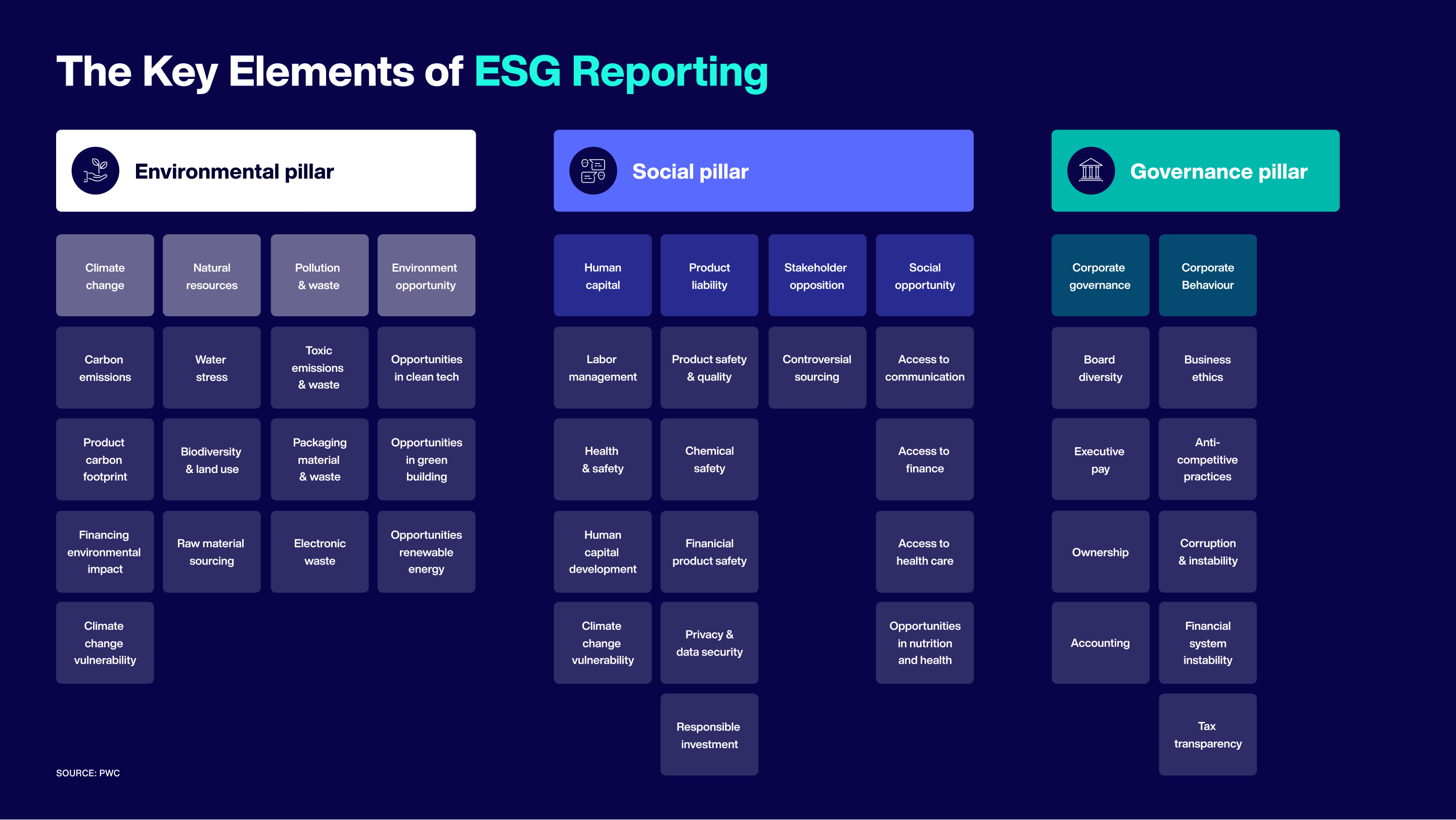
A Deeper Dive into ESG Topics
To move toward practical application, we need a more formal and comprehensive list of the topics that comprise E, S, and G. The Organisation for Economic Co-operation and Development (OECD) has compiled a detailed classification of ESG topics that are commonly used by rating agencies and reporting standards. This gives us a systematic inventory of what needs to be considered in an ESG assessment.
Let's examine the topics within each pillar using the OECD's classification.
Behind ESG Ratings: Unpacking Sustainability Metrics
This document provides an authoritative breakdown of ESG topics. We will focus on Annex B, which contains a table defining the key topics within each pillar.
Please navigate to "Annex B. ESG topic descriptions" and review the table titled "Table A B.1. ESG topic classification used for this paper". You will read this table in three parts, starting with the Environmental pillar.
1. The Environmental Pillar
The "E" in ESG addresses a company's impact on the natural environment. This includes its use of resources like energy and water, the waste it generates, and its emissions. Many of these topics will be familiar from your work in chemical engineering and food production, where process efficiency, waste reduction, and resource management are critical.
Behind ESG Ratings: Unpacking Sustainability Metrics
Now, let's focus on the Environmental pillar in the OECD's classification table.
In "Table A B.1", please read the descriptions for each topic under the Environmental pillar. These topics range from GHG emissions and water management to biodiversity and climate resilience.
2. The Social Pillar
The "S" in ESG concerns how a company manages its relationships with its stakeholders, including its employees, suppliers, customers, and the communities where it operates. It covers everything from labor practices and workplace safety to data privacy and community impact. Your background in managing supplier quality and internal audits for standards like BRCGS, which includes ethical trading and personnel clauses, provides a strong foundation for understanding these topics.
Behind ESG Ratings: Unpacking Sustainability Metrics
Next, we'll examine the topics that make up the Social pillar.
In the same table, please read the descriptions for each topic under the Social pillar. Note the breadth of issues, from internal concerns like health and safety to external ones like consumer interests.
3. The Governance Pillar
The "G" in ESG refers to the systems of control and oversight that guide a company. It's about a company's leadership, internal controls, executive pay, shareholder rights, and business ethics. This pillar is the foundation that supports the Environmental and Social pillars, as strong governance is necessary to implement and oversee effective E and S policies. Your experience as a quality supervisor and internal auditor, which involves ensuring compliance and managing systems, directly relates to the principles of good governance.
Behind ESG Ratings: Unpacking Sustainability Metrics
Finally, let's review the Governance pillar, which provides the framework for managing E and S issues.
In "Table A B.1", please read the descriptions for each topic under the Governance pillar. This includes topics like corporate governance, business ethics, and corruption.
By systematically defining these topics, the ESG framework provides a clear, structured, and comprehensive way for a company to analyze and report on its sustainability performance.
Conclusion
In this lesson, we have defined the three pillars of Environmental, Social, and Governance. We've moved from the high-level vision of the SDGs to the specific categories that form the backbone of modern sustainability reporting. You now have a detailed map of the topics that an ESG report must address.
Key Takeaways:
- ESG stands for Environmental, Social, and Governance, a framework that breaks down sustainability into specific, measurable topics.
- The Environmental pillar covers a company's impact on the planet, including emissions, resource use, and waste.
- The Social pillar addresses a company's relationships with its stakeholders, such as employees, customers, and communities.
- The Governance pillar relates to a company’s leadership, ethics, internal controls, and shareholder rights, forming the foundation for managing E and S issues.
- This structured approach allows companies, investors, and other stakeholders to assess and compare performance on non-financial factors in a standardized way.
Now that we have a clear definition of what ESG covers, our next lesson will explore why it has become so critical. We will examine the value proposition of ESG for different stakeholders, particularly investors and regulators, to understand the powerful drivers behind the global push for ESG reporting.