Hello! In our last lesson, we traced the evolution from the broad, qualitative principles of Corporate Social Responsibility (CSR) to the specific, data-driven framework of Environmental, Social, and Governance (ESG). You learned that this shift was largely driven by investors seeking to understand the financial risks and opportunities tied to a company's sustainability performance.
Today, we'll explore one of the most important frameworks that helps companies and stakeholders understand what "sustainability" means in practice: the UN Sustainable Development Goals (SDGs). These goals provide a shared global roadmap for a better future. For a business, they are much more than a list of ideals; they are a powerful strategic tool for identifying risks, unlocking innovation, and aligning corporate strategy with global priorities. This understanding is fundamental for any ESG consultant seeking to guide a company's efforts.
What are the Sustainable Development Goals?
The Sustainable Development Goals are a collection of 17 interlinked global goals designed to be a "shared blueprint for peace and prosperity for people and the planet, now and into the future." They were adopted by all United Nations Member States in 2015 as part of the 2030 Agenda for Sustainable Development.
To get a clear overview of these 17 goals, let's turn to a resource developed by KPMG and the UN Global Compact.
[PDF] SDG Industry Matrix for Food, Beverage and Consumer Goods
This document provides an excellent introduction to the SDGs. Because it's tailored to the food and consumer goods industry, it will be particularly relevant as we proceed.
First, read the introductory page titled New Global Goals. This will give you the context behind their creation. Then, turn to the next page and review the full list of the 17 Sustainable Development Goals.
Seeing all 17 goals together can be overwhelming. A useful way to conceptualize them is the "SDG wedding cake" model, which groups the goals into three layers, showing their dependency. This model powerfully illustrates that a healthy economy and society depend on a healthy planet, a core principle of sustainability we discussed in our first lesson.
Sustainable Development Goals explained | SDG United Nations Sustainability
This video from Sustainability Illustrated provides a clear and memorable visualization of how the SDGs are interconnected.
Please watch from the beginning until the end of the wedding cake explanation. Pay close attention to how the presenter organizes the 17 goals into the three layers: biosphere, society, and economy.
As you saw, the four "biosphere" goals—Life Below Water, Life on Land, Clean Water, and Climate Action—form the foundation. They support the eight "society" goals, which in turn enable the four "economy" goals. This structure reinforces that economic activity doesn't happen in a vacuum; it is entirely dependent on thriving societies and a stable environment.
From Global Goals to Business Strategy
The SDGs were written for governments, but their achievement depends heavily on the private sector. For businesses, the SDGs provide a strategic compass. They highlight the world’s most pressing challenges, which in turn represent significant risks to be managed and immense opportunities for innovation and growth.
The business case for engaging with the SDGs is compelling.
[PDF] IN TEGRATING THE SDG s IN T O A PRACTICAL GUID E
This guide, a collaboration between the Global Reporting Initiative (GRI) and the UN Global Compact, explains why businesses should align with the SDGs.
Please read the introduction, Setting the scene. Note the points it makes about new market opportunities, risk mitigation, and the growing interest from investors who see the SDGs as a list of material ESG issues.
A common mistake is "cherry-picking"—tackling only the easiest goals or simply relabeling existing activities with an SDG logo. A strategic approach, however, involves a rigorous process of prioritization, much like the risk assessments you are familiar with from your quality management work. This is called principled prioritization. It helps a company focus on the SDGs where it has the most significant impacts—both negative and positive—across its entire value chain.
The GRI guide outlines a two-pronged approach for this prioritization:
- Entry Point A: Assess Risks to People and the Environment. This involves identifying the most severe negative impacts a company causes or contributes to (e.g., pollution, poor labor conditions) and mapping them to relevant SDG targets. The goal is to mitigate these risks.
- Entry Point B: Identify Opportunities for Positive Contribution. This involves exploring how a company's core products, services, and investments can provide solutions to SDG-related challenges (e.g., developing nutritious food products, creating resource-efficient technologies).
This entire process can be visualized as a cycle of understanding, prioritizing, and integrating.

The SDGs in Practice: The Food & Beverage Industry
Let's make this concrete by looking at examples from an industry you know well. The KPMG "SDG Industry Matrix" you looked at earlier provides specific examples of how food and beverage companies can create "shared value"—value for both their business and society—by aligning with the SDGs.
[PDF] SDG Industry Matrix for Food, Beverage and Consumer Goods
This is where the theory becomes practice. This resource will show you exactly how SDGs translate into business opportunities in your sector.
First, read the section Opportunities for shared value. This summarizes the key themes for the industry, such as sustainable supply chains and product innovation. Next, browse the detailed examples for a few specific goals. I suggest you focus on the following, which are highly relevant to your background: SDG 2: Zero Hunger (pages 19-21). Look at the examples from companies like Cargill and Diageo, which focus on nutrition and smallholder farmer development. SDG 8: Decent Work and Economic Growth (pages 31-32). Notice how initiatives like SABMiller's use of locally-sourced ingredients create economic opportunities in their supply chains. SDG 12: Responsible Consumption and Production (pages 36-38). This section is full of examples related to packaging reduction (PepsiCo), sustainable sourcing (LEGO), and reducing CO2 emissions (Heineken), all of which fall squarely within the scope of production and quality management.
As you read, consider how a client in the food industry might use this matrix. It's a tool for brainstorming, for seeing how competitors are acting, and for identifying strategic initiatives that go beyond simple compliance to create new business value. This is precisely the kind of strategic guidance an ESG consultant provides.
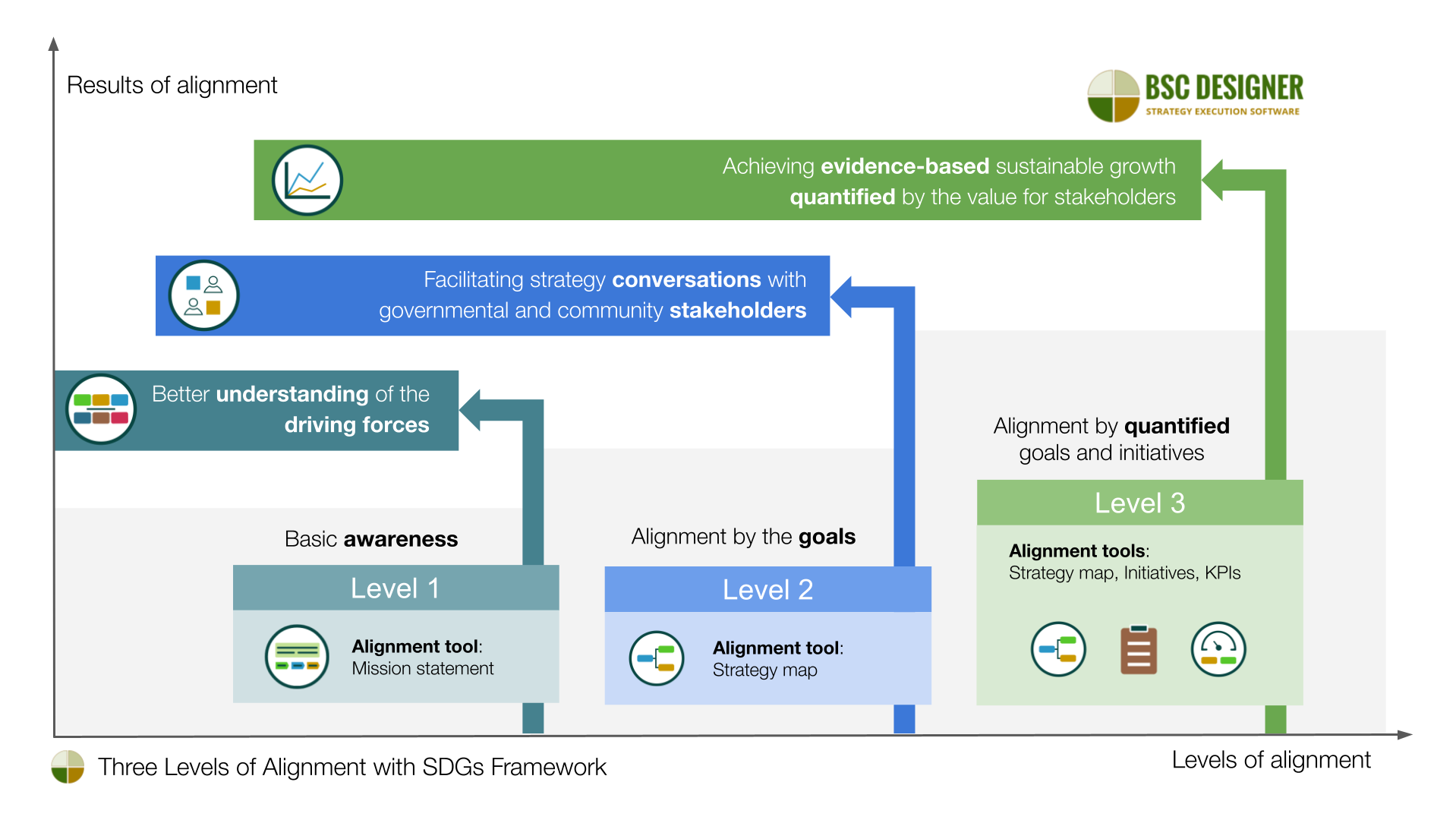
The maturity of a company's SDG alignment can be viewed in levels, from basic awareness to having a strategy with quantified, evidence-based goals.
Conclusion
In this lesson, you've been introduced to the UN Sustainable Development Goals and seen how they serve as a vital strategic framework for businesses. Rather than being a peripheral concern, the SDGs offer a direct path to identifying material risks, fostering innovation, and communicating a company's purpose to investors and other stakeholders.
Key Takeaways:
- The 17 UN Sustainable Development Goals (SDGs) are a universal blueprint for a sustainable future, structured in interconnected layers of biosphere, society, and economy.
- For businesses, the SDGs are not a philanthropic checklist but a strategic tool for identifying risks, finding market opportunities, and driving long-term value.
- Companies use principled prioritization to focus on the SDGs where their impact is most significant, considering both negative risks to mitigate and positive contributions to scale.
- Alignment with the SDGs can lead to tangible business benefits, including enhanced reputation, access to new markets, and increased investor confidence.
You now have a high-level map (the SDGs) that companies use to navigate the vast landscape of sustainability. In our next lesson, we will zoom in on the specific language that companies use to report on these efforts. We will define each of the three pillars of ESG—Environmental, Social, and Governance—and begin to explore the key topics and metrics that fall under each.