In our previous lesson, we established a solid foundation by defining sustainability and its three interconnected pillars: environmental, social, and economic. We saw that true sustainability requires a balance across all three, moving beyond a narrow focus on profit or environmentalism alone.
Today, we will build directly on that foundation to explore how these broad ideas have been translated into corporate practice. This lesson traces the important journey from the early concept of Corporate Social Responsibility (CSR) to the specific, data-driven ESG framework that is central to your goal of becoming an ESG reporting consultant. Understanding this evolution is key to appreciating why modern sustainability reporting is structured the way it is and why it has become so influential.
From Good Intentions to Corporate Strategy: The Rise of CSR
After World War II, as corporations grew in size and influence, a new conversation began about their role in society beyond simply making money. This led to the concept of Corporate Social Responsibility (CSR).
At its heart, CSR is a self-regulating business model that helps a company be socially accountable—to itself, its stakeholders, and the public. It represents the formal beginning of businesses considering their impact on society.
CSR, ESG and Sustainability: Key Differences Explained
This article from JAGGAER provides an excellent overview of CSR's origins.
Please read the section What Is Corporate Social Responsibility?. As you read, notice that the concept, first formalized by Howard Bowen in 1953, challenged the idea that profit was a company's only purpose. It argued that businesses have an obligation to align their actions with societal values.
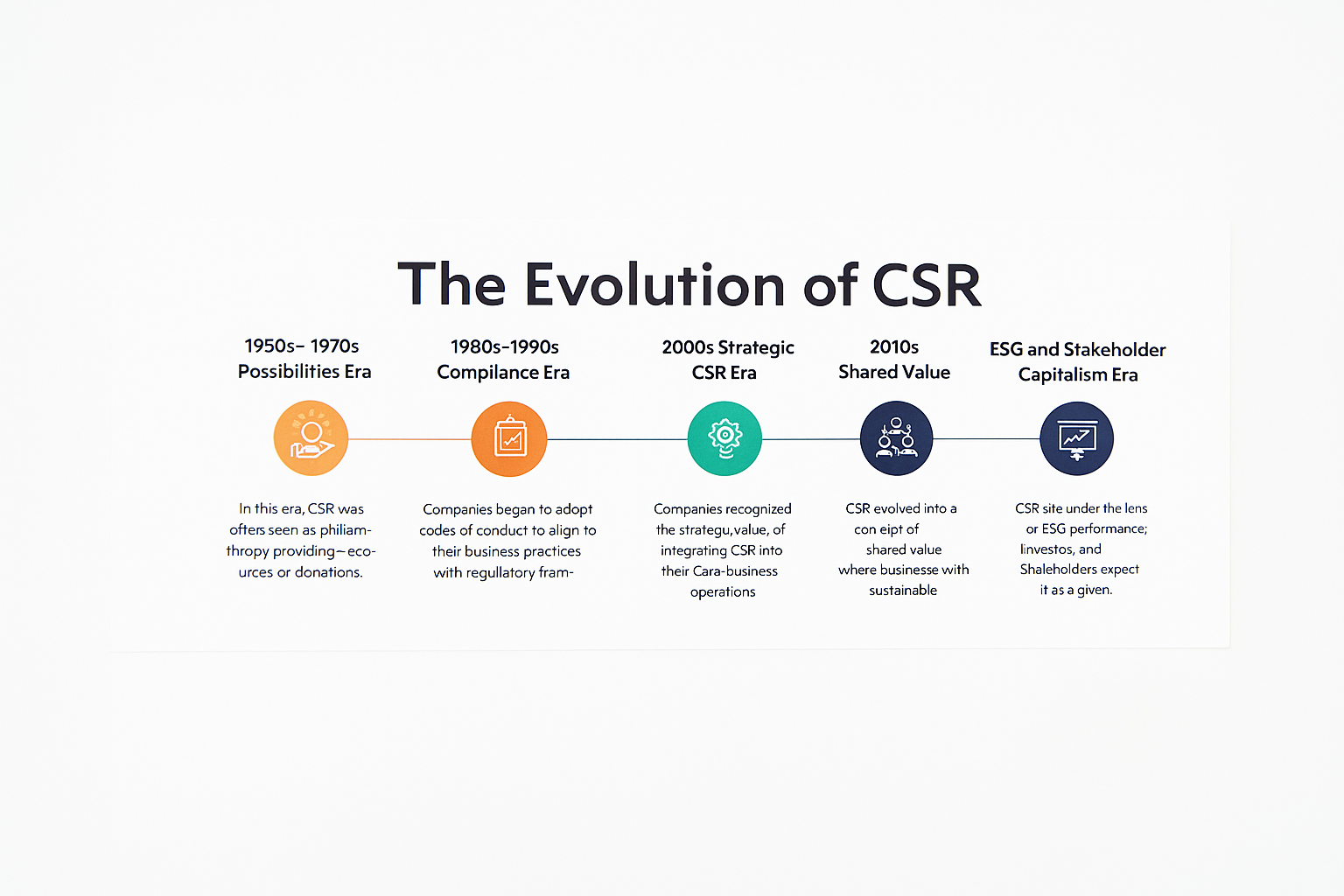
The timeline below visualizes this early period and the subsequent stages we will discuss in this lesson. CSR began in what's described as the "Possibilities Era," where the idea of corporate philanthropy and ethical responsibility first took root.
The Limitations of Early CSR
While CSR was a crucial step forward, its initial form had significant limitations. The responsibility was often placed on the shoulders of individual business leaders, making it dependent on their personal conscience and priorities. This led to a few key challenges:
- It was often discretionary and inconsistent. CSR activities could be anything from charitable donations to community projects, but they were often separate from the core business strategy and could be cut during difficult financial times.
- It lacked measurability and standardization. Because CSR was qualitative and voluntary, it was difficult to measure a company's true impact or compare its performance against competitors.
- It was susceptible to "greenwashing." The lack of standardized metrics made it easy for companies to use CSR for public relations, highlighting positive actions while not necessarily addressing fundamental negative impacts of their operations.
To put it in terms of your quality management background, early CSR was like a company having a general "commitment to quality" without a formal, auditable system like BRCGS or ISO 9001. The intent might be good, but without defined processes, metrics, and verification, it's hard to ensure consistent outcomes or drive systematic improvement.
The following video succinctly explains this qualitative nature of CSR.
What is the difference between ESG, CSR, sustainability, and Net Zero?
This clip from the "Driving Net Profit with Zero Emissions" channel clearly defines CSR and highlights its voluntary, qualitative nature.
Please watch the segment on CSR, from the beginning of the CSR section. Pay attention to how the speaker contrasts it with ESG by describing it as "more qualitative."
The Evolution to ESG: A Paradigm Shift
The weaknesses of the traditional CSR model created a demand from investors, regulators, and other stakeholders for something more rigorous, comparable, and transparent. This demand catalyzed the evolution from CSR to Environmental, Social, and Governance (ESG).
The pivotal shift occurred in the early 2000s and was driven primarily by the financial community. They wanted to understand how a company's performance on sustainability issues could translate into material financial risks and opportunities.
ESG and the Changing Language of Corporate Social Responsibility
This article from the California Management Review provides a fantastic, in-depth look at the origins of ESG and the crucial change in perspective it represents.
First, read the introduction. Focus on the paragraph beginning "While the ESG reference..." It explains the fundamental departure of ESG from CSR: a shift from a values-based discourse (doing good for moral reasons) to a value-based discourse, focused on financial performance and value creation. Next, read the section ESG Origin. This part details how the term was coined in a 2004 UN-led initiative called "Who Cares Wins," which was aimed squarely at financial institutions. This investor focus is the key to understanding ESG.
ESG took the ethical foundations of CSR and institutionalized them. It transformed the vague notion of "doing good" into a structured framework for assessing and managing a company's resilience and long-term value in a changing world.
The core differences are:
- Focus: CSR is often about reputation and philanthropy (how a company uses its profits). ESG is about risk management and operational integration (how a company makes its profits).
- Audience: CSR reporting was traditionally aimed at the public and community. ESG reporting is primarily designed for investors, lenders, and regulators.
- Nature: CSR is largely qualitative and voluntary. ESG is quantitative, data-driven, and increasingly mandated by regulations.
The following video clip gives a clear definition of ESG that complements what you've just read.
What is the difference between ESG, CSR, sustainability, and Net Zero?
This is the same video as before, now focusing on the definition of ESG.
Please watch the segment explaining ESG, from the beginning of the ESG section. Notice the emphasis on investors, measurable metrics (from standards like GRI and SASB), and the idea of ESG as the "next iteration of CSR."
Clarifying the Relationship: Sustainability, CSR, and ESG
It's common to see these terms used interchangeably, but as you now know, they have distinct meanings and relationships.
- Sustainability is the overarching concept or goal, based on the three pillars (environmental, social, economic) and the principle of meeting present needs without compromising the future.
- CSR is a business framework for contributing to the goal of sustainability, historically focused on self-regulation, community engagement, and philanthropy.
- ESG is a specific, criteria-based framework used to evaluate a company's performance on sustainability issues, with a focus on financially material risks and opportunities for investors.
The diagram below helps visualize this relationship. Sustainability is the broadest concept. CSR is a way businesses have approached it. ESG is a more recent, data-driven application primarily used for performance evaluation and investment.

To consolidate this entire evolutionary path, the table below provides a concise summary.
CSR, ESG and Sustainability: Key Differences Explained
Returning to the JAGGAER article, these sections summarize the transition and provide a helpful comparative table.
First, read the short sections The Evolution of CSR into ESG and What Is ESG?. These paragraphs neatly summarize the shift from individual conscience (CSR) to organizational obligation (ESG). Finally, carefully study the summary table provided in the article. This table clearly outlines the progression from Philanthropy to CSR, then to ESG, detailing the core features, drivers, and limitations of each stage.
Conclusion
In this lesson, we have charted the critical evolution from broad Corporate Social Responsibility to the specific and measurable ESG framework. This journey reflects a maturation in how businesses and investors understand the relationship between corporate activity and sustainable development.
Key Takeaways:
- Corporate Social Responsibility (CSR) was the foundational framework for business accountability, rooted in ethics, philanthropy, and voluntary action.
- The limitations of CSR—its discretionary nature, lack of measurability, and potential for greenwashing—created a need for a more rigorous approach.
- Environmental, Social, and Governance (ESG) emerged as the evolution of CSR, driven by the investment community.
- The key shift was from a values-based approach (doing good for moral reasons) to a value-based approach (managing sustainability issues because they are financially material).
- ESG institutionalizes sustainability by making it measurable, systematic, and integral to corporate strategy and risk management, much like a formal quality management system.
You now understand not just what ESG is, but why it exists and the historical context that shaped it. In our next lesson, we will dive deeper into the framework itself and define each of the three components—Environmental, Social, and Governance—in detail.