Welcome to your first lesson. This course is designed to guide you from the foundational concepts of sustainability all the way to the practical skills needed to produce a professional ESG report, leveraging your extensive background in quality and production management.
Today, we will start at the very beginning by addressing the core concept of sustainability. The goal of this lesson is to define sustainability and understand its three fundamental pillars: environmental, social, and economic. Mastering this framework is the essential first step before we can dive into the specifics of ESG reporting in later lessons. Let's begin.
What is Sustainability?
The term "sustainability" is often used interchangeably with environmentalism, but its true meaning is much broader. At its core, sustainability is about endurance. It refers to the capacity to meet the needs of the present without compromising the ability of future generations to meet their own needs. It's a long-term perspective that considers the intricate balance between human activities and the planet's resources.
To get a clear and concise introduction, let's watch a short video.
What is SUSTAINABILITY? Explained By An Expert
This video from Go Green Post provides an excellent, straightforward explanation of sustainability, moving beyond the common "green" stereotypes.
Please watch the first minute of the video, up to the point where the narrator introduces the three pillars from the start. Pay attention to how the definition shifts from just "things that benefit the environment" to a broader idea of sustaining our way of life and the Earth's resources indefinitely.
The Three Pillars of Sustainability
To make the broad concept of sustainability actionable, it is commonly broken down into three interconnected dimensions, often called the three pillars:
- Environmental (or Planet)
- Social (or People)
- Economic (or Profit)
These are also known as the "Triple Bottom Line," a term you will frequently encounter in business contexts. The central idea is that for an activity, organization, or society to be truly sustainable, it must achieve a balance across all three areas. Neglecting one pillar ultimately undermines the others.
This concept is often visualized as three overlapping circles, where true sustainability lies at their intersection.
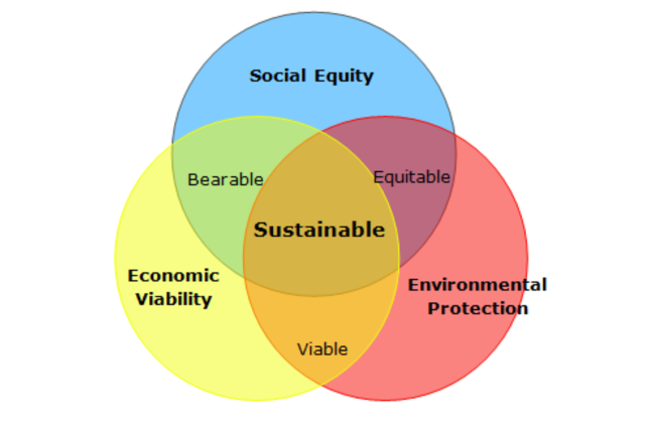
Let's continue with the video you started, which now walks through each of these pillars.
What is SUSTAINABILITY? Explained By An Expert
The remainder of the video explains each pillar and uses a simple business example to show how they are interconnected.
Watch from the explanation of the pillars to the end. Notice how the example of the company using lake water demonstrates the negative consequences of focusing only on short-term profit at the expense of the environmental and social pillars.
A Deeper Look at Each Pillar
Now that you have a general overview, let's examine each pillar in more detail, connecting them to concepts from your professional background.
The Three Pillars of Sustainability
This article from JAGGAER provides a clear, business-oriented breakdown of each pillar. We will read the sections dedicated to each one.
First, read the introductory section What are the Three Pillars of Sustainability?. This part introduces the "Planet, People, Profit" framing and briefly contrasts the three-pillar model with the ESG framework, which we will cover in the next lesson. Next, read the detailed descriptions for each pillar: The Environmental Pillar: This covers topics like resource management and emissions. Your work on standardizing drying processes and implementing a carbon footprint plan fits squarely within this pillar. The Equity Pillar: This relates to human well-being. It extends concepts from your experience with GMP and worker safety to broader issues like human rights in the supply chain and community impact. The Economic Pillar: This pillar emphasizes long-term viability, not just short-term profit. Your achievements in increasing production efficiency and reducing costs are prime examples of strengthening economic sustainability.
The Pillars in Practice: A Food Industry Perspective
The true power of this framework comes from understanding that the pillars are not just related, but inseparable. Actions in one area inevitably impact the others. This is particularly evident in complex global supply chains, such as those in the food industry.
The following article discusses how the food industry is evolving its understanding of sustainability.
This article from AgroFOOD Industry Hi Tech is highly relevant to your background. It highlights the shift in the food industry towards a more holistic view of sustainability.
Please read two key sections: Start from the beginning and read to the end of the introduction, focusing on the quote from Monique van de Vijver. Pay attention to how the author points out that the food industry's focus is expanding beyond a purely "green agenda". Next, read the section titled "Environmental issues inextricably linked with poverty." This part powerfully illustrates the interconnectedness of the pillars, explaining how poverty among smallholder farmers can drive ecological problems. This directly relates to the challenges of managing a sustainable and ethical supply chain.
This interconnectedness is a key theme in modern supply chain management, as shown in the conceptual framework below. Notice how the "Triple Bottom Line" is a cornerstone of the "Sustainable" element.

A More Nuanced Model: Nested Circles
The overlapping circles diagram is a useful starting point, but it can be misleading. It implies that the three pillars are equal and that one can be "traded off" against another. A more accurate model, grounded in systems thinking, is that of nested circles.
This alternative model recognizes a fundamental hierarchy:
- The economy exists within and is a function of society.
- Society exists within and is fundamentally dependent on the environment.
Without a healthy environment, society cannot thrive; without a functional society, a stable economy is impossible. Let's watch a video that explains this critical distinction.
Triple bottom line (3 pillars): sustainability in business
This video from Sustainability Illustrated critiques the standard "overlapping circles" model and presents the more robust "nested circles" model.
Watch the full video. The first part reviews the Triple Bottom Line concept you're now familiar with. The video then questions the "trade-off" implication of the overlapping model. Finally, it uses basic scientific principles to introduce the nested model, arguing that the economy is a "wholly owned subsidiary of the environment."
This nested perspective is crucial for robust sustainability strategy and reporting. It aligns with an engineering mindset, where understanding system boundaries and dependencies is paramount to designing effective and resilient solutions.
Conclusion
In this lesson, we established the foundational definition of sustainability and its three-pillar framework.
Key Takeaways:
- Sustainability is about meeting present needs without compromising the future, balancing environmental, social, and economic considerations.
- The three pillars (Planet, People, Profit) provide a structure for analyzing and acting on sustainability issues.
- The pillars are deeply interconnected. As seen in the food industry, social and economic issues like poverty can be direct drivers of environmental degradation.
- A more sophisticated view sees the pillars as nested circles, with the economy dependent on society, and society dependent on the environment. This model emphasizes that there are non-negotiable ecological limits.
You now have a solid conceptual base. In our next lesson, we will build upon this by exploring how these ideas have evolved within the business world, leading from the general concept of Corporate Social Responsibility (CSR) to the specific, data-driven ESG (Environmental, Social, and Governance) framework that is the central focus of this course.