Bonjour! Welcome to your next lesson.
In our last session, you learned how to make polite, single-step requests using pourriez-vous and voulez-vous. This is a fantastic skill for maintaining a professional and helpful tone. For example, you can now confidently say, Pourriez-vous redémarrer votre modem, s'il vous plaît ?.
Today, we'll build directly on that foundation. A single instruction is often not enough to solve a technical problem. Your goal in this lesson is to learn how to give multi-step troubleshooting instructions using sequence words like d'abord (first), ensuite (next), puis (then), and enfin (finally). By the end of our session, you'll be able to guide a customer through a complete troubleshooting process, making your instructions clear, logical, and easy to follow.
1. The Key Words for Creating a Sequence
In any language, when we give a series of instructions, we use specific words to mark the order of the steps. In French, these are called les connecteurs chronologiques (chronological connectors). They are the glue that holds your instructions together.
To start, let's watch a short video that introduces the most common sequence words.
Les connecteurs du discours en français | B1 B2 Première partie
The video 'Les connecteurs du discours en français' from the French School TV channel will introduce us to the essential words for ordering actions.
Please watch from 01:06 to 02:55. The speaker will present the words used to start a sequence, continue it, and finish it. Listen for the pronunciation of 'd'abord', 'ensuite', 'puis', and 'enfin'.
As the video explained, these words are organized logically:
- To begin:
d'abord/tout d'abord(first / first of all) - To continue:
ensuite/puis(next / then) - To finish:
enfin/finalement(finally / lastly)
These are the fundamental building blocks for giving clear, multi-step directions.
2. Expanding Your Sequencing Vocabulary
While the words from the video are the most common, there are a few other useful variations that you will hear and can use to sound more versatile.
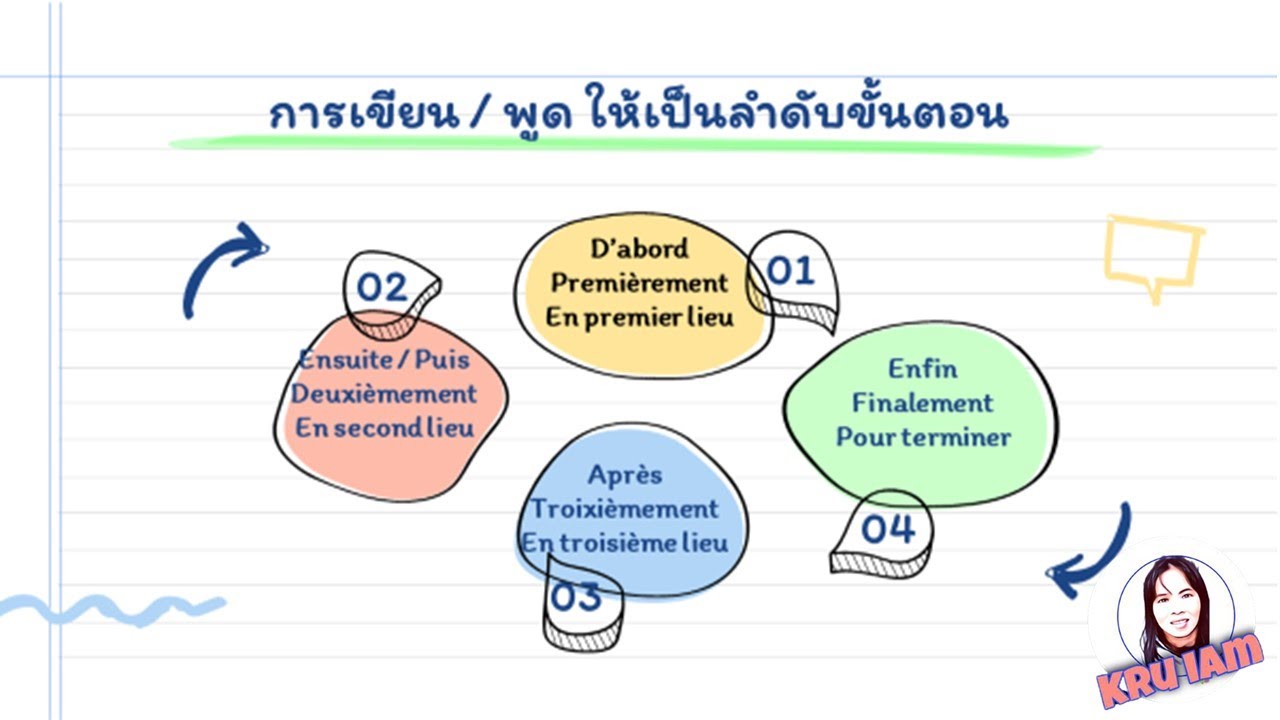
This image provides a great visual summary of the main sequence words and some common alternatives.
To see these words used in context, let's look at a helpful article.
115 ESSENTIAL words for ADVANCED CONVERSATION ...
The article '115 ESSENTIAL words for ADVANCED CONVERSATION' from Ohlalafrenchcourse.com has a section dedicated to words for enumeration, which are perfect for our needs.
In the article, find the section titled 'Enumerate in French'. Read through the list of words like 'Premièrement', 'Ensuite', 'Puis', '(Tout) d'abord', and 'Enfin'. Pay attention to the example sentences to understand how they are used.
From these resources, here are the key takeaways for your work in a call center:
-
To start an instruction set:
D'abord: "First". This is your most reliable starting word.Tout d'abord: "First of all". Slightly more formal.Premièrement: "Firstly". Also a good, clear option.
-
For the middle steps:
Ensuite: "Next" or "Then". Very common and clear.Puis: "Then". It is largely interchangeable withensuite. You can use them both in the same sequence to add variety (e.g., useensuitefor step 2 andpuisfor step 3).Après: "After". You can use it like this:Après, cliquez sur le bouton.(After, click the button.)
-
For the final step:
Enfin: "Finally". This is the perfect word to signal the last action.Finalement: "Finally" or "In the end". Also very common.
3. Combining Sequence Words with Instructions
Now, let's combine these new words with the polite request phrases you learned in the previous lesson. This will allow you to build a full set of professional, clear, and courteous instructions.
The structure is simple: Sequence Word + , + Instruction.
Imagine you are helping a customer whose Wi-Fi is not working. Here’s how you could guide them through a troubleshooting sequence:
Vous (Agent): "D'accord, nous allons essayer quelques étapes simples. D'abord, pourriez-vous redémarrer votre routeur, s'il vous plaît ?"
(Okay, we are going to try a few simple steps. First, could you please restart your router?)Client: "C'est fait."
(It's done.)Vous: "Merci. Ensuite, sur votre ordinateur, ouvrez les paramètres Wi-Fi."
(Thank you. Next, on your computer, open the Wi-Fi settings.)Client: "D'accord."
(Okay.)Vous: "Puis, sélectionnez le nom de votre réseau et cliquez sur 'Connecter'."
(Then, select your network's name and click 'Connect'.)Client: "Ça marche ! Je suis connecté."
(It's working! I'm connected.)Vous: "Parfait. Enfin, ouvrez un navigateur web pour vérifier que vous avez accès à Internet."
(Perfect. Finally, open a web browser to check that you have internet access.)
Notice how the sequence words create a logical flow. The customer knows exactly where they are in the process.
Test your understanding!
You need to guide a customer to clear their web browser's cache. The steps are:
- Open the browser settings. (
ouvrir les paramètres du navigateur) - Find the 'Privacy and Security' section. (
trouver la section 'Confidentialité et sécurité') - Click on 'Clear browsing data'. (
cliquer sur 'Effacer les données de navigation')
How would you write this three-step instruction using D'abord, Ensuite, and Enfin?
Show answer
Here is one possible way to phrase it:
"D'abord, ouvrez les paramètres du navigateur. Ensuite, trouvez la section 'Confidentialité et sécurité'. Enfin, cliquez sur 'Effacer les données de navigation'."
For extra politeness, you could phrase the first step as: "D'abord, pourriez-vous ouvrir les paramètres du navigateur, s'il vous plaît ?"
Conclusion
Excellent work today! You have successfully learned how to structure a series of instructions, a critical skill for any technical support or customer service role. By guiding customers through problems step-by-step, you make the process less stressful for them and increase your chances of resolving the issue quickly.
Key Takeaways:
- Use sequence words to give multi-step instructions.
- Start with
d'abordorpremièrement. - Continue with
ensuiteorpuis. They are often interchangeable. - Conclude with
enfinorfinalement. - Combine these words with polite requests (
Pourriez-vous...) or simple commands (Cliquez...) to create a clear and professional troubleshooting script.
Preview of the Next Lesson:
So far, you've learned to ask the customer to perform actions. But what about the actions you are performing? In the next lesson, we will learn to use the futur proche (aller + infinitive) to explain the next immediate action you will take. You'll be able to say things like, "Je vais vérifier votre dossier" (I am going to check your file) or "Je vais lancer un test sur votre connexion" (I am going to run a test on your connection).
À la prochaine