Bonjour! Welcome to your next French lesson.
In our last session, we focused on guiding a customer through a series of steps using sequence words like d'abord, ensuite, and enfin. This is perfect for telling the customer what they need to do. But what about the actions you are taking?
Today, you will learn how to explain the next immediate action you are going to perform. This is essential for keeping the customer informed and managing the call professionally. To do this, we will master a very common and useful structure called the futur proche (the near future). By the end of this lesson, you'll be able to confidently say things like, "I am going to check your file" or "We are going to run a test."
1. What is the 'Futur Proche'?
The futur proche is the French equivalent of saying you are "going to" do something. It's not a complicated new tense to memorize. Instead, it's a simple, two-part construction that you will use constantly in spoken French.
To understand its structure, let's start with a clear explanation.
Le futur proche: An easy guide to “going to” in French
The article 'Le futur proche: An easy guide to “going to” in French' from LingoCulture provides an excellent introduction. It explains that this structure is simply the verb 'aller' (to go) followed by an action verb in its infinitive form.
Please read the first two main sections of the article: the introduction and 'How to use le futur proche'. This will give you the basic formula: aller + infinitive.
The key to using the futur proche is knowing the present tense of the verb aller (to go). Since aller is an irregular verb, you need to memorize its forms.
Here is the conjugation, which you will use all the time:
| Pronoun | Aller (to go) |
|---|---|
| Je | vais (I go/am going) |
| Tu | vas (You go/are going - informal) |
| Il/Elle/On | va (He/She/One goes/is going) |
| Nous | allons (We go/are going) |
| Vous | allez (You go/are going - formal/plural) |
| Ils/Elles | vont (They go/are going) |
So, the structure is always: Subject + conjugated aller + infinitive verb.
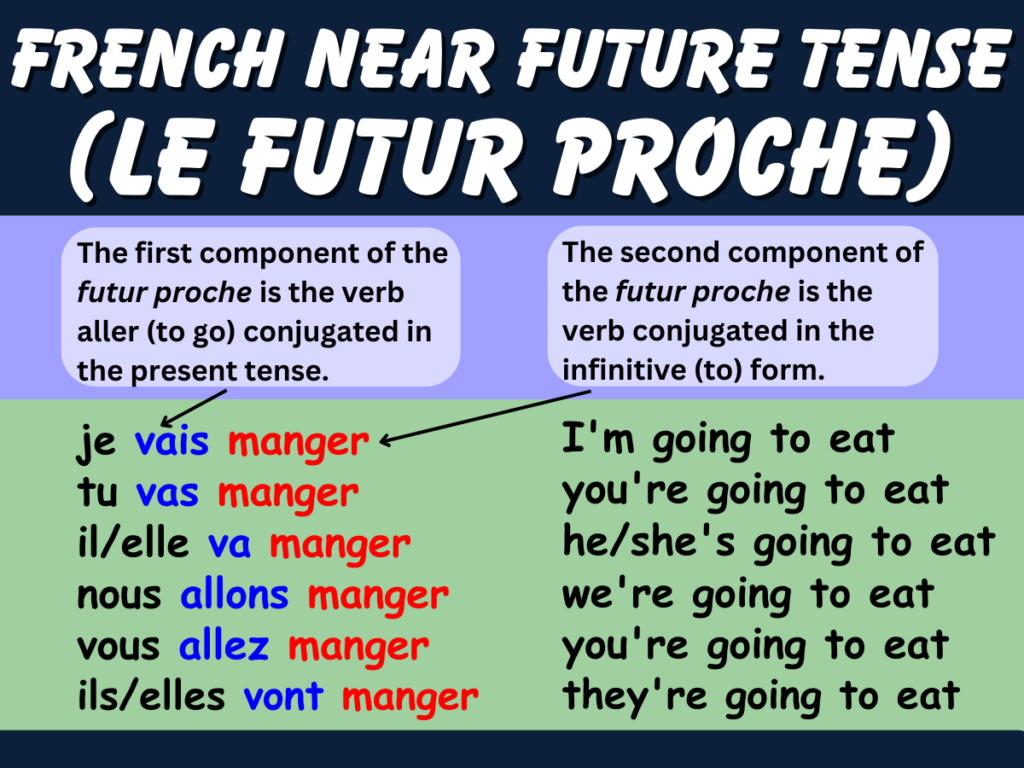
2. Building Sentences with the 'Futur Proche'
Now that you know the formula, let's see how it's used to build full sentences. We'll watch a video that breaks this down step-by-step.
The near future in French | Le futur proche | Learn French | French grammar
The video 'The near future in French' by The perfect French with Dylane provides clear examples for each subject pronoun. This will help you hear the pronunciation and see the structure in action.
Please watch the following parts: 00:25 - 02:19: Introduction to the concept and a review of the verb 'aller'. 02:19 - 03:27: Examples with 'Je vais...' (I am going to...). 06:24 - 08:21: Examples with 'Nous allons...' (We are going to...) and 'Vous allez...' (You are going to...). Pay close attention to the pronunciation and the simple structure: the second verb is always in its infinitive (unconjugated) form.
3. Using the 'Futur Proche' in a Call Center
In your role, you'll primarily use Je vais... to state your own actions and Nous allons... to describe actions you are taking as a team or company.
Here are some phrases that will be extremely useful for you:
- Je vais vérifier votre connexion.
(I am going to check your connection.) - Maintenant, je vais lancer un test.
(Now, I am going to run a test.) - Un instant, je vais consulter votre dossier.
(One moment, I am going to consult your file.) - D'accord, nous allons essayer une autre solution.
(Okay, we are going to try another solution.) - Nous allons vous envoyer un nouveau modem.
(We are going to send you a new modem.)
The Negative Form
What if you need to say what you are not going to do? The structure is also simple. You place ne...pas around the conjugated verb, which is aller.
Structure: Subject + ne + conjugated aller + pas + infinitive verb.
Example:
- Je ne vais pas redémarrer votre ordinateur.
(I am not going to restart your computer.) - Nous n'allons pas changer votre mot de passe.
(We are not going to change your password.)
This visual guide summarizes both the positive and negative forms well.

Test your understanding!
You are on a call and need to inform the customer of your next action. How would you say the following in French?
- I am going to open your file. (to open =
ouvrir) - We are going to check your payment details. (to check =
vérifier) - I am not going to ask for your password. (to ask for =
demander)
Show answer
- Je vais ouvrir votre dossier.
- Nous allons vérifier vos détails de paiement.
- Je ne vais pas demander votre mot de passe.
4. Hearing the 'Futur Proche' in a Natural Conversation
To help you get used to hearing this tense in a real-world context, let's listen to a short, slow conversation between two people making plans. This aligns with your preference for learning through practical dialogue.
Slow French Conversation: Making Plans | Super Easy French 175
In this 'Super Easy French' video from the Easy French channel, two speakers discuss their upcoming plans. Listening to this will help you recognize the 'futur proche' when spoken naturally.
Watch from 02:14 to 03:14 and again from 03:52 to 05:25. Listen for phrases that start with 'je vais...', 'on va...', 'tu vas...'. Don't worry about understanding every single word; just focus on identifying the near future tense being used.
Did you hear phrases like tu vas faire quoi ? (what are you going to do?), je vais aller chez une autre copine (I'm going to go to another friend's place), and on va plutôt partir (we're going to leave instead)? This shows how common this structure is in everyday speech.
Conclusion
Très bien! You have now learned one of the most practical and common ways to talk about the future in French. You can now clearly and professionally inform a customer about the immediate actions you plan to take.
Key Takeaways:
- The
futur procheis used to talk about the near future, just like "going to" in English. - The formula is simple: conjugated
aller+ infinitive verb. - For your job, the most important forms will be
Je vais...(I am going to...) andNous allons...(We are going to...). - To make it negative, wrap
ne...pasaround the form ofaller:Je ne vais pas...
Preview of the Next Lesson:
Today, you learned how to state what you are about to do. In the next lesson, we will expand on this by learning how to explain the actions you are taking on your end to resolve an issue. This will involve using the futur proche and other phrases to describe ongoing processes, giving the customer a complete picture of how you are helping them.
À la prochaine