Bonjour ! Welcome to the first lesson of our second module. You've built a strong foundation in French pronunciation, and now we'll start putting it all together in practical, professional conversations.
Introduction
This lesson begins your journey into the specifics of call center communication. Our goal is to master the very first and most crucial part of any professional interaction: the greeting. We will focus on the learning outcome: Greet callers formally using appropriate time-of-day expressions (Bonjour, Bonsoir).
A proper greeting sets the tone for the entire call. It shows respect and professionalism. We will cover:
- When to use Bonjour (Hello / Good morning / Good afternoon).
- When to use Bonsoir (Good evening).
- How to use these greetings in a formal call center environment.
In the last lesson, you learned that statements in French typically end with a falling intonation (↘). You will use this exact pattern today when you deliver a confident, professional greeting.
Let's begin opening our first professional call.
Part 1: The Two Essential Greetings - Bonjour & Bonsoir
In French, your primary greeting changes depending on the time of day. Unlike in English where "Hello" works 24/7, French makes a distinction between the day and the evening.
The infographic below gives a clear visual summary of the main French greetings and when to use them.
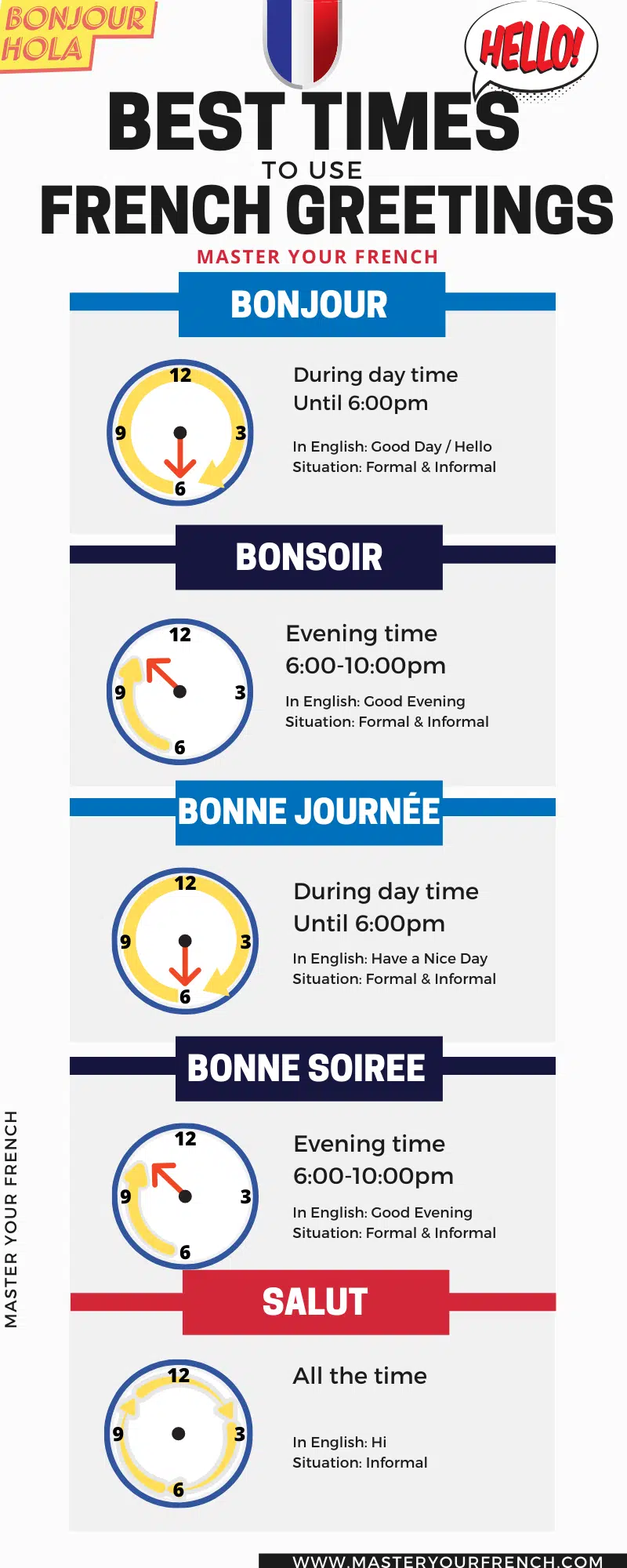
As you can see, the two essential greetings you will use to start a conversation are:
- Bonjour: Used from the morning until the late afternoon.
- Bonsoir: Used in the evening.
But when exactly does the day end and the evening begin? And are there other greetings you should be aware of? The following video explains these subtleties very clearly.
Bonjour, Bonsoir & Bonne nuit: French Greeting Tips
Let's watch the video 'Bonjour, Bonsoir & Bonne nuit' from the channel Comme une Française. It will help you understand the precise timing and context for these greetings.
Please watch from 0:43 to 3:13. Pay close attention to: The approximate time the speaker suggests for switching from Bonjour to Bonsoir (around 6 pm). The difference between a greeting (Bonjour) and a farewell (Bonne journée - Have a nice day). Why Bonne nuit (Good night) is never used as a greeting.
Key points from the video:
- Bonjour: Use this from the moment you wake up until about 6 p.m. (18:00). It covers "Good morning" and "Good afternoon." It is only used to start a conversation.
- Bonsoir: Use this from about 6 p.m. onwards. It means "Good evening." It can be used to both start a conversation and to say goodbye in the evening.
- Important Distinction: Do not confuse Bonjour with Bonne journée ("Have a good day") or Bonsoir with Bonne soirée ("Have a good evening"). Bonne journée and Bonne soirée are used to end a conversation, not to start one.
Part 2: Making it Formal for a Professional Setting
In a call center, you are representing a company, so your language must be formal and polite. While a simple Bonjour is acceptable, adding a title shows a higher level of respect.
The two titles you will use are:
- Monsieur (for a man) - pronounced roughly as "muh-SYUH"
- Madame (for a woman) - pronounced "ma-DAM"
So, your greetings become:
Bonjour, Monsieur.Bonjour, Madame.Bonsoir, Monsieur.Bonsoir, Madame.
When answering a call, you won't know if the caller is a man or a woman, so you will typically use the greeting without a title. However, when you are addressing a customer whose gender you know, using Monsieur or Madame is standard practice.
Let's look at a resource that reinforces this.
Self Introduction and Basic Greetings in Formal French
The article 'Self Introduction and Basic Greetings in Formal French' from FrenchPod101 clearly explains the use of these formal greetings.
Please read the sections 'Bonjour ("Hello")' and the two tables that follow ('Greeting During the Day' and 'Greeting or Farewell in the Evening or at Night'). This will solidify your understanding of using Bonjour and Bonsoir with Monsieur and Madame.
Remember the falling intonation from our last lesson. When you say these phrases, your voice should be confident and drop slightly at the end: Bonjour, Madame. ↘
Part 3: The Professional Phone Greeting
Now, let's bring this all together into the specific context of your goal: answering a call at a call center. The standard professional greeting is a simple, efficient formula.
This formula is: [Company Name], bonjour.
This immediately tells the caller they have reached the right place. Let's see how this is explained and demonstrated.
French Phone Phrases for Smooth Calls
The article 'French Phone Phrases for Smooth Calls' on FrenchPod101.com provides the exact script you need.
Please read the subsection titled '2 – Answering'. Focus on the part that explains how to answer a professional call: '[Company name], bonjour.' or '[Company name], [Your name] bonjour.'
Here are some examples you can practice saying out loud:
- "Service Technique, bonjour." ↘ (Technical Support, hello.)
- "Compagnie ABC, bonsoir." ↘ (ABC Company, good evening.)
To hear these greetings used in a natural, formal conversation, let's watch one more video. This video is in French, but it includes Arabic subtitles, which may help you follow along.
😄📞 Comment parler au téléphone en français ? | Conversation française
The video 'Comment parler au téléphone en français ?' from Guillaume Posé demonstrates several formal phone calls. Listen for the greetings at the start of each interaction.
Watch the two example conversations from 0:28 to 3:11 and from 4:33 to 6:04. Notice how the professionals answer the phone (e.g., 'Cabinet Médical Santé +, je vous écoute.') and how the caller always begins with a polite 'Bonjour !'.
This video shows you exactly how these simple greetings are the starting point for every professional call.
Test your understanding!
Imagine you work for a company called "Solution Pro". Choose the best and most professional greeting for each situation.
- A call comes in at 11:00 AM.
- A call comes in at 7:30 PM (19:30).
- You are finishing a call in the afternoon and want to wish the customer a good day.
Choices:
A) Solution Pro, bonsoir.
B) Solution Pro, bonjour.
C) Bonne journée.
D) Bonne nuit.
Show answer
- B) Solution Pro, bonjour. (11:00 AM is during the day).
- A) Solution Pro, bonsoir. (7:30 PM is in the evening).
- C) Bonne journée. (This is how you say "Have a good day" when ending a conversation).
Conclusion
Excellent work! You have just learned the first and most fundamental script for your future role. A professional greeting is simple but powerful.
Key Takeaways:
- Use Bonjour to greet callers from the morning until about 6 PM.
- Use Bonsoir to greet callers in the evening (after 6 PM).
- The professional formula for answering the phone is: "[Company Name], bonjour/bonsoir."
- Remember to use a falling, declarative intonation (↘) to sound confident.
- Do not confuse greetings (Bonjour) with farewells (Bonne journée).
Preview of the Next Lesson:
Now that you have greeted the caller, what's next? In our next lesson, we will cover the learning outcome: "Introduce yourself and your company using a standard script." You will learn to build directly on today's greeting by adding your name and solidifying the purpose of the call.
Continue practicing these greetings out loud. Try inventing a company name and answering imaginary calls. À la prochaine ! (See you next time!)