Bonjour! In our last lesson, you mastered the first essential step of a professional call: the greeting. Now, we'll build directly on that foundation.
Introduction
This lesson focuses on the next logical step in a professional call: introducing yourself and your company. Our goal is to master the learning outcome: Introduce yourself and your company using a standard script.
Last time, you learned to greet callers with a confident [Company Name], bonjour. Today, we will expand that phrase by adding your name, creating a complete, professional opening statement. This is a crucial step that establishes your identity and confirms to the caller that they've reached the right person.
To see where this fits in the grand scheme of a call, look at this flowchart. After the Prise de contact (Initial contact/Greeting), the very next step is Présentation de l'entreprise (Company presentation), which includes introducing yourself.
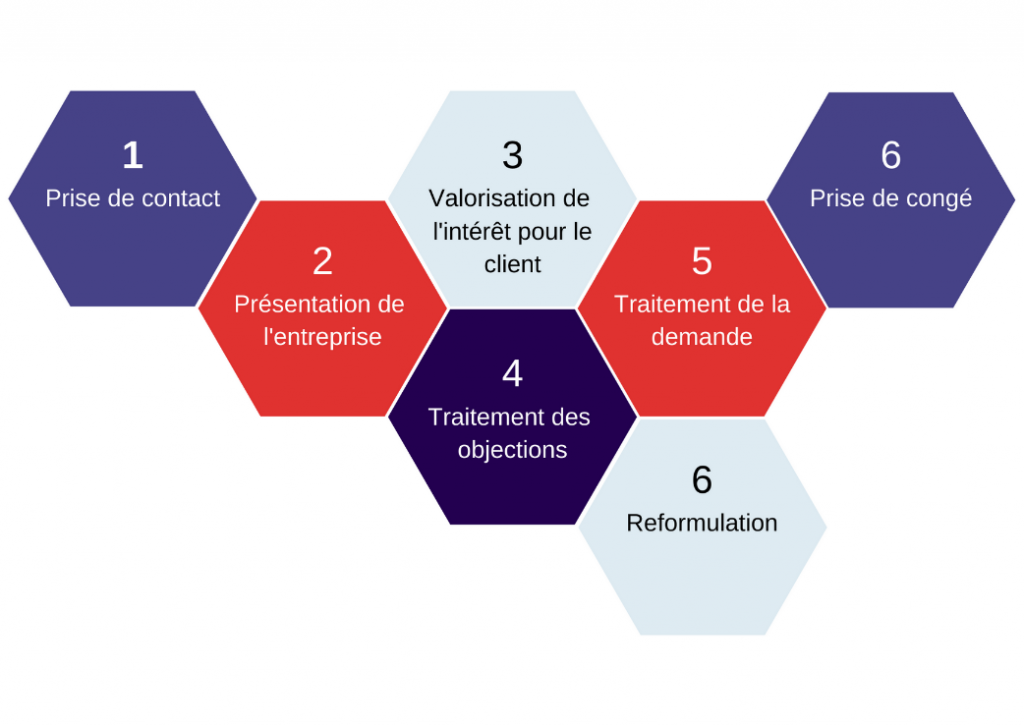
Let's learn the scripts that will make this second step polished and professional.
Part 1: The Complete Professional Script
In a call center, efficiency and clarity are key. There is a standard formula that combines the greeting, the company name, and your name into one smooth sentence.
The most comprehensive and professional script is:Bonjour, [Nom de la société], [Votre prénom] à l'appareil.
(Hello, [Company Name], [Your first name] speaking.)
Let's break it down:
Bonjour: The greeting you already know. UseBonsoirin the evening.[Nom de la société]: The company's name. You can saysociété [Nom]or just the name itself.[Votre prénom]: Your first name. In most customer service roles, using your first name is standard.à l'appareil: This is a key phone expression that literally means "at the device." It's the French equivalent of saying "speaking" or "on the line."
To see this script in context, please read the following article, which is written for professionals in your target field.
Accueil téléphonique : 5 phrases pour répondre au ... - Dexem
The article 'Accueil téléphonique : 5 phrases pour répondre' from Dexem provides a perfect example of a professional call opening.
Please read the first point, titled '1. Identifier la personne qui appelle et l’objet de sa demande'. Focus on the example script provided in italics: 'Bonjour, société [nom], [prénom de l’opérateur] à l’appareil, comment puis-je vous être utile ?'
The article gives the full phrase: Bonjour, société [nom], [prénom de l’opérateur] à l’appareil, comment puis-je vous être utile ? For now, we are focusing on the first part. We will learn how to ask "How can I help you?" in a future lesson.
Part 2: Useful Variations of the Script
While the script above is excellent, you will hear other variations. It's important to recognize them and have them as options.
Variation 1: The Concise Introduction
A shorter, very common way to answer is to state the company and your name right after the greeting.
Formula: [Company Name], [Your Name], bonjour.
This is a direct and efficient script you've seen before. It is demonstrated well in this resource.
French Phone Phrases for Smooth Calls
The article 'French Phone Phrases for Smooth Calls' from FrenchPod101.com shows this concise version of the introduction.
Find the section '2 – Answering'. Notice the example: '[Company name], [Your name] bonjour.' This reinforces the structure.
Example: Solution Pro, Ahmed, bonjour.
Variation 2: Using Je m'appelle...
The phrase Je m'appelle... means "My name is..." (literally, "I call myself..."). It is another formal and polite way to state your name.
Formula: Bonjour, je m'appelle [Votre Nom] de la société [Nom de la société].
This structure is often used when you are the one making the call, but it's perfectly fine for receiving calls too. It's very clear and universally understood.
Let's watch a short video clip to hear this in action.
L'appel téléphonique professionnel - French Business Call - (B1/B2)
In this clip from 'Learn French with Timo', the speaker makes a professional call and introduces himself using 'Je m'appelle...'
Watch the section from 0:35 to 0:47. Listen for how the speaker says: 'Bonjour, je m'appelle Timothée de la société Spicy French.'
This introduces you to the verb s'appeler (to be named). For now, you only need to know Je m'appelle.... You will learn more about this verb later.
Test your understanding!
You work for a company named "InfraNet". Your name is Fatima. A customer calls in the morning. Which of the following is the most complete and professional way to greet them and introduce yourself, based on the primary script we learned?
A) Bonjour, c'est Fatima.
B) InfraNet, bonjour.
C) Bonjour, InfraNet, Fatima à l'appareil.
D) Je m'appelle Fatima.
Show answer
C) Bonjour, InfraNet, Fatima à l'appareil.
This option is the best because it includes all three key elements in a professional structure: the greeting (Bonjour), the company name (InfraNet), and your name with the professional phone expression (Fatima à l'appareil). Option B is good but incomplete. Options A and D are ways to state your name, but they don't mention the company, which is essential when answering a business line.
Part 3: Practice Your Professional Introduction
Now it's your turn to build and practice your own script. Choose a fictional company name that sounds like a tech support or customer service center (e.g., "Connect-Action", "Solution Directe", "ZenTech").
Use the main script we learned:Bonjour, [Nom de la société], [Votre prénom] à l'appareil.
Practice saying it out loud:
- "Bonjour, Connect-Action, [Your Name] à l'appareil." ↘
- "Bonsoir, Solution Directe, [Your Name] à l'appareil." ↘
- "Bonjour, ZenTech, [Your Name] à l'appareil." ↘
Remember to use the falling intonation (↘) at the end of the statement to sound confident and professional, just as we practiced in the lesson on intonation. Record yourself if you can and listen back. Does it sound clear and welcoming?
Conclusion
Fantastic work today! You have now combined the greeting with a full professional introduction. This two-part opening sets a competent and helpful tone for the entire customer interaction.
Key Takeaways:
- A standard professional introduction follows the greeting.
- The most complete script is:
Bonjour, [Company Name], [Your Name] à l'appareil. à l'appareilis a key phrase meaning "speaking" or "on the line."- Other valid variations include
[Company Name], [Your Name], bonjour.and usingJe m'appelle [Name] de la société [Company].
Preview of the Next Lesson:
Now that you have greeted the caller and introduced yourself, you will often need to state basic facts or confirm information. The next lesson covers: "Use the present tense of 'être' (to be) and 'avoir' (to have) to state basic information." These are the two most important verbs in French, and mastering them will allow you to say things like "Je suis votre conseiller" (I am your advisor) and "Vous avez un dossier chez nous" (You have a file with us).
À bientôt! (See you soon!)