Introduction
In our recent lessons, we have systematically deconstructed an option's sensitivities to market variables. We've explored Delta and Gamma (sensitivity to the underlying price), Vega (sensitivity to volatility), and most recently, Theta (sensitivity to the passage of time). We now arrive at the final primary Greek: Rho ().
This lesson focuses on defining and interpreting Rho, which measures how an option's price responds to changes in the risk-free interest rate. While its impact is often considered less immediate than that of the other Greeks, especially for short-term options, understanding Rho is essential for a complete picture of option pricing, particularly within the Black-Scholes-Merton framework. We will explore the intuition behind this relationship and examine the factors that determine its magnitude.
Defining Rho: Sensitivity to Interest Rates
At its core, Rho quantifies the change in an option's theoretical value for a one percentage point (100 basis points) change in the risk-free interest rate. Formally, it is the first partial derivative of the option's value function with respect to the risk-free rate, .
Where is the option's value and is the risk-free rate.
Before diving into the mechanics, let's clarify what we mean by the "risk-free rate" and see a practical example of how Rho is interpreted. The following video provides a concise introduction.
Stock Option Greeks: Delta, Theta, Vega, Rho, & Gamma - Finance for Aspiring Quants
This video from the Socratica channel, "Stock Option Greeks," clearly introduces Rho and its practical application.
Please watch the following segments: Definition of Rho: This will give you the formal mathematical definition. Risk-Free Rate: Understand what is typically used as a proxy for the risk-free rate in financial modeling. A Practical Example: This clip shows how a specific Rho value translates into a change in the option's dollar price.
As the video demonstrates, if a call option is worth $5.00 and has a Rho of 0.04, a 1% increase in the risk-free rate (e.g., from 3% to 4%) would theoretically increase the option's value by $0.04 to $5.04, assuming all other factors remain constant.
The Intuition: Why Do Interest Rates Affect Option Prices?
To understand why Rho behaves as it does, we need to think about the fundamental nature of call and put options in relation to cash. The concepts of opportunity cost and the time value of money are central here.
The next video segment provides an excellent intuitive explanation for this relationship.
Stock Option Greeks: Delta, Theta, Vega, Rho, & Gamma - Finance for Aspiring Quants
Let's return to the Socratica video to understand the "why" behind Rho.
Watch the segment from explaining the effect of interest rates on call and put options. Focus on the logic of opportunity cost.
Let's consolidate this logic:
-
Call Options (Positive Rho): A call option gives you the right, but not the obligation, to buy an asset at a future date for a predetermined strike price. This means you can delay spending your money. If interest rates rise, the cash you are holding while you wait to potentially exercise the option can earn a higher return. This makes the ability to delay payment more valuable, thus increasing the call option's price.
-
Put Options (Negative Rho): A put option gives you the right to sell an asset. If you own a put, you are essentially waiting for a potential future payout. If interest rates rise, the alternative—selling your asset now and investing the cash at the higher risk-free rate—becomes more attractive. This increased opportunity cost of holding the put option makes it less valuable, causing its price to decrease.
This fundamental relationship explains why call options have positive Rho and put options have negative Rho.
Another way to understand this, which connects directly to the Black-Scholes-Merton model, is to consider the strike price, . The model values an option by considering the present value of its potential future payoff. The strike price is a cash amount that is paid or received at expiration. Its present value is calculated by discounting it using the risk-free rate.
For a call option, the strike is a future payment. A higher interest rate means you are discounting that payment more heavily, making its present value lower. Since the call's value is conceptually (Stock Price - Present Value of Strike), a lower present value for the strike results in a higher call value. The opposite is true for a put.
The following video explains this from the perspective of the BSM formula's structure.
The Greeks Explained: Options Analysis in Excel
The video "The Greeks Explained" by Ryan O'Connell connects this intuition directly to the components of the Black-Scholes-Merton formula.
Watch the portion from explaining the cost of carry. The presenter highlights how the discounted strike price term, Ke^{-rT}, within the formula drives the sign of Rho for calls and puts.
Factors Influencing Rho's Magnitude
Like the other Greeks, Rho's value is not constant. It changes based on the option's characteristics, primarily its time to expiration and moneyness.
1. Time to Expiration
The magnitude of Rho (both positive for calls and negative for puts) increases as time to expiration increases. The longer the time horizon, the more significant the effect of discounting the strike price. A change in the interest rate has a much larger impact on the present value of a payment due in two years than on one due in two weeks.
Long-Term Equity Anticipation Securities (LEAPS), which are options with expirations more than a year away, are therefore much more sensitive to interest rate changes than short-dated options.

2. Moneyness
The magnitude of Rho is greatest for in-the-money (ITM) options. This is because ITM options have the highest probability of being exercised, meaning the payment of the strike price is most likely to occur. Therefore, the present value of that strike price is a more significant component of the option's current value. For far out-of-the-money (OTM) options, the probability of exercise is very low, so the interest rate's effect on the strike price's present value is less relevant to the option's price.
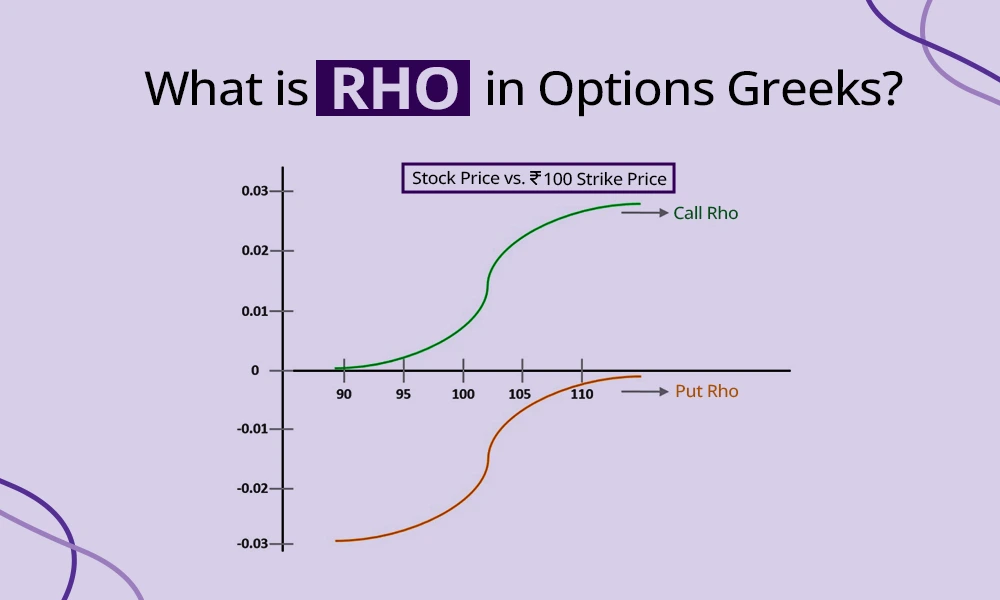
For a deeper dive into these characteristics, the following article provides clear summaries and examples.
Understanding Rho: Definition, Uses, and Calculations for Options
This Investopedia article reinforces the concepts we've discussed with clear examples and statements.
Please read the section Understanding Rho Calculations and Practical Applications. Pay attention to the numerical examples and the summary sentences about moneyness and time to expiration.
The Formulas and Practical Importance
For completeness, here are the formulas for Rho under the Black-Scholes model. As you can see, they directly involve the time to expiration () and the discounted strike price ().
- Call Rho:
- Put Rho:
Where is the cumulative distribution function of a standard normal distribution, which in the BSM context represents the risk-neutral probability of the option expiring in-the-money.
In practice, as several of our resources have noted, Rho is often considered the "least important" of the five main Greeks for most retail option traders. This is because:
- Interest rates tend to move much more slowly than stock prices or implied volatility.
- For short-dated options, the effect of Rho is very small compared to the effects of Delta, Gamma, and Vega.
However, for institutional portfolio managers, those trading long-dated options, or in an environment of significant interest rate volatility, managing Rho exposure can be crucial.
Conclusion
This lesson completes our tour of the five primary option Greeks by introducing Rho, the measure of interest rate risk. While its day-to-day impact may be less dramatic than its counterparts, it is an integral part of the theoretical pricing models and a key risk factor for certain strategies and time horizons.
Key Takeaways:
- Definition: Rho measures the change in an option's price for a 1% change in the risk-free interest rate.
- Sign: Call options have positive Rho because higher rates increase the opportunity cost of not holding cash, making the right to buy later more valuable. Put options have negative Rho because higher rates make the alternative (earning interest on cash) more attractive, thus increasing the opportunity cost of holding the put.
- Time to Expiration: Rho's magnitude increases with time to expiration. The longer the period, the more pronounced the effect of interest rate compounding on the present value of the strike price.
- Moneyness: Rho's magnitude is greatest for in-the-money options, as they have the highest probability of being exercised and realizing the strike price payment.
We have now defined the sensitivities to price (Delta, Gamma), volatility (Vega), time (Theta), and interest rates (Rho). In our upcoming lessons, we will build on this foundation to learn how these Greeks are calculated in practice and, more importantly, how they are used to construct and manage hedged portfolios.