Introduction
In our last lesson, you learned how to calculate the primary option Greeks, giving you the quantitative tools to measure an option's various sensitivities. We established that Delta () measures an option's price change relative to a $1 move in the underlying asset. Now, we will put that knowledge to practical use.
Today's lesson focuses on one of the most fundamental risk management techniques in finance: constructing a delta-neutral portfolio. This is the process of combining positions in options and their underlying asset to create a portfolio whose value is, to a first-order approximation, immune to small fluctuations in the asset's price. This is a core strategy for market makers, hedge funds, and institutional traders. By the end of this lesson, you will be able to calculate the precise number of shares or options needed to neutralize the directional risk of a given position.
What is Delta Hedging?
The core idea of delta hedging is to create a portfolio with a total delta of zero. Such a portfolio is called delta-neutral. If a portfolio's delta is zero, its value will not change for infinitesimal changes in the price of the underlying asset. It's a way of isolating your portfolio from directional risk, allowing you to potentially focus on other factors, like volatility (Vega) or time decay (Theta).
The following video provides an excellent introduction to the concept and its purpose.
Delta Hedging Explained: Options Trading Strategies
In "Delta Hedging Explained," Ryan O'Connell gives a clear, concise overview of this strategy.
Please watch the segment from on delta hedging. Focus on the core objective: to offset the delta of an option with an opposing position in the underlying stock, creating a portfolio whose total delta is zero.
The Mechanics of Constructing a Hedge
To build a delta-neutral portfolio, you need to combine instruments with positive and negative deltas so that they cancel each other out. For instance:
- A long call option has a positive delta. To hedge it, you would take a position with a negative delta, such as short-selling the underlying stock.
- A short put option also has a positive delta. It would also be hedged by short-selling the stock.
- A long put option or a short call option has a negative delta. To hedge this, you would take a position with a positive delta, such as buying the underlying stock.
A crucial point in these calculations is the distinction between the delta of a single option contract and the delta of your entire position.
Position Delta vs. Per-Option Delta
The Greek formulas we studied in the last lesson give you the delta for a single share underlying one option. However, options are traded in contracts (typically for 100 shares in the US), and you may hold many contracts. To calculate your hedge correctly, you must first calculate your position delta.
The Bionic Turtle channel provides a very clear explanation of this distinction.
Hedging (aka, neutralizing) option delta and gamma (FRM T4-19)
This video, "Hedging (aka, neutralizing) option delta and gamma," makes the critical distinction between "percentage Greeks" (per-option) and "position Greeks."
Please watch from this section. The key formula to internalize is that Position Delta = Quantity × Per-Option Delta. Note how being short the options (a negative quantity) flips the sign of the position delta.
The general formula, including the standard contract multiplier, is:
Position Delta = Per-Option Delta × Number of Contracts × Multiplier
- The Multiplier is the number of shares per contract, typically 100.
- The Number of Contracts is positive if you are long and negative if you are short.
For example, if you are short 10 call option contracts, and each option has a delta of 0.60, your position delta is:
This means your position loses approximately $600 for every $1 increase in the stock price.
Calculating the Hedging Position
Once you know your portfolio's delta, you can calculate the size of the offsetting position needed to make it delta-neutral. The formula is straightforward.
Delta Hedging - CFA, FRM, and Actuarial Exams Study Notes
This article from AnalystPrep provides the essential formula and definition for our task.
Please read the introductory section, from the beginning down to the first example. Pay close attention to the formula for the optimal hedge and the equation for a delta-neutral portfolio.
As the article states, the number of units of the hedging instrument () you need is:
Where:
- Portfolio Delta is the delta of the position you want to hedge.
- Delta is the delta of the instrument you are using to hedge.
Crucially, the delta of one share of the underlying stock is always exactly 1. Therefore, if you are hedging an option position with the underlying stock, the formula simplifies to:
Let's revisit our example of the short 10 call contracts with a position delta of -600. To hedge this, you would need:
You would need to buy 600 shares of the stock. Your new, hedged portfolio would have a delta of:
Examples in Practice
Let's walk through two common scenarios you might face in an exam.
1. Hedging an Option Position with Stock
This is the classic scenario for a market maker who just sold options to a client.
Delta Hedging Explained: Options Trading Strategies
Let's return to the Ryan O'Connell video for a worked numerical example.
Watch the segment from on hedging short calls. Here, the trader is short 2,000 call options with a delta of 0.6. The video walks you through calculating the position delta and then determining the number of shares to buy to create a delta-neutral portfolio. (Note: The video implicitly uses a multiplier of 1, so the "position delta" it calculates is actually a hedge ratio. Using our more explicit formula: Position Delta = 0.6 * (-2000) = -1200. Shares to buy = -(-1200) = 1200.)
2. Hedging a Stock Position with Options
This scenario applies to an investor holding a large number of shares who wants to hedge against price movements using options.
Delta Hedging - CFA, FRM, and Actuarial Exams Study Notes
The AnalystPrep article provides excellent, exam-style examples for this case.
Please read and work through Example 1 and Example 2 in the article. Example 1 shows how to hedge a long stock position by selling call options. Example 2 demonstrates how to hedge a short stock position using either long calls or short puts. These examples clearly apply the N_H formula and show how the sign of the result tells you whether to buy or sell the hedging instrument.
The Imperfection of a Static Hedge
So, we have constructed our delta-neutral portfolio. Is our work done? Unfortunately, no. A delta hedge is only perfect for a moment in time. As the underlying stock price changes, the option's delta also changes (a property governed by Gamma, as you know). This means a portfolio that is delta-neutral today may not be tomorrow, or even in the next minute.
This phenomenon is illustrated perfectly in the table below. Imagine we are long 100 call options on a stock. When the stock price is $50, the option's delta is 0.5.
- Option Position Delta = 0.5 × 100 = +50.
- To hedge, we short 50 shares of the stock, for a hedge delta of -50.
- Total Portfolio Delta = 50 - 50 = 0. The portfolio is delta-neutral.
Now see what happens when the stock price moves.
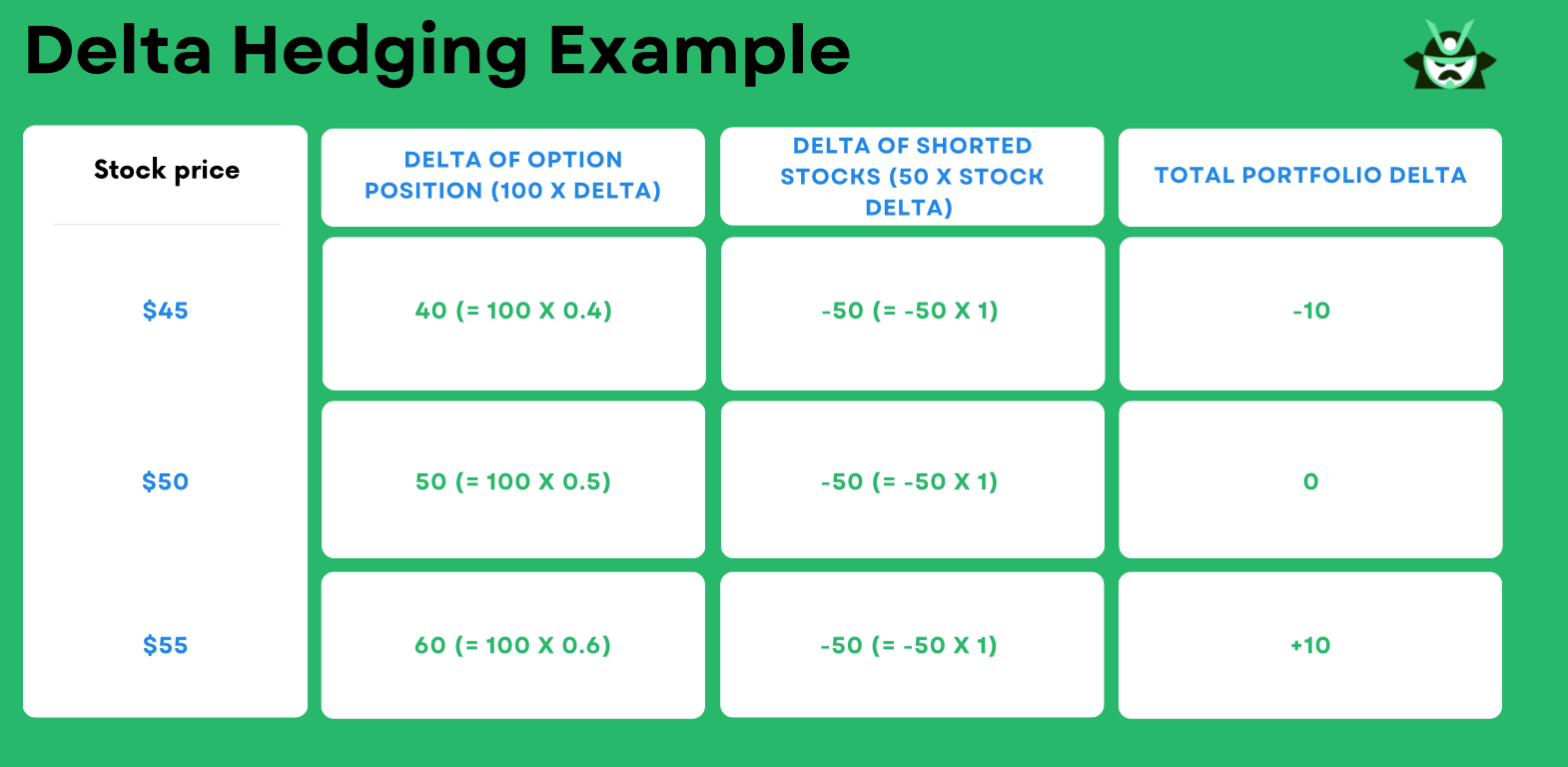
As you can see:
- When the stock price rises to $55, the option's delta increases to 0.6. The portfolio delta becomes . It is no longer neutral.
- When the stock price falls to $45, the option's delta decreases to 0.4. The portfolio delta becomes .
This illustrates that a "set-and-forget" or static hedge is imperfect. To maintain delta neutrality, a trader must continuously adjust their hedge by buying or selling shares as the stock price moves. This process is known as dynamic hedging.
Conclusion
In this lesson, we took the practical step of using Delta to manage risk. You learned how to construct a delta-neutral portfolio, a fundamental skill in financial engineering.
Key Takeaways:
- A delta-neutral portfolio has a total delta of zero, making its value insensitive to small changes in the underlying asset's price.
- To calculate the hedge, you must first find the position delta (Per-Option Delta × Number of Contracts × Multiplier).
- The number of hedging units is calculated as . For hedging with stock, this simplifies to .
- A delta hedge is not static; because an option's delta changes with the stock price (due to Gamma), the hedge must be continuously adjusted.
The imperfection of the static delta hedge leads us directly to our next topic. We will explore the challenges and mechanics of dynamic hedging and introduce the concept of a delta-gamma neutral portfolio, which seeks to create a more robust hedge that is stable not just for a moment, but also across small price movements.