Introduction
In our previous lessons, we have analyzed how an option's price is affected by changes in the underlying asset's price (Delta and Gamma) and its volatility (Vega). We now turn to the final, inexorable factor influencing an option's value: the passage of time. Unlike stock price or volatility, time moves in only one direction and its effect is a constant pressure on an option's premium.
This lesson introduces Theta (), the option Greek that measures this time decay. You will learn to define and interpret Theta, understand why options are considered "decaying assets," and explore how the rate of this decay changes based on the option's moneyness and time to expiration. For an option holder, Theta often represents a daily cost, a hurdle that must be overcome by favorable moves in price or volatility.
What is Theta? The Cost of Time
An option's price is composed of intrinsic and extrinsic value. As we've discussed, extrinsic value (or time value) represents the "hope" or potential for the option to become more profitable before it expires. Since options have a finite lifespan, this potential diminishes with each passing day. At expiration, all extrinsic value vanishes, leaving only the option's intrinsic value. Theta is the Greek that quantifies this daily erosion of extrinsic value.
Let's begin with a video that clearly defines Theta and explains the fundamental reason for time decay.
Option Theta Explained (Time Decay Visualized With Examples)
The video "Option Theta Explained" from the projectoption channel provides an excellent foundation for this topic. It breaks down the concept of time decay and connects it directly to extrinsic value.
Please watch the first three segments: Introduction to Theta: Focus on the core definition of Theta as the daily decay in extrinsic value. A Numerical Example: This gives a practical sense of how a Theta value of, say, -0.05 translates into a daily price change. Why Options Decay: This segment provides the intuition. Pay close attention to the comparison between an option with 30 minutes to expiration and one with 365 days. This highlights how time value is linked to the probability of future price movements.
As the video explains, Theta is almost always negative for a long option position (i.e., an option you own). A Theta of -0.05 means that, all else being equal, the option will lose $0.05 of value per share ($5 per standard contract) each day. For an option seller, this decay works in their favor, as the liability they hold decreases in value over time. In this context, traders often speak of being "long theta" (if they are net sellers of options) or "short theta" (if they are net buyers).
The Acceleration of Time Decay
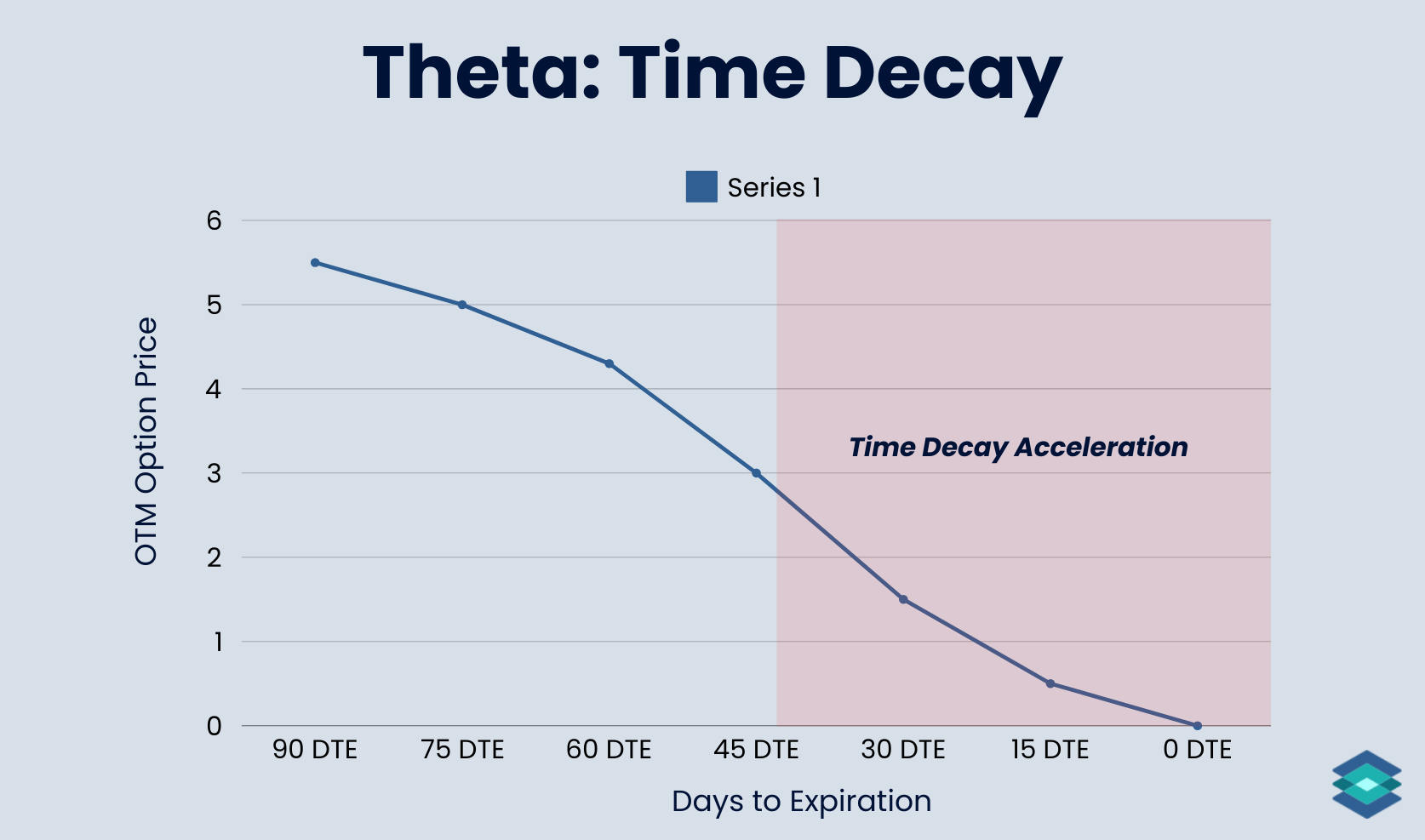
A critical characteristic of Theta is that its effect is not linear. The rate of time decay accelerates as the option approaches its expiration date. An option with 90 days remaining might lose value slowly, but in its final 30 days, the value erosion becomes much more aggressive.
This phenomenon is a direct consequence of how uncertainty resolves over time. Far from expiration, the probability distribution of the underlying's future price is wide, and the passage of a single day doesn't change it much. Close to expiration, however, the distribution of possible outcomes narrows dramatically with each passing day, causing the extrinsic value to collapse rapidly.
This accelerating decay is vividly illustrated in the following chart.
The next video segment provides empirical evidence for this acceleration.
Option Theta Explained (Time Decay Visualized With Examples)
Let's return to the "Option Theta Explained" video to see a study that visualizes this acceleration.
Watch the segment from Accelerating Decay. The chart presented here, based on historical data for at-the-money straddles, clearly shows how the majority of extrinsic value is lost in the final weeks before expiration.
Factors Influencing Theta's Magnitude
The magnitude of Theta is not the same for all options. It is primarily influenced by the option's moneyness and the level of implied volatility.
1. Moneyness
Theta is typically most negative for at-the-money (ATM) options.
- ATM options have the maximum amount of extrinsic value. Since Theta is the decay of this value, it's logical that the options with the most extrinsic value to lose will have the largest negative Theta.
- Deep in-the-money (ITM) options behave more like the underlying stock. Their value is mostly intrinsic, leaving little extrinsic value to decay.
- Far out-of-the-money (OTM) options have very little extrinsic value to begin with. The market already assigns a low probability of them becoming profitable, so there isn't much "hope" value to erode.
The following graph illustrates this relationship for a put option.
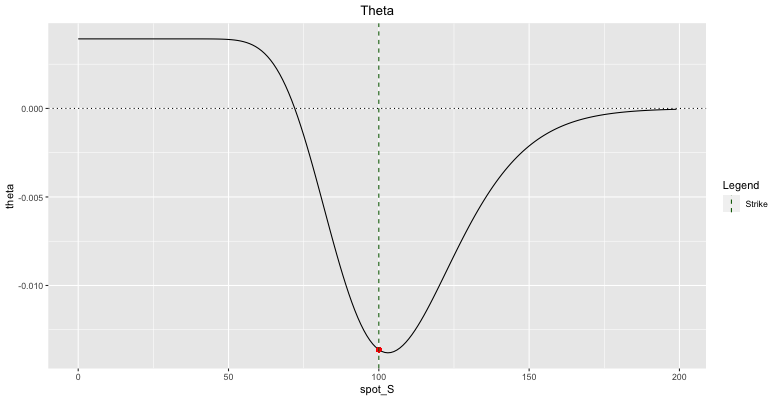
An interesting edge case, visible in the chart, is that the Theta of a very deep-in-the-money put option can become positive. This is a complex scenario related to the cost of carry and the fact that an early exercise of the put might be preferable. For most practical purposes and for ATM or OTM options, you can consider Theta to be negative.
2. Implied Volatility
Higher implied volatility leads to a more negative Theta. This follows directly from our lessons on volatility and Vega. Higher volatility increases an option's extrinsic value (it has a higher Vega). Since there is more extrinsic value to decay, the daily rate of that decay (Theta) must also be greater in magnitude.
The Gamma-Theta Trade-Off: No Free Lunch
Your background in probability and modeling will help you appreciate the elegant balance that exists within option pricing. There is a profound relationship between Gamma, which we previously learned benefits an option holder during large price moves, and Theta, which is a constant drain on the option's value. This is often summarized as: "There is no free lunch."
An option holder is long Gamma, meaning they profit from the curvature of the option's payoff. However, they must "pay" for this privilege through the daily time decay, or Theta. Conversely, an option seller is short Gamma (exposing them to losses from large price moves) but collects the Theta decay as a daily "income."
This trade-off is formally captured within the Black-Scholes-Merton partial differential equation. A simplified form of this relationship for a delta-hedged portfolio is:
This approximation shows that Theta and Gamma are of opposite signs. To have a large positive Gamma, you must accept a large negative Theta. Understanding this relationship is fundamental to managing an options portfolio.
To delve deeper into this crucial concept, the following reading connects the intuitive idea of "paying for gamma" with the underlying theory.
Chapter 5 The Greeks | The Derivatives Academy
This text from "The Derivatives Academy" provides a sophisticated view of Theta, framing it as the cost of holding a position with positive Gamma.
Please read the following two sections: The cost of Gamma: This section introduces the core concept of Theta as the payment for the convexity benefits of Gamma. The Gamma-Theta balance: This part presents the formal relationship derived from the Black-Scholes equation, cementing the idea that these two Greeks are intrinsically linked. Focus on the interpretation of the formula, not the derivation itself.
Conclusion
In this lesson, we have explored Theta, the measure of an option's decay over time. It is a constant force working against the option buyer and for the option seller.
Key Takeaways:
- Definition: Theta measures the rate of decline in an option's value due to the passage of time, specifically affecting its extrinsic value.
- Interpretation: It is usually expressed as a negative number for long options, representing the dollar amount an option is expected to lose per day, holding other factors constant.
- Behavior: Time decay is non-linear and accelerates as expiration approaches. Theta is most negative for at-the-money options, which have the highest extrinsic value to lose.
- The Gamma-Theta Trade-off: Positive Gamma (the potential for convexity profit) does not come for free. It is paid for by negative Theta (time decay).
We have now covered the primary sensitivities to price, volatility, and time. In our next lesson, we will briefly cover Rho, which measures sensitivity to interest rates, thereby completing our initial survey of the most important option Greeks.