Introduction
In our previous lesson, we established the core concepts of forward and futures contracts. A key feature of those instruments is that they represent a firm obligation for both parties to transact at a future date. Today, we turn our attention to a different, and perhaps more flexible, type of derivative: the option.
This lesson introduces the foundational building blocks of the options world. We will define the two primary types of options—calls and puts—and explore their key parameters. The crucial distinction between an option and a forward/future contract is that an option gives the buyer the right, but not the obligation, to buy or sell an asset. We will also differentiate between American and European style options, a distinction based on when this right can be exercised.
What is an Option?
An option is a financial contract that derives its value from an underlying asset, just like the forwards and futures we've already discussed. The revolutionary concept, however, is the asymmetry it introduces.
- The buyer (or holder) of the option pays a price, known as the premium, to acquire a right.
- The seller (or writer) of the option receives this premium and, in exchange, takes on an obligation to perform if the buyer chooses to exercise their right.
This "right without an obligation" is the feature that makes options so versatile for both speculation and risk management. To build some intuition, let's watch a short video that uses a real-world analogy to explain the concepts of call and put options.
Intro Option Contracts -Calls & Puts. Class Replay. SIE Exam Prep & Series 7 Exam. Lecture 1 of 4
This video from the "Series 7 Guru" channel provides excellent, non-technical analogies for understanding call and put options.
Watch the instructor's explanation of a call option using a car buying scenario. Then, continue with his explanation of a put option using a car leasing example. Focus on who has the choice and who has the obligation in each case.
The Four Basic Option Positions
As the video illustrates, there are two fundamental types of options:
- Call Option: Gives the holder the right to buy an underlying asset at a specified price. You would buy a call if you are bullish, i.e., you expect the asset's price to rise.
- Put Option: Gives the holder the right to sell an underlying asset at a specified price. You would buy a put if you are bearish, i.e., you expect the asset's price to fall.
Combining these two types with the two sides of the contract (buyer/long and seller/short) gives us four basic positions every options trader must know. The following diagram provides a perfect summary.
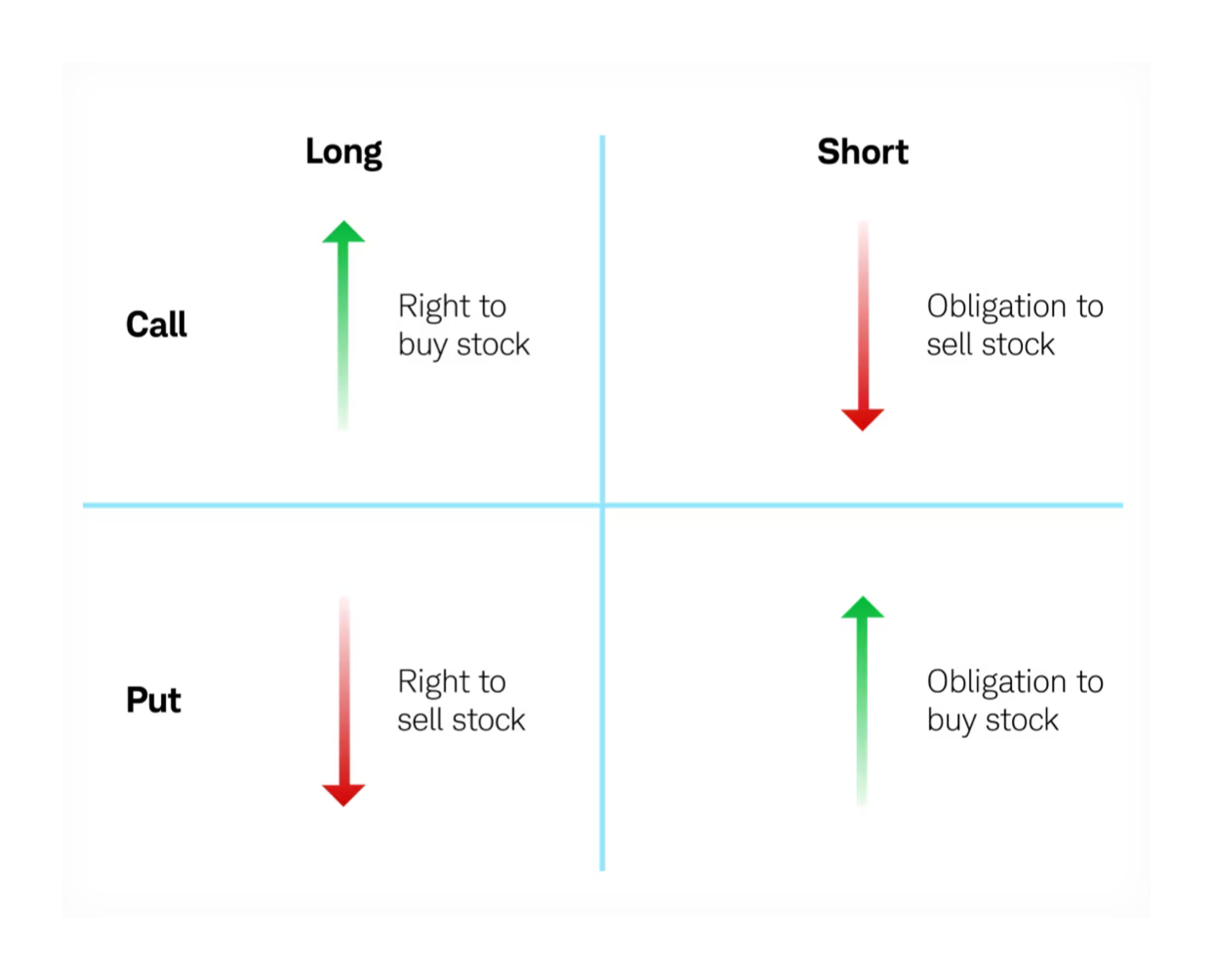
Let's break down each quadrant:
- Long Call: You have the right to buy the underlying stock at a predetermined price.
- Short Call: You have the obligation to sell the underlying stock if the long call holder exercises their right.
- Long Put: You have the right to sell the underlying stock at a predetermined price.
- Short Put: You have the obligation to buy the underlying stock if the long put holder exercises their right.
It's critical to be comfortable with the terminology used to describe these positions. The following video segment clarifies the various synonyms used for the buyer and seller.
Intro Option Contracts -Calls & Puts. Class Replay. SIE Exam Prep & Series 7 Exam. Lecture 1 of 4
The instructor will now clarify the language used for option buyers and sellers, which is essential for exam questions.
Watch this segment from 06:28 to 09:51. Note the interchangeable terms: Long position: buyer, owner, holder. This party has the choice. Short position: seller, writer. This party has the obligation.
Key Parameters of an Option Contract
Unlike the customized forward contracts we saw in the last lesson, most options traded by the public (especially on stocks) are standardized, much like futures. This standardization makes them easy to trade on exchanges. The specific terms of a contract are defined by a set of key parameters.
Intro Option Contracts -Calls & Puts. Class Replay. SIE Exam Prep & Series 7 Exam. Lecture 1 of 4
This part of the lecture details the components that make up a standardized option contract description.
Watch the segment from 13:06 to 20:10. The instructor uses the example "1 Apple Dec 170 Call" to explain the following parameters: Contract Multiplier: How many shares one contract controls (typically 100). Underlying Interest: The asset the option is based on (e.g., Apple stock). Expiration Date: When the option ceases to exist. Strike Price (or Exercise Price): The price at which the right can be exercised. Type: Call or Put.
Moneyness: Intrinsic Value and Time Value
An option's value, or premium, can be conceptually broken down into two parts: intrinsic value and time value. The relationship between the underlying asset's current price and the option's strike price determines its moneyness.
An option can be:
- In-the-Money (ITM): The option has intrinsic value. Exercising it would be immediately profitable (before considering the premium paid).
- At-the-Money (ATM): The strike price is equal to the underlying asset's price.
- Out-of-the-Money (OTM): The option has no intrinsic value. Exercising it would result in a loss.
The following reading clearly defines these states and introduces the formulas for intrinsic value, which should feel familiar given your background in mathematics.
Call & Put Option Payoff Charts + Formulas (CFA/FRM)
This article from AnalystPrep provides concise, formula-based definitions for moneyness and the components of an option's premium.
Read the section titled Moneyness to see the definitions for both call and put options. Then, read the next section on Intrinsic and Time Value to understand how the premium is composed.
As the reading states, the formulas for intrinsic value are:
- Call Intrinsic Value:
- Put Intrinsic Value:
Where is the current stock price and is the strike price.
The following video provides a more conversational walkthrough of these concepts and introduces a very useful mnemonic: "Call Up, Put Down."
Intro Option Contracts -Calls & Puts. Class Replay. SIE Exam Prep & Series 7 Exam. Lecture 1 of 4
This segment explains moneyness and the components of the premium in a more intuitive way, introducing a helpful memory aid.
Watch the section from 20:10 to 33:43, which covers intrinsic value and the concepts of ITM, ATM, and OTM. Pay close attention to the "Call Up, Put Down" mnemonic. A call has intrinsic value when the stock price is up from the strike; a put has intrinsic value when the stock price is down from the strike. The video then continues from 33:43 to 38:55 to explain how the premium is the sum of this intrinsic value and the remaining time value.
American vs. European Options
The final key parameter to understand is the option's exercise style. This defines when the holder can exercise their right.
- American Style: The option can be exercised at any time on or before the expiration date. This offers maximum flexibility to the holder. Most exchange-traded stock options are American style.
- European Style: The option can only be exercised on the expiration date itself. Many index options and options on futures are European style.
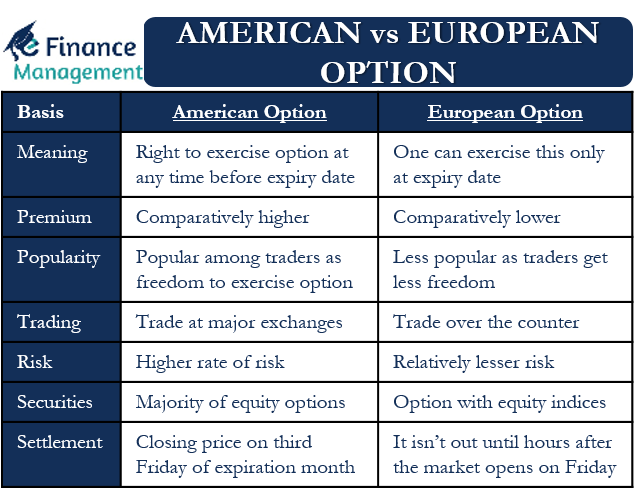
This difference in flexibility has a direct impact on the option's premium and the risk faced by the seller. Because an American option gives the holder more rights (i.e., the right of early exercise), it is at least as valuable as, and typically more valuable than, an equivalent European option.
The table below provides a clear summary of the differences.
The following short video clip reinforces this distinction.
Intro Option Contracts -Calls & Puts. Class Replay. SIE Exam Prep & Series 7 Exam. Lecture 1 of 4
This final clip explains the practical difference between American and European exercise styles.
Watch the segment from 56:12 to 59:16. Note that American style options present more risk to the writer, as they can be assigned an exercise notice at any time.
Conclusion
In this lesson, we have moved from the world of obligations (forwards and futures) to the world of rights. We have defined the fundamental option contracts and their essential characteristics.
Key Takeaways:
- An option contract gives the buyer (holder) the right, but not the obligation, to buy (a call) or sell (a put) an underlying asset. The seller (writer) receives a premium and takes on an obligation.
- The key parameters of a standardized option are its underlying asset, type (call/put), strike price, expiration date, and contract size (multiplier).
- An option's moneyness (in-the-money, at-the-money, or out-of-the-money) describes the relationship between the stock price and the strike price, and determines its intrinsic value. The premium is the sum of this intrinsic value and its time value.
- American options can be exercised at any point up to expiration, while European options can only be exercised at expiration. This makes American options generally more valuable.
Now that we have a solid grasp of what options are, our next lesson will focus on visualizing their financial outcomes. We will learn to draw and interpret payoff diagrams for calls, puts, and forwards, which provide a powerful graphical tool for understanding the profit and loss potential of these instruments.