Introduction
Welcome to the first lesson of our module on derivative securities. In the previous module, we explored stochastic models like Geometric Brownian Motion and the Wilkie model, which are designed to forecast the potential future paths of asset prices. Now, we shift our focus from modeling the assets themselves to understanding financial contracts whose values are derived from these underlying assets.
This lesson introduces the two most fundamental types of these contracts: forwards and futures. We will define what each contract is, explore their purposes, and, most importantly, clearly distinguish between their key features. Mastering this distinction is the foundation for understanding the entire world of derivatives.
What is a Forward Contract?
At its core, a forward contract is a straightforward, private agreement between two parties to buy or sell an asset at a predetermined price on a specific future date. It's a customized contract, meaning the two parties can negotiate all the terms to suit their specific needs: the exact asset, the quantity, the delivery date, and the price.
- The party that agrees to buy the asset holds the long position.
- The party that agrees to sell the asset holds the short position.
Because these are private contracts negotiated directly between two parties, they are said to be traded Over-The-Counter (OTC), rather than on a formal exchange.
Let's look at a practical example to solidify this.
Futures and Forwards - Definition and Examples
This article from the Corporate Finance Institute provides a clear definition of a forward contract and a very intuitive example involving a coffee shop.
First, read the brief definition under the heading Forward Contracts. Then, study the Forward Contract Example section. Notice how the contract locks in a price, creating a different outcome for the buyer (Ben) and seller (CoffeeCo) depending on how the market price moves.
As the coffee shop example illustrates, the primary function of a forward contract is to manage risk. Ben, the coffee shop owner, is worried about rising coffee bean prices. By entering into a forward contract, he locks in a price of $4/lb, eliminating the uncertainty. He is hedging his exposure to price fluctuations. Of course, this cuts both ways: if the price falls, he is still obligated to pay the higher, agreed-upon price. This creates a zero-sum game: one party's gain is the other party's loss.
However, the private, customized nature of forward contracts introduces two significant problems:
- Counterparty Risk: What if CoffeeCo goes bankrupt and cannot deliver the coffee beans? Or what if Ben's coffee shop fails and he cannot pay? Since it's a private agreement, the non-defaulting party might have to resort to legal action to get what they are owed. There is a risk that your "counterparty" in the contract will fail to meet their obligation.
- Illiquidity: Suppose Ben's business plans change and he no longer needs the coffee. It would be very difficult for him to get out of the contract. He would have to find a third party willing to take over his exact, customized position, or try to renegotiate with CoffeeCo, who would have no obligation to agree.
These challenges led to the development of a more structured alternative: the futures contract.
What is a Futures Contract?
A futures contract is conceptually the same as a forward contract: it is an agreement to buy or sell an asset at a predetermined price on a future date. The crucial difference is that futures are standardized and traded on a formal exchange.
This standardization applies to several aspects of the contract:
- Asset Quality: The grade or quality of the underlying asset is specified (e.g., Brent Crude oil of a certain type).
- Contract Size: The quantity of the asset in one contract is fixed (e.g., 1,000 barrels of oil).
- Maturity Dates: A limited number of expiry dates are available to trade (e.g., contracts for November, December, January, etc.).
This standardization allows futures to be traded anonymously and in large volumes on an exchange, just like stocks.

By moving the trading from a private setting to a public exchange, futures contracts solve the main problems of forwards. Let's explore how.
Key Differences: Forwards vs. Futures
While both are agreements for a future transaction, their operational mechanics are fundamentally different. The following video gives an excellent overview of these distinctions.
Futures Contracts Explained: An Insight into Futures and Forwards
This video by Ryan O'Connell provides a clear, step-by-step comparison of the seven key differences between forward and futures contracts.
Please watch the section from this point. The narrator will walk you through the following seven points of comparison: standardization, settlement, credit risk, contract size, delivery, regulation, and liquidity. Pay close attention to the concepts of daily settlement and the role of the exchange.
Let's consolidate and expand on the most important points from the video.
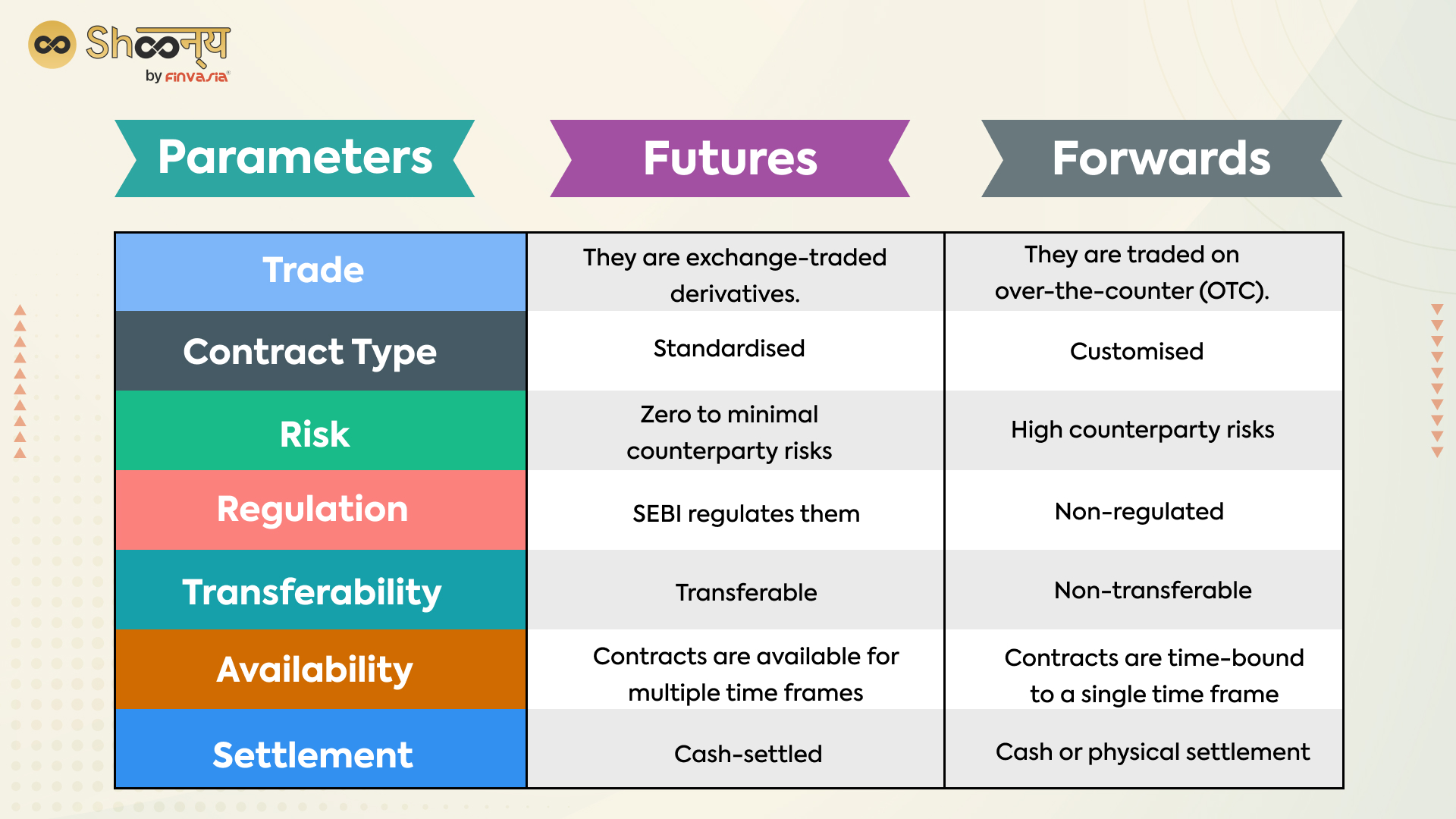
1. Trading Venue and Standardization
- Forwards: Traded Over-The-Counter (OTC). The terms are customized and negotiated privately between two parties. This offers great flexibility.
- Futures: Traded on organized exchanges (like the CME Group shown in the video). The terms (contract size, maturity, asset grade) are standardized, making them fungible and easy to trade.
2. Counterparty Risk and the Clearing House
- Forwards: Each party bears the credit risk of the other. If one party defaults, the other suffers a loss.
- Futures: This risk is virtually eliminated by an entity called a clearing house. The clearing house inserts itself into the middle of every trade, acting as the buyer to every seller and the seller to every buyer. Your obligation is not to another trader, but to the clearing house. Since the clearing house guarantees all transactions, you don't need to worry about the creditworthiness of the person on the other side of your trade.
3. Settlement and Margining
This is arguably the most critical difference.
- Forwards: The contract is typically settled only once, at the maturity date. Any profit or loss on the position accumulates until the end.
- Futures: Profits and losses are settled daily through a process called marking-to-market. To facilitate this, both parties must post a deposit, called a margin, into an account with the exchange.
- At the end of each trading day, the exchange marks your position to the current market price.
- If your position has gained value, your margin account is credited with the profit.
- If your position has lost value, the loss is deducted from your margin account.
- This daily settlement prevents large losses from accumulating and significantly reduces the risk of default. If a trader's margin account falls below a certain level (the maintenance margin), they receive a margin call and must deposit more funds or their position will be closed.
The video below explains the role of the clearing house and the margining system in more detail.
CFA Level I Derivatives - Forward Contracts vs Futures Contracts
This video from PrepNuggets focuses on the institutional structures that separate futures from forwards, particularly the clearing house and margin accounts.
Watch the segment on futures contracts to understand the function of the clearing house. Then, watch the detailed explanation of the margin mechanism, which covers the initial margin, marking-to-market, and the maintenance margin.
4. Liquidity and Regulation
- Forwards: Due to their custom nature, they are very illiquid. It's hard to exit a position before maturity. They are also largely unregulated, being private contracts.
- Futures: Standardization and exchange trading make them highly liquid. You can exit a position at any time by simply taking an offsetting trade (e.g., selling a contract to close out a long position). They are also heavily regulated by government agencies.
Conclusion
In this lesson, we have defined and distinguished between forward and futures contracts. While both serve to lock in a price for a future transaction, their designs lead to very different risk, liquidity, and operational profiles.
Key Takeaways:
- A forward contract is a customizable, private (OTC) agreement between two parties, which carries significant counterparty risk and is illiquid. Settlement typically occurs once at maturity.
- A futures contract is a standardized agreement traded on an exchange. Counterparty risk is virtually eliminated by the clearing house and a daily marking-to-market settlement process funded by margin accounts.
- The standardization of futures makes them highly liquid and subject to regulation, whereas the bespoke nature of forwards offers flexibility at the cost of liquidity and higher risk.
Understanding this foundational difference is crucial. Forwards are about flexibility and customization, while futures are about liquidity, transparency, and risk mitigation.
In our next lesson, we will introduce another cornerstone of the derivatives market: options. We will define call and put options and then learn how to visualize the profit and loss potential of these new instruments, as well as forwards and futures, using payoff diagrams.