Welcome to the third lesson in our course. In the previous two lessons, we established the "what" and "where" of financial markets—defining the key financial instruments and the markets where they are traded. Now we turn to a fundamental question: how do the prices of these instruments behave?
This brings us to one of the most important and debated concepts in modern finance: the Efficient Market Hypothesis (EMH). This lesson is dedicated to understanding this theory. We will define the hypothesis and then break it down into its three distinct forms: weak, semi-strong, and strong. Mastering these definitions is a crucial step for your CM2 exam and provides the theoretical bedrock for many of the asset pricing models we will encounter later in the course.
What is an Efficient Market?
At its heart, the Efficient Market Hypothesis states that a financial market is "informationally efficient." This means that the prices of securities, like stocks and bonds, fully reflect all available information at any given time.
What are the practical implications of this idea? If prices already incorporate all information, it becomes impossible for an investor to consistently achieve "abnormal returns"—that is, profits that are higher than what one would expect for the level of risk taken. Any new information is almost instantaneously incorporated into the price, leaving no window for an investor to systematically profit from it.
To get a clear picture of how prices react to new information in an efficient versus an inefficient market, the following video provides a helpful visual introduction.
Efficient Market Hypothesis【Dr. Deric】
This video from Dr. Deric offers a concise definition of the EMH and illustrates how stock prices adjust to new information under different market conditions.
Please watch from the beginning to get a solid definition of EMH. Then, watch the next segment on price reactions, which contrasts an efficient market's instantaneous price adjustment with the delayed reactions or overreactions seen in inefficient markets.
The key takeaway is that in an efficient market, you can't "beat the market" by trying to find undervalued stocks or by timing your trades based on new announcements. By the time you act, the information is already in the price. The only way to earn higher returns is to take on more risk.
The Three Forms of Market Efficiency
The general idea of "all available information" is quite broad. To make the hypothesis testable and more precise, economists have defined three distinct levels or "forms" of market efficiency, based on what specific set of information is considered to be reflected in prices. These forms are hierarchical: weak, semi-strong, and strong.
The following video provides an excellent overview of all three forms. We will use it as a guide as we break down each one.
The Different Types of Market Efficiency: Weak Form, Semi-Strong Form and Strong Form
This video from David Hillier gives a clear, sequential explanation of weak, semi-strong, and strong form market efficiency.
We will watch this video in three parts as we discuss each form of the EMH below. For now, just be aware that it will be our main video resource for this section.
1. Weak-Form Efficiency
The weak form is the most basic level of market efficiency. It asserts that current security prices fully reflect all information contained in past market data, which includes historical prices, trading volume, and short interest.
- Information Set: All historical price and trading data.
- Implication: If a market is weak-form efficient, you cannot earn abnormal returns by using technical analysis (also known as chartism). Technical analysts look for patterns in past price movements (e.g., "head and shoulders," "support and resistance levels") to predict future prices. The weak-form EMH says this is a futile effort because any information from past prices is already incorporated into the current price. Future price movements are random and cannot be predicted from past behaviour.
Let's watch the segment from the David Hillier video that covers this.
The Different Types of Market Efficiency: Weak Form, Semi-Strong Form and Strong Form
This clip defines weak-form efficiency and its direct consequences for technical analysis.
Please watch the section from the beginning of the explanation. Pay close attention to the idea that if a market is not weak-form efficient, it implies that patterns in prices could be exploited for profit.
2. Semi-Strong Form Efficiency
The semi-strong form is a broader and more powerful version of the hypothesis. It states that current security prices reflect all publicly available information. This includes the historical data from the weak form, but also adds all other public information, such as:
-
Company financial statements (earnings reports, balance sheets)
-
News announcements (mergers, product launches, regulatory changes)
-
Economic data (inflation figures, interest rate changes)
-
Analyst reports
-
Information Set: All publicly available information.
-
Implication: If a market is semi-strong form efficient, you cannot earn abnormal returns using fundamental analysis. Fundamental analysts study a company's financial health, its industry, and the overall economy to determine a stock's "intrinsic value" and identify mispriced securities. The semi-strong EMH argues that this analysis is pointless for earning excess returns, as the market has already digested all this public information and incorporated it into the stock's price.
Now, let's continue with the David Hillier video.
The Different Types of Market Efficiency: Weak Form, Semi-Strong Form and Strong Form
This part of the video explains semi-strong efficiency and its implications for reacting to news.
Please watch the segment from this section. The example of Apple's earnings announcement clearly illustrates how quickly public news is priced in, making it difficult to trade on.
3. Strong-Form Efficiency
This is the most extreme and comprehensive version of the hypothesis. Strong-form efficiency asserts that security prices reflect all information, both public and private (or "insider" information).
- Information Set: All public AND all private information.
- Implication: If a market is strong-form efficient, no one can earn abnormal returns, not even insiders with privileged information. For example, a CEO who knows about an upcoming merger before it's announced would not be able to profit by buying their company's stock, because in a strong-form efficient market, that information would somehow already be reflected in the price.
Let's watch the final segment of the video.
The Different Types of Market Efficiency: Weak Form, Semi-Strong Form and Strong Form
This final clip defines the strong form of market efficiency.
Please watch from this section. Note the key idea that you cannot continually generate profits, even with the best information.
For a more formal and detailed set of definitions, which will be useful for your exam preparation, please read the following excerpt from an Actuarial Education Company study note.
[PDF] The Efficient Markets Hypothesis - Actuarial Education
This document from ActEd, a provider for actuarial exams, offers precise definitions of the three forms of EMH and explains their consequences for different types of investment analysis.
Please read the section titled "1.2 The three forms of the Efficient Markets Hypothesis". Focus on the definitions of Weak form, Semi-strong form, and Strong form EMH. Pay attention to how each form directly negates the effectiveness of technical analysis, fundamental analysis, and insider trading, respectively.
The Hierarchical Relationship
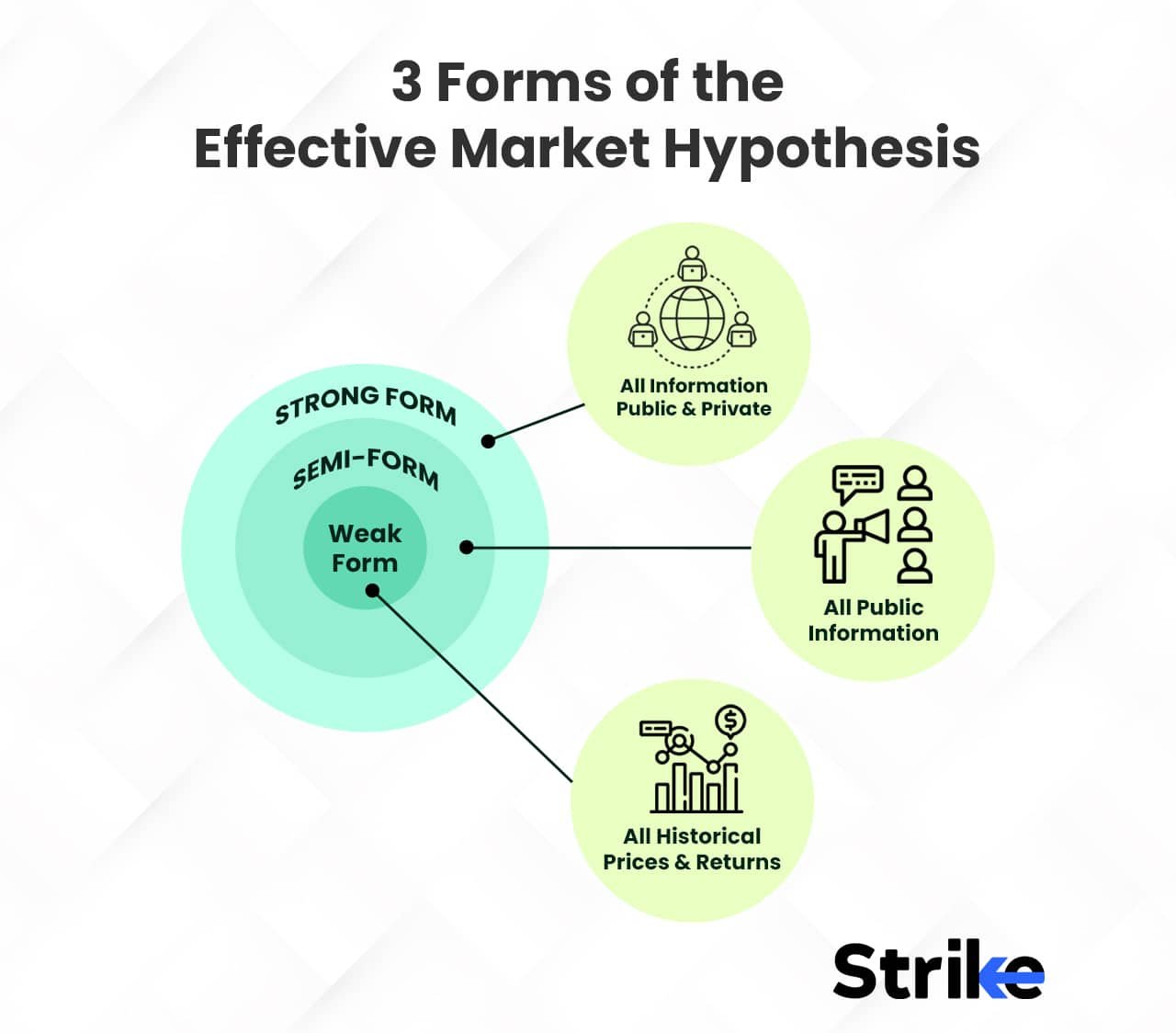
It is essential to understand that these three forms are nested within each other. The information sets are cumulative.
- The set of all public information (semi-strong) naturally includes the set of past prices (weak).
- The set of all information (strong) naturally includes the set of all public information (semi-strong).
Therefore, if a market is strong-form efficient, it must, by definition, also be semi-strong and weak-form efficient. If a market is semi-strong form efficient, it must also be weak-form efficient. The reverse is not true. A market could be weak-form efficient without being semi-strong form efficient.
This hierarchical relationship is perfectly captured in the following diagram.
The following table summarizes the key distinctions:
| Form of EMH | Information Reflected in Prices | Implication: Can you earn abnormal returns using... |
|---|---|---|
| Weak | Historical market data (prices, volume) | Technical Analysis? No. |
| Semi-strong | All publicly available information | Fundamental Analysis? No. |
| Strong | All public and private information | Insider Information? No. |
Conclusion
In this lesson, we have defined the Efficient Market Hypothesis and its three distinct forms. This theory provides a foundational lens through which to view price movements in financial markets.
Here are the key takeaways:
- Efficient Market Hypothesis (EMH): The theory that asset prices fully reflect all available information. This makes it impossible to consistently earn risk-adjusted returns that are above average.
- Weak-Form Efficiency: Prices reflect all past market data. This implies that technical analysis is ineffective.
- Semi-Strong Form Efficiency: Prices reflect all publicly available information. This implies that fundamental analysis based on public data is ineffective.
- Strong-Form Efficiency: Prices reflect all information, both public and private. This implies that even insiders cannot consistently profit from their privileged knowledge.
- Hierarchy: The forms are nested: strong implies semi-strong, and semi-strong implies weak.
We have focused today on the definitions of the hypothesis. This naturally leads to the next question: Is it true? In our next lesson, we will delve into the empirical evidence for and against each form of the EMH, exploring decades of research that has attempted to determine just how efficient financial markets really are.