Welcome back to our course on Financial Engineering and Loss Reserving. In our last lesson, we defined the Efficient Market Hypothesis (EMH) and its three forms—weak, semi-strong, and strong—which provide a theoretical framework for how information is incorporated into asset prices.
Today, we move from theory to practice by examining the real-world evidence. Our goal is to answer the question: Are financial markets actually efficient? We will investigate the decades of empirical research that have tested each form of the EMH. As a statistician, you'll find the methodologies used—such as autocorrelation tests and event studies—quite familiar, although their application to financial data may be new. This lesson will explore the arguments and evidence both for and against the hypothesis, laying the groundwork for understanding why the EMH remains one of the most debated topics in finance.
Evidence on Weak-Form Efficiency
Recall that the weak-form EMH states that all information from past prices is already reflected in the current price. This directly implies that technical analysis—the practice of predicting future prices from past price patterns—should be fruitless. So, how do we test this?
The primary test is to see if stock returns are predictable. If returns are unpredictable, they are said to follow a random walk, a concept from probability theory you may be familiar with. A random walk implies that the next price change is independent of all previous price changes.
Evidence FOR Weak-Form Efficiency
The main evidence supporting weak-form efficiency comes from studies of autocorrelation. Researchers measure the correlation between a stock's return on one day and its return on the next day, or over other time intervals.
[PDF] ifm-21-18-study-note.pdf - SOA.org
This study note from the Society of Actuaries (SOA) provides a concise summary of the evidence related to the weak form of EMH, including the concept of a random walk and autocorrelation tests.
Please read section 4.1.1, "Weak Form". Focus on the initial findings by Kendall (1953), which first suggested that prices behave like a random walk. Also, pay close attention to the description of autocorrelation tests and their results, which found coefficients very close to zero, suggesting no relationship between returns on consecutive days.
The overwhelming finding from these studies is that for most major stock markets, the autocorrelation of daily or weekly returns is negligible. This lack of correlation is strong evidence against the usefulness of technical analysis and supports the weak-form EMH. If past price movements don't predict future ones, then charts of past prices are useless for generating future profits.
Evidence AGAINST Weak-Form Efficiency
However, the picture isn't completely clear. While short-term correlations are near zero, some studies have found small but statistically significant patterns over different time horizons:
- Short-Term Momentum: Some research indicates a slight positive correlation in returns over 3 to 12-month periods. This means that stocks that have performed well recently tend to continue performing well for a few months. This is often called the "momentum effect."
- Long-Term Reversal: Over longer periods, such as 3 to 5 years, studies have found a negative correlation. Stocks that were past "winners" tend to underperform, and past "losers" tend to perform better. This is known as the "reversal effect."
These findings suggest that investors may underreact to news in the short term (leading to momentum) and overreact to long-term trends (leading to reversal). While these effects challenge a pure random walk, they are often small and can be difficult to profit from after accounting for transaction costs.
Evidence on Semi-Strong Form Efficiency
The semi-strong form EMH claims that prices reflect all publicly available information. This implies that fundamental analysis based on public data (like earnings reports, economic news, or analyst recommendations) cannot be used to consistently earn abnormal returns.
The primary tool for testing this is the event study. In an event study, we look at how stock prices react around a specific news event (the "event date"). The key is to measure the abnormal return, which isolates the part of a stock's return that is not explained by overall market movements.
The expected return is often calculated using a market model, which we will explore in detail later in the course. If a market is semi-strong form efficient, we should see a large abnormal return on the day of the announcement, but no significant abnormal returns in the days following it.
Evidence FOR Semi-Strong Form Efficiency
Most event studies provide strong support for the semi-strong EMH. Let's start with an intuitive video explanation.
Efficient Market Hypothesis: Definition & Examples (Easy Explanation)
This video from Helpful Professor Explains! provides simple, real-world examples of the semi-strong EMH in action.
Watch the section from this timestamp. It illustrates how markets react almost instantly to public news like earnings reports and economic policy changes, which is the core idea behind semi-strong efficiency tests.
A classic example of a formal event study is examining stock prices of companies that are targets of merger or takeover attempts.
[PDF] ifm-21-18-study-note.pdf - SOA.org
This section of the SOA study note describes a well-known event study that provides classic evidence for semi-strong efficiency.
Please read the final paragraph of section 4.1.2, "Semi-Strong Form", which details the takeover study. Notice how the abnormal returns occur before and at the announcement, but crucially, the price trend stops immediately after. This shows how quickly the public information is absorbed by the market.
The findings are consistent across thousands of such studies: the market adjusts to new public information with remarkable speed, usually within minutes or hours. This makes it extremely difficult for an investor to read an announcement and trade quickly enough to profit.
Evidence AGAINST Semi-Strong Form Efficiency
Despite this, some persistent anomalies challenge the semi-strong EMH. These are often cases where the market seems to underreact to news, with prices continuing to drift for some time after the event.
[PDF] The Efficient Markets Hypothesis - Actuarial Education
This study note from ActEd details several well-documented examples of market under-reaction, which contradict the semi-strong EMH.
Please read the part of section 2.2 titled "Under-reaction to events". Focus on the two key examples: post-earnings announcement drift and the reaction to de-mergers. These "anomalies" suggest that in some cases, the market is slow to fully incorporate new public information.
These anomalies suggest that while markets are largely efficient, they may not be perfectly efficient. We will explore these anomalies in more detail in a future lesson.
Evidence on Strong-Form Efficiency
The strong-form EMH is the most extreme version, asserting that prices reflect all information, both public and private. This would mean that even corporate insiders with privileged information cannot earn abnormal returns.
Evidence AGAINST Strong-Form Efficiency
Testing this form is challenging because trading on private, material information is illegal (insider trading). However, we can look at two key sources of evidence.
-
Insider Trading Profits: In many countries, corporate insiders (like directors and senior executives) must publicly report their trades in their own company's stock. Studies consistently show that these insiders tend to earn significant abnormal returns. They tend to buy before good news is announced and sell before bad news. This is direct evidence against the strong-form EMH. If private information were already in the price, they couldn't profit from it.
-
Legislation: The very existence of strict laws and regulations against insider trading is, in itself, evidence that markets are not strong-form efficient. Regulators create these rules precisely because they believe private information provides an unfair advantage that can be exploited for profit.
The general consensus is that the strong-form EMH does not hold in reality.
CFA Level I Equity Investments - Efficient Market Hypothesis
This video from PrepNuggets, aimed at CFA candidates, concisely states the conclusion regarding strong-form efficiency.
Watch the short segment on the strong form from this timestamp. The key takeaway is that due to the profitability (and illegality) of insider trading, markets are not strong form efficient.
Evidence FOR Strong-Form Efficiency (in a broader sense)
While private information is clearly valuable, strong-form efficiency can also be tested by looking at the performance of those who are presumed to have the best information and analytical skills: professional fund managers. If anyone could consistently find an informational edge, it would be them.
However, the evidence is stark: the vast majority of actively managed mutual funds fail to outperform their market benchmarks (like the S&P 500 or FTSE 100) over the long run, especially after accounting for fees.
[PDF] ifm-21-18-study-note.pdf - SOA.org
This section of the SOA note presents compelling data on the performance of professional fund managers.
Please read the paragraph in section 4.1.3, "Strong Form," that discusses mutual funds. Focus on the data presented: most funds underperform the market most of the time. Also, note that after fees, the performance is even worse. This supports the idea that even for experts, beating the market is incredibly difficult.
This finding is a powerful argument for a "highly efficient" market, even if it's not perfectly strong-form efficient. If the most dedicated professionals with vast resources cannot consistently win, it suggests that readily available information is already priced in, making it a very level playing field.
Summary of the Evidence
The world of market efficiency is not black and white. The evidence is nuanced, and after decades of research, a general consensus has emerged.
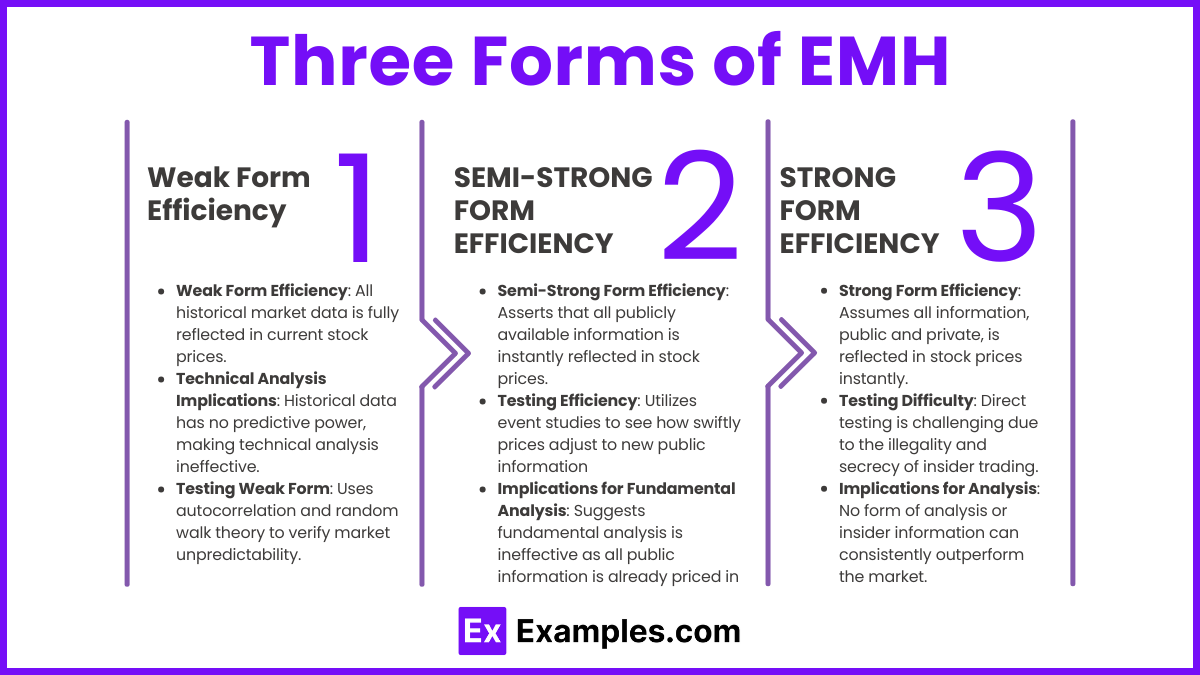
Here is a summary table of the key findings:
| Form of EMH | Main Implication | Evidence For | Evidence Against | General Consensus |
|---|---|---|---|---|
| Weak | Technical analysis is useless. | Returns show near-zero short-term autocorrelation (random walk). | Short-term momentum and long-term reversal effects. | Largely holds. Markets are very difficult to predict from past prices. |
| Semi-strong | Fundamental analysis is useless. | Event studies show prices react almost instantly to public news. | Some anomalies like post-earnings announcement drift. | Mostly holds. It is extremely difficult to profit from public news. |
| Strong | Insider information is useless. | Most professional fund managers fail to consistently outperform the market. | Documented profits from illegal insider trading. | Does not hold. Private information is valuable. |
Conclusion
In this lesson, we have moved beyond the definitions of the Efficient Market Hypothesis to examine the empirical evidence. We've seen that the question of "are markets efficient?" doesn't have a simple yes or no answer.
Here are your key takeaways:
- Weak Form: Largely supported. Stock price movements are very close to a random walk, making technical analysis an unreliable strategy in major markets.
- Semi-Strong Form: Mostly supported. The market incorporates public news with incredible speed, making it extremely difficult for investors to react and profit. However, some persistent anomalies suggest minor inefficiencies.
- Strong Form: Generally rejected. The ability of insiders to profit from private information shows that not all information is reflected in prices. However, the failure of most professional investors to beat the market suggests it is highly competitive and efficient.
The conclusion is that real-world markets are neither perfectly efficient nor completely inefficient. They are a battleground of information, and for the most part, information wins quickly.
The evidence we have reviewed has profound consequences for investment strategy. If it's so difficult to beat the market, should an investor even try? This brings us to the great debate between active and passive investment management, which will be the topic of our next lesson.