Welcome back. In our last lesson, we examined the empirical evidence for and against the Efficient Market Hypothesis (EMH). The key conclusion was that while markets aren't perfectly efficient (especially regarding private information), they are highly competitive and quick to incorporate public information. The weak and semi-strong forms of EMH appear to be very good approximations of reality for major financial markets.
This finding leads directly to one of the most significant and practical questions in all of finance: If it is so difficult to consistently find an edge, what is the best way to invest? This lesson tackles that question by exploring the profound implications of market efficiency for the great debate between active and passive investment management. By the end of our 60 minutes, you will be able to explain how the EMH provides a powerful theoretical and practical justification for a specific investment approach.
1. Active vs. Passive: Two Competing Philosophies
At its core, investing involves deciding which assets to buy and sell. Two fundamentally different philosophies guide this process: active and passive management.
Active investment management is the attempt to "beat the market." Active managers believe that through superior skill, research, and timing, they can identify mispriced securities (stocks that are either undervalued or overvalued) and construct a portfolio that delivers higher returns than a standard market benchmark, like the S&P 500 index. This outperformance is often referred to as generating alpha. This approach naturally involves frequent buying and selling as new opportunities are identified.
Passive investment management, on the other hand, is the decision to "be the market." Passive investors do not try to pick individual winners or time the market. Instead, they aim to replicate the performance of a specific market benchmark by holding all (or a representative sample) of the securities in that index. The strategy is typically "buy and hold," with minimal trading.
To get a clear overview of these two approaches, please watch the following video.
The Active Vs Passive Investing Debate
The video "The Active Vs Passive Investing Debate" from The Plain Bagel offers a concise introduction to the core characteristics of each strategy.
Please watch the segment from the beginning. Focus on how it defines the goal of active investing (to achieve alpha) versus the goal of passive investing (to mimic a benchmark).
The table below provides a helpful summary of the key differences between the two strategies.
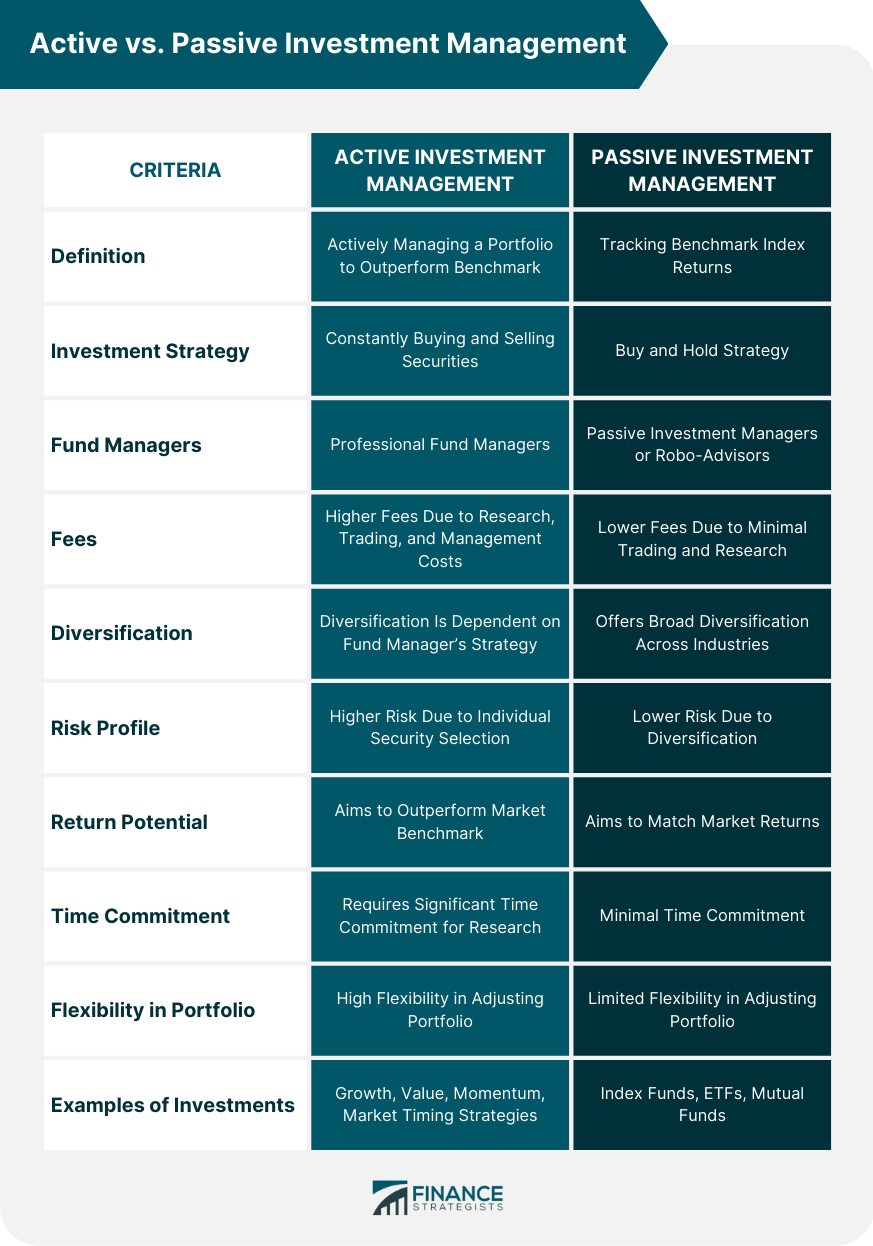
2. The EMH as the Dividing Line
The choice between active and passive management is not just a matter of preference; it is rooted in one's belief about how markets work. The Efficient Market Hypothesis lies at the very heart of this division.
-
The Passive Investor's Viewpoint: Proponents of passive investing are, in essence, believers in the semi-strong form of the EMH. They argue that since all publicly available information is already reflected in stock prices, the market is the most efficient processor of information available. Therefore, searching for mispriced securities is a futile exercise. Any outperformance by an active manager is more likely due to luck than skill.
-
The Active Investor's Viewpoint: Active managers, by definition, believe that markets are not perfectly efficient. They argue that behavioral biases, emotional decision-making, and structural market issues create exploitable pricing errors. They believe their research and analysis can uncover these opportunities before the rest of the market does.
Let's deepen this connection with another segment from the video.
The Active Vs Passive Investing Debate
This part of the video explicitly connects the two investment philosophies to their underlying beliefs about market efficiency.
First, watch the section explaining the passive view, which is grounded in the EMH. Then, watch the following segment on the active view, which highlights the belief in market inefficiencies and investor irrationality.
For a more formal explanation, which aligns with the material you'll encounter in your CM2 exam, the following text is essential.
[PDF] The Efficient Markets Hypothesis - Actuarial Education
This chapter from an actuarial study guide directly addresses the implications of EMH for investment management styles.
First, please read the section titled Active versus passive. Pay close attention to the argument presented in the 'Question' and 'Solution' box: "Why can active management not be justified according to the EMH?". Then, read the section on the implications of EMH. It formally states that market efficiency provides a rationale for passive strategies like index tracking.
In summary, the EMH provides the theoretical backbone for passive investing. If markets are efficient, active management is a zero-sum game before costs. Since active management involves significant costs, it becomes a negative-sum game after costs are factored in.
3. The Practical Evidence: Costs and Performance
Theory is one thing, but as a statistician, you know that the real test is in the data. The practical case for passive investing rests on two powerful pillars: costs and long-term performance statistics.
The Hurdle of Costs
Active management is inherently more expensive. These costs come from several sources:
- Management Fees: Paying for a team of highly-paid analysts, portfolio managers, and researchers.
- Trading Costs: Frequent buying and selling incurs brokerage commissions and bid-ask spreads.
- Tax Inefficiency: Selling appreciated assets can trigger capital gains taxes, which are passed on to the investor, reducing net returns.
Passive funds, by contrast, have very low costs because their operation is largely automated. They don't require expensive research teams, and their low turnover makes them highly tax-efficient.
The Performance Data
This cost hurdle means that for an active fund to outperform a passive one, it must not only beat the market but beat it by a margin wide enough to cover its higher fees. The evidence from the last lesson, and from decades of research, shows this is extraordinarily difficult.
The following video provides some stark, real-world numbers on how active managers have fared against their benchmarks.
Active vs. Passive Investing: Which is Better?
The hosts of "The Money Guy Show" discuss a well-known study on active manager performance and highlight the practical benefits of passive index funds.
First, watch the segment from this timestamp. It presents data from a SPIVA (S&P Indices Versus Active) report, showing the low percentage of active managers who succeed in outperforming their benchmarks over a 15-year period. Then, watch from this section, which summarizes the key advantages of index funds: tax efficiency, low cost, and emotional discipline.
The data is overwhelming: over any meaningful long-term period, the vast majority of active funds in major categories like U.S. large-cap stocks fail to beat their index. The small minority that do succeed in one period are rarely the same ones that succeed in the next, suggesting that luck plays a significant role. This is exactly what the EMH would predict.
4. When Might Active Management Be Considered?
While the case for passive investing is compelling, the debate is not entirely one-sided. Active management may still have a role in specific situations. The key is to identify areas where markets might be less efficient.

Here are a few arguments in favor of active management:
- Less Efficient Markets: Active managers argue they can add more value in markets that are less scrutinized by analysts, such as emerging markets, small-cap stocks, or certain segments of the bond market. However, as technology and information flow have improved, even these markets have become more efficient over time.
- Downside Protection: A passive index fund is fully exposed to market downturns. An active manager has the flexibility to move into more defensive assets (like cash) if they anticipate a market decline, potentially offering better risk management.
- Specific Goals: Investors may have unique objectives (e.g., generating a specific level of income, or adhering to ethical/ESG criteria) that cannot be met by a broad market index. A tailored, active approach may be necessary.
Despite these points, the default position, strongly supported by the EMH and empirical data, is that for most investors seeking broad market exposure, a low-cost passive strategy is the most statistically sound approach.
Conclusion
In this lesson, we connected the theory of market efficiency to the practical world of investment strategy. The implications are clear and have reshaped the investment industry over the past several decades.
Here are your key takeaways:
- EMH as the Rationale: The Efficient Market Hypothesis provides the core theoretical argument for passive investing. If markets efficiently price all public information, attempting to beat the market is unlikely to succeed consistently.
- Active vs. Passive Goals: Active management aims to outperform a benchmark (achieve alpha), while passive management aims to match a benchmark's return.
- The Power of Costs and Data: The combination of higher fees and the difficulty of finding an informational edge means that, empirically, most active managers underperform their passive benchmarks over the long term.
- Passive as the Default: For most investors, a low-cost, diversified, passive strategy (like an index fund or ETF) is the most logical application of the principles of market efficiency.
We have established that markets are highly, though not perfectly, efficient. This begs the question: what are the sources of the minor inefficiencies that do exist? In our next and final lesson of this module, we will explore some of the persistent "market anomalies" and introduce the field of behavioral finance, which seeks to explain these puzzles by looking at the psychology of investors themselves.