Welcome to the final lesson in our first module on the foundations of financial markets. In our previous discussion, we established that the Efficient Market Hypothesis (EMH) provides a powerful rationale for passive investing. If markets are highly efficient, consistently beating them becomes a formidable challenge, primarily reserved for luck rather than skill.
However, the story doesn't end there. Financial markets are not perfect laboratories; they are complex systems driven by human beings. This lesson delves into the fascinating cracks in the EMH, exploring the persistent patterns known as market anomalies. We will then introduce the field of behavioral finance, which uses insights from psychology to explain why these deviations from perfect rationality occur. By the end of our session, you will be able to describe common market anomalies and the behavioral finance critiques they inspire.
1. What are Market Anomalies?
In the context of the EMH, an "anomaly" is a predictable pattern in asset returns that seems to contradict the hypothesis. If an anomaly is real and persistent, it suggests that an investor could potentially use a simple trading rule based on historical data or public information to earn risk-adjusted returns that are higher than what the market average would predict.
This directly challenges the weak and semi-strong forms of market efficiency.
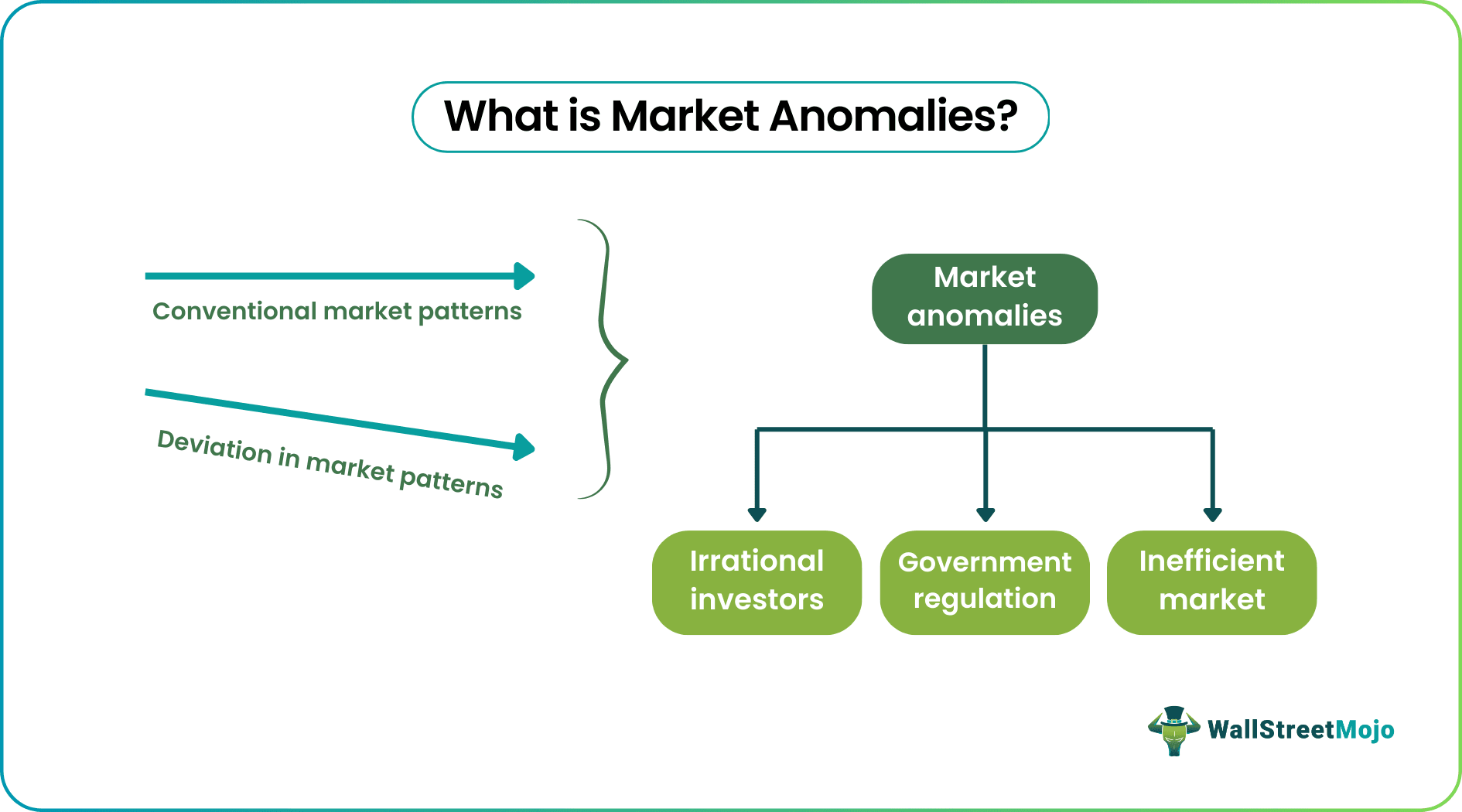
It's crucial to approach anomalies with a healthy dose of skepticism. As you know from your background in statistics, correlation does not imply causation. Some patterns discovered in historical data may be mere statistical flukes (data mining), while others might be too small to be profitably exploited after accounting for transaction costs. Furthermore, once an anomaly becomes widely known, the very act of traders trying to exploit it can cause the pattern to disappear.
[PDF] ifm-21-18-study-note.pdf - SOA.org
This section from a Society of Actuaries study note provides a concise definition of market anomalies and, importantly, outlines several critical caveats to keep in mind when studying them.
Please read the introduction to the section "Empirical Evidence against the EMH: Market Anomalies". Focus on the definition of an anomaly and the three caveats mentioned: the anomaly may not persist, it may require high-frequency trading to exploit, and it could be an artifact of data mining.
2. A Gallery of Common Anomalies
Researchers have identified numerous anomalies over the years. They can be broadly grouped into several categories. Let's explore some of the most well-documented examples.
A. Anomalies related to Market Structure and Events
These anomalies are tied to specific corporate events or the structure of certain investment vehicles.
- Closed-End Fund Discount: A closed-end fund issues a fixed number of shares and then invests the proceeds. While you would expect the fund's share price to trade at or very near its Net Asset Value (NAV) per share—the market value of its underlying investments—these funds often trade at a persistent discount. This violates the "law of one price," as the fund's shares are cheaper than the assets they represent.
- Earnings Surprises (Post-Earnings-Announcement Drift): The semi-strong EMH predicts that a company's stock price should react instantaneously to an earnings announcement. However, studies show that firms reporting unexpectedly good earnings tend to see their stock prices drift upwards for weeks or even months afterward. Similarly, firms with bad news see a continued downward drift. This suggests the market underreacts to the initial news.
- Initial Public Offerings (IPOs): IPOs often exhibit two puzzling behaviors. First, the initial offering price is frequently set too low, leading to a significant "pop" on the first day of trading. This suggests an opportunity for those able to get IPO allocations. Second, over the long run (3-5 years), IPO stocks have historically tended to underperform comparable non-issuing firms, suggesting investors were initially too optimistic.
The following video provides an excellent walkthrough of these three classic anomalies.
Market anomalies (for the CFA Level 1 exam)
The video "Market anomalies (for the CFA Level 1 exam)" from the 'Let me explain' channel clearly explains several anomalies relevant to professional finance exams.
Please watch the following segments: Closed-end fund discounts: Pay attention to the real-world example and the potential (but insufficient) explanations. Earnings surprises: Note how the slow price adjustment contradicts the semi-strong form of EMH. IPOs: Focus on the "first-day pop" phenomenon and the reasoning behind initial underpricing.
B. Calendar and Time-Based Anomalies
These are patterns related to specific times of the day, week, or year.
- The January Effect: Historically, stock returns, particularly for smaller companies, have been observed to be higher in January than in other months. A common explanation is tax-loss selling, where investors sell losing stocks at the end of the year to realize a capital loss for tax purposes, and then buy them back in January, pushing prices up.
- The Monday Effect (or Weekend Effect): Studies have shown that stock returns on Mondays tend to be lower, on average, than on other days of the week. No single explanation for this is universally accepted.
[PDF] ifm-21-18-study-note.pdf - SOA.org
This same study note provides a quick, clear summary of these time-based anomalies.
Please read the short section titled "Calendar/Time Anomalies" to get a definition of the January, Monday, and Time-of-Day effects.
The existence of these anomalies doesn't automatically invalidate the EMH. As we noted, some may be statistical quirks or too costly to exploit. However, their persistence has led researchers to look for deeper explanations beyond the model of a perfectly rational investor.
3. Behavioral Finance: The Psychology of Investing
Behavioral finance seeks to explain market anomalies by integrating psychological theories into financial models. Its central premise is that investors are not the perfectly rational, utility-maximizing agents described in classical economic theory. Instead, they are human beings, susceptible to cognitive errors and emotional impulses.
Behavioral Finance | Investor Irrationality
The video "Behavioral Finance | Investor Irrationality" by The Plain Bagel gives a great introduction to this field, contrasting it with traditional finance.
Please watch from the beginning of the video. Focus on the core idea of bounded rationality—that we aim for "good enough" decisions rather than perfectly optimal ones—and how the mental shortcuts we use can lead to problems in finance.
Behavioral finance categorizes the systematic errors investors make into two broad types: cognitive biases and emotional biases.
Cognitive Biases: Errors in Thinking
These are biases that stem from faulty reasoning or memory. They are more about how we process information than how we feel.
- Belief Perseverance: The tendency to cling to one's initial beliefs, even when faced with contradictory information. A key example is Confirmation Bias, where we subconsciously seek out and give more weight to information that supports our existing views.
- Information-Processing Biases: Errors that occur when we try to digest and act on information. An example is Mental Accounting, where we treat money differently depending on its source or intended use (e.g., being more reckless with "winnings" from an investment than with our initial capital).
Emotional Biases: Errors from Feelings
These biases originate from impulse, intuition, and emotion rather than conscious thought. They are often harder to correct than cognitive biases.
- Loss Aversion: The tendency for people to feel the pain of a loss more strongly than the pleasure of an equivalent gain. This can lead investors to hold on to losing stocks for too long, hoping to "break even."
- Regret Aversion: The desire to avoid the pain of regretting a decision. This can lead to herding, where investors follow the crowd—buying what everyone else is buying—because a decision feels "safer" and less prone to individual regret if it turns out to be wrong. Herding is a key driver of market bubbles and momentum.
To get a full breakdown of these biases, let's return to the video.
Behavioral Finance | Investor Irrationality
This video provides clear definitions and examples of both cognitive and emotional biases.
First, watch the segment on cognitive biases, focusing on the distinction between belief perseverance and information processing errors. Then, watch the section on emotional biases, paying close attention to how loss aversion and regret aversion can lead to herd behavior and market momentum.
These biases provide plausible psychological underpinnings for many of the anomalies we've discussed. For example, the underreaction to earnings news could be explained by a cognitive bias like conservatism, where investors are too slow to update their beliefs. The momentum effect, where past winners continue to perform well, can be linked to herding and regret aversion.
Conclusion
This lesson marks the end of our foundational module on financial markets. We've journeyed from the basic functions of markets to the elegant theory of the EMH, its practical implications for investing, and finally, to the fascinating challenges posed by real-world anomalies and human psychology.
Here are your key takeaways:
- Market Anomalies: These are persistent, predictable patterns in stock returns that appear to contradict the Efficient Market Hypothesis. Examples include the January effect, the post-earnings-announcement drift, and the closed-end fund discount.
- Behavioral Finance: This field provides a compelling explanation for anomalies by arguing that investors are not always rational. Their decisions are influenced by systematic psychological biases.
- Cognitive vs. Emotional Biases: Cognitive biases are errors in reasoning (e.g., confirmation bias), while emotional biases stem from feelings (e.g., loss aversion and regret aversion), which can lead to herding.
- A Balanced View: While markets are highly competitive and largely efficient, they are not perfect. Behavioral finance helps us understand why deviations occur, but exploiting these anomalies remains difficult due to transaction costs and the risk that they disappear once identified.
We've spent this module examining how markets and investors behave. We saw the ideal of the "rational investor" in the EMH and the more realistic, psychologically-driven investor of behavioral finance. In our next module, we will formalize the concept of rational decision-making by introducing Utility Theory. This will provide the mathematical framework for modeling how a rational, risk-averse individual should make choices under uncertainty, setting the stage for building portfolios and pricing complex assets.