Hello! Welcome to the first lesson in our new module, "Database Interaction with PDO."
In the previous module, we built a solid foundation for writing robust PHP code by mastering error and exception handling. We learned how to manage predictable issues with try-catch blocks and how to debug unpredictable problems using logs. Now, we're moving on to a core component of virtually every dynamic web application: the database.
This lesson addresses a fundamental question: How should we talk to a database in modern PHP? The answer is PDO (PHP Data Objects). Our goal is to understand why PDO is the standard choice. You will learn to explain the benefits of using PDO, focusing on its role as a database abstraction layer. This knowledge is crucial for writing professional, secure, and maintainable applications.
1. What is a Database Abstraction Layer?
Before we dive into the benefits of PDO, let's clarify what "database abstraction" means.
Imagine you need your PHP application to communicate with a MySQL database. You would use a specific set of PHP functions or methods designed only for MySQL. Now, what if you decide to switch to a different database system, like PostgreSQL? You would have to rewrite all of your database-related code because PostgreSQL uses a different set of commands.
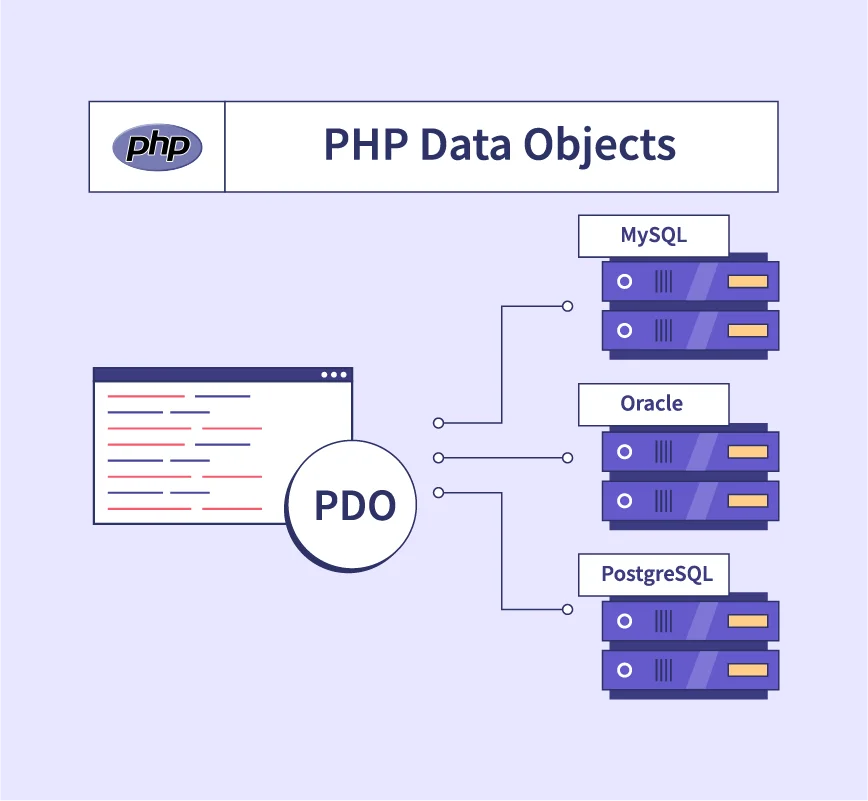
A database abstraction layer solves this problem. It acts like a "universal translator" between your PHP code and the database. You write your code once, using the abstraction layer's consistent set of functions. The layer then handles the "translation" to the specific database system you're connected to. PDO is PHP's built-in abstraction layer.
This diagram illustrates the concept perfectly:
To get a quick overview of what PDO is and how it compares to older methods, please watch this short introductory video.
What Is PDO? | Introduction To Object-Oriented PHP | OOP For Beginners | PHP Tutorials
The video 'What Is PDO?' from Code With Dary provides a concise introduction to PHP Data Objects and its core purpose.
Watch the first 1 minute and 22 seconds (from 00:00 to 01:22). Pay attention to the definition of a database access abstraction layer and the comparison between PDO and MySQLi regarding database support.
2. The Core Benefits of Using PDO
Now that we have a conceptual understanding, let's explore the specific advantages that make PDO the modern standard. We'll focus on four key areas: portability, security, error handling, and developer-friendly features.
The following article, "PHP PDO: A Comprehensive Guide to Secure Database Interactions," provides an excellent summary of these benefits. We will refer to it throughout this section.
PHP PDO: A Comprehensive Guide to Secure Database Interactions
This article gives a clear and structured overview of the main advantages of using PDO. We'll start by reading the introductory sections to get a solid footing.
First, read the sections 'What is PDO?' and 'Advantages of Using PDO'. This will give you a high-level map of the benefits we are about to discuss in detail.
Benefit 1: Database Independence
As we've discussed, this is the primary benefit of abstraction. PDO supports over a dozen different database drivers. This means you can write your application and, if needed, switch from MySQL to PostgreSQL or SQLite by changing only one line of code: the connection string (DSN).
This makes your application highly portable and future-proof.
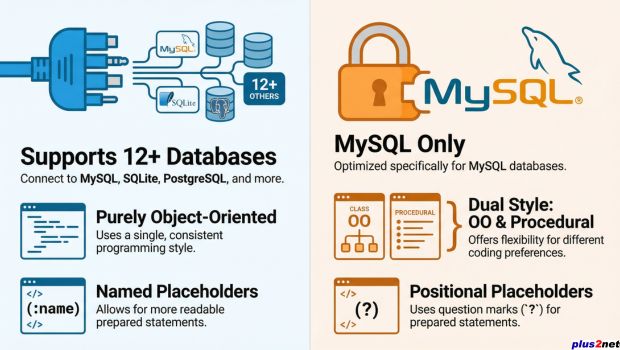
Now, refer back to the "PHP PDO" article and see a concrete example of this.
PHP PDO: A Comprehensive Guide to Secure Database Interactions
Let's see how database independence works in practice by looking at the connection strings for different databases.
Read the subsection 'Database Independence: Switch Databases Easily Without Changing Your Code'. Notice how the PHP code for creating a PDO object remains the same, with only the $dsn string changing for MySQL, PostgreSQL, and SQLite.
Benefit 2: Enhanced Security with Prepared Statements
This is arguably the most critical benefit of PDO, especially given your interest in cybersecurity. PDO helps protect your application from SQL injection attacks.
An SQL injection attack occurs when a malicious user tricks your application into running unintended SQL code, potentially allowing them to steal data, modify records, or destroy your database. This usually happens when user input is directly concatenated into a query string.
The best way to understand the danger is to see it in action.
PHP PDO Tutorial Part 1 - Prepared Statements - SQL Injection - Full PHP 8 Tutorial
The video 'PHP PDO Tutorial Part 1' by Program With Gio has an excellent and very clear demonstration of a real SQL injection attack. Watching this will make the threat feel much more tangible.
Watch from 09:16 to 12:59. The video shows how a simple query that includes user input can be manipulated from the URL to bypass authentication and retrieve all user records from the database. This is a classic SQL injection.
PDO prevents this using prepared statements. The process works in two steps:
- Prepare: You send the SQL query to the database, but with placeholders (
?or named placeholders like:email) instead of actual user data. The database engine parses this query template and prepares to execute it. - Execute: You send the user's data separately. The database binds this data to the placeholders and executes the prepared query.
Because the data is sent separately from the query structure, the database engine never confuses the data with executable SQL commands. The attacker's input is treated as plain text, not as code.
The "PHP PDO" article provides a concise code example of this defense.
PHP PDO: A Comprehensive Guide to Secure Database Interactions
Now, let's look at how prepared statements provide the solution to the attack we just saw.
Read the subsection 'Security: Prepared Statements and Parameterized Queries Prevent SQL Injection'. Note the use of the :email placeholder.
Benefit 3: Consistent Error Handling
This benefit connects directly to our previous module. Instead of generating PHP warnings or fatal errors that halt script execution abruptly, PDO can be configured to throw PDOException objects when a database error occurs.
This allows you to wrap your database operations in try-catch blocks, giving you a clean, consistent, and predictable way to handle database failures, just as you would handle other application-specific errors.
PHP PDO: A Comprehensive Guide to Secure Database Interactions
Let's see how this looks in code, which should be very familiar after our last module.
Read the subsection 'Error Handling: PDO Provides Robust Error Handling Mechanisms'. The try-catch block is the key takeaway here.
Benefit 4: Rich Features and Better Developer Experience
Beyond the "big three" benefits, PDO also includes a host of features that make a developer's job easier and code cleaner.
- Named Placeholders: Instead of using anonymous
?placeholders, you can use descriptive names like:user_id,:email, and:status. This makes complex queries much easier to read and maintain. - Flexible Data Fetching: PDO can return query results in various formats (e.g., associative arrays, numerically indexed arrays, standard objects, or even instances of your own custom classes) with a simple option, reducing the amount of manual data formatting you need to do.
- Transaction Support: PDO has built-in support for database transactions, which allow you to group multiple database queries together. The entire group will either succeed or fail as a single unit, which is essential for maintaining data integrity (e.g., transferring money between two bank accounts).
To see how these features provide a real advantage over older methods, it's helpful to look at a direct comparison.
A fair comparison of mysqli vs. PDO
The article 'A fair comparison of mysqli vs. PDO' does a great job of showing how PDO's features result in more concise and readable code.
Read the sections 'Where PDO is superior over mysqli', 'Named placeholders', 'General inconvenience in binding', and 'Getting multiple rows'. Focus on the code examples and notice how much less boilerplate code is needed with PDO to achieve the same result.
Conclusion
In this lesson, we established the foundational "why" behind using PDO. It is not just another way to talk to a database; it is the modern, professional standard in PHP for very specific and important reasons.
Key Takeaways:
- Abstraction: PDO is a database abstraction layer, providing a single, consistent API to interact with many different database systems.
- Portability: This abstraction makes your code portable, allowing you to switch database backends with minimal effort.
- Security: PDO's prepared statements are the primary defense against SQL injection, one of the most common web security vulnerabilities.
- Error Handling: PDO uses exceptions (
PDOException), allowing for clean and structured error handling withtry-catchblocks. - Developer Experience: Features like named placeholders and flexible data fetching modes lead to more readable, maintainable, and concise code.
Preview of the Next Lesson:
Now that you can confidently explain why we use PDO, our next step is to learn how. In the next lesson, you will write your first lines of PDO code as we cover how to establish a database connection using the PDO object.