Hello and welcome to your second lesson.
In our first session, we established a framework for analysing any set piece by breaking it down into four phases: Preparation, Delivery, Execution, and Transition. This gave us the "what" and "when" of a set piece.
Today, we will focus on the "who." This lesson addresses the primary player roles during both attacking and defensive set pieces. Understanding these roles is fundamental for you as a future set-piece coach, as it's the foundation for designing effective routines, assigning responsibilities, and scouting your opposition. By the end of this lesson, you will be able to describe the specific jobs players are tasked with in both major phases of the game.
Attacking Roles: The Cast of the Play
An attacking set piece is like a well-choreographed play. Each player has a specific role designed to contribute to the collective goal. These aren't just positions; they are functions. A player might be a goalscorer in one routine and a decoy in the next.
Let's begin by studying a clear breakdown of these functional roles.
Positioning, Movement & Roles in Attacking Corner Kicks
The article 'Positioning, Movement & Roles in Attacking Corner Kicks' from The Football Analyst provides an excellent overview of the key functions players perform during attacking corners. These concepts apply broadly to other attacking set pieces as well.
Please read the section titled 'Functional Roles in Offensive Corners'. As you read, focus on understanding the distinct purpose of each role.
As the article explains, we can categorise the primary attacking roles as follows:
-
The Taker (or Shooter): This is the player delivering the ball. Their role extends beyond just kicking; they are the on-field decision-maker who must read the defensive setup and select the correct delivery type and target area. They often initiate the routine with a signal. This role is central to the Delivery phase.
-
The Short-Option Player: Positioned near the taker, this player creates a tactical problem for the defence. Do they send a defender out to cover the short option, leaving space in the box? Or do they ignore them and risk a 2v1 on the wing? This player's primary function is to manipulate the defence during the Preparation phase.
-
Finishers (The Attackers): These are the players tasked with getting on the end of the delivery. The article makes a crucial distinction:
- Reference Finisher: The primary aerial target of the routine. Their job is to win the first contact and score.
- Facilitator: A player whose main job is to create space for the finisher. They do this through decoy runs (dragging defenders away) or by setting screens/blocks (physically impeding a defender's path). Facilitators are the unsung heroes of many successful routines.
-
The Clearing Player (or Edge-of-Box Player): This player positions themselves outside the penalty area. They have a vital dual role that bridges the Execution and Transition phases:
- Attacking Transition: Attack cleared balls ("second balls") to sustain pressure, often with a long-range shot or by recycling possession.
- Defensive Transition: Act as the first line of defence to delay or stop a counter-attack.
-
Defensive Safeguards (or "Rest Defence"): These are the players (usually one or two) who stay back and take no part in the initial attack. Their sole responsibility is to provide security against a counter-attack, marking the opponent's forward(s). Their role exists entirely within the Transition phase.
This tactical diagram provides a static view of how these roles might be arranged in a specific routine.
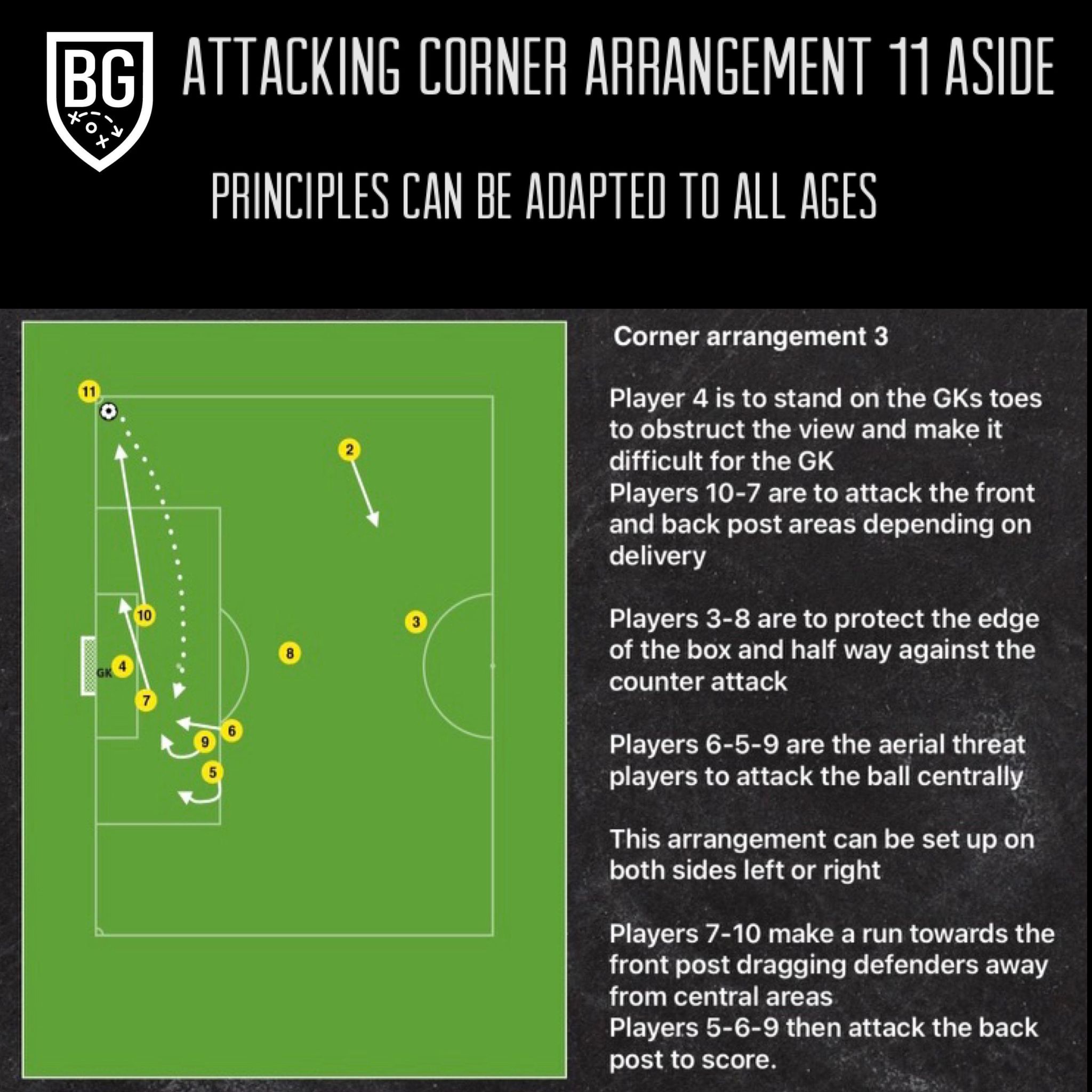
Now, let's see these roles in action. The following video analyses some of Arsenal's corner routines, which are excellent examples of well-defined player functions.
Arsenal's CORNER TACTICS Explained | Tactical Analysis
This analysis of Arsenal's corner tactics by The Tactics Guy demonstrates how elite teams use specific player roles to create advantages.
Watch the segments from 00:38 to 01:44. As you watch, try to map the actions you see to the functional roles we've just discussed: 00:38 - 00:58: Notice the player pinning the first defender. What role is this? 00:58 - 01:25: See how players form a 'shield'. What is their function? 01:25 - 01:44: Observe the player tasked with blocking the goalkeeper.
In the video, you saw clear examples of Facilitators. The player pinning the first defender, the players forming a "shield" to block other defenders, and the player standing next to the goalkeeper are all performing facilitator roles. Their primary job isn't to score themselves, but to create the space and opportunity for a designated Finisher to attack the ball in a high-probability area.
Defensive Roles: The System Dictates the Job
On the defensive side, a player's role is largely determined by the overall defensive system the coach chooses. There are three primary systems for defending corners and wide free kicks.
To familiarise yourself with them, let's watch this short overview.
This video from Tifo Football provides a concise introduction to the three main defensive systems used at set pieces.
Watch the video from 01:22 to 05:43. Pay attention to the fundamental difference between man-marking (following a player) and zonal marking (defending a space), and how the hybrid model combines them.
Now that you understand the concepts of man-marking, zonal marking, and hybrid systems, let's examine the specific player roles within each. We will use a detailed coaching document to explore the individual responsibilities.
Three strategies for defending corners: Zonal, Man to Man and ...
This document from The Coaching Manual, 'Three strategies for defending corners', gives a player-by-player breakdown of roles and responsibilities for each defensive system. This level of detail is exactly what a set-piece coach works with.
Scan through the 'Roles and responsibilities' sections for Zonal Marking, Man-To-Man Marking, and Mixed Zonal and Man to Man marking. You don't need to memorise every player's job, but rather understand how the roles differ between the systems.
Let's summarise the key roles based on that resource and common professional practice.
1. Roles in a Zonal System
In a pure zonal system, roles are defined by the space a player must defend.
- Goalkeeper: Commands the 6-yard box, claims high balls, makes reaction saves.
- Post Players: One player on each post (less common now) or just a player covering the near-post space. Their job is to block shots and clear balls off the line.
- First Zonal Line: A line of (often 3-4) players across the 6-yard box. These are typically the team's best headers of the ball. Their role is to aggressively attack any ball that enters their zone.
- Second Zonal Line: Another line of players positioned higher up (e.g., around the penalty spot) to cover deeper deliveries and challenge runners.
- Edge-of-Box Player(s): Positioned to win second balls and, crucially, to press short corner options or launch counter-attacks.
- Counter-Attack Threat: One player may be left upfield to pin back defenders and provide an immediate outlet upon winning possession.
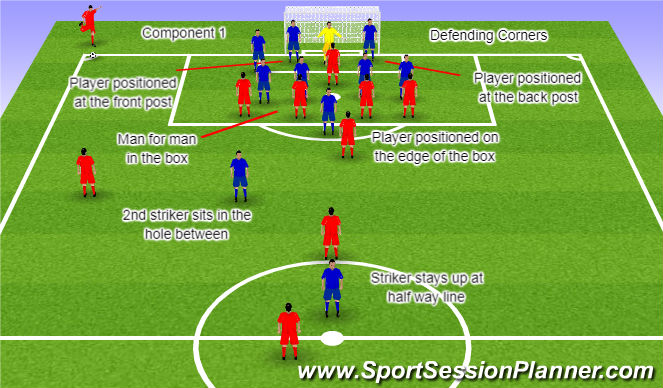
2. Roles in a Man-Marking System
Here, roles are defined by the specific opponent a player must defend.
- Man-Markers: The majority of players are assigned an opponent and are responsible for preventing that player from getting a free run or header. The key instruction is to stay "touch tight."
- Goalkeeper Protector: Sometimes one player is tasked with marking any opponent trying to impede the goalkeeper, rather than a specific player.
- Free/Zonal Players: Even in a man-marking system, there is often one "free" player in a key zone (like the near-post area) to attack the ball, and players on the edge of the box.
3. Roles in a Hybrid System
This is the most common system in modern football. Roles are a blend of the two.
- Zonal Players: Typically, the 3-5 best aerial defenders are assigned to key zones (e.g., across the 6-yard box) with the sole task of attacking the ball.
- Man-Markers: The remaining defenders are assigned to man-mark the opposition's most dangerous threats who are not starting in the zonal players' areas.
- Edge-of-box / Counter-Attack Players: As with the other systems, players are still required to cover the edge of the box and provide a counter-attacking outlet.
Test your understanding!
You are setting up your defence for a corner. The opposition's main threat is a player who makes a late, fast run from deep towards the penalty spot.
In a hybrid system, what type of role would you assign to a player to deal with this specific threat: a zonal role or a man-marking role? Briefly explain why.
Show answer
You would assign a man-marking role.
Reasoning: A zonal defender is responsible for an area. A fast runner from deep can gain momentum and attack the space before the static zonal defender can react effectively. A dedicated man-marker, however, can track that runner's entire movement, disrupt their timing, and prevent them from gaining a clean run and jump.
Conclusion
Today, we've populated the set-piece framework with the actors who carry it out. By moving from the phases of a set piece to the specific roles of the players, you are building a more complete picture of set-piece analysis.
Key Takeaways:
- Attacking roles are functional and describe a player's job within a routine. Key roles include the Taker, Finishers, Facilitators (space creators), and Defensive Safeguards.
- Defensive roles are determined by the system. In Zonal marking, players defend a space. In Man-marking, players defend a specific opponent. A Hybrid system strategically combines both.
- As a coach, assigning the correct roles to the right players is a critical part of your job, whether you are designing an attack or organising a defence.
Preview of the Next Lesson:
We now understand the sequence of events (phases) and the responsibilities of the players (roles). But how do we measure if a set piece was successful beyond the simple outcome of goal or no goal? In the next lesson, we will begin to answer that by exploring the world of data. We will define key set piece performance indicators (KPIs) and the concept of Expected Goals (xG), giving you the tools to analyse set-piece effectiveness objectively.