Hello and welcome to your first lesson. Your goal is to become a professional set-piece coach, and this course is designed to give you the tactical knowledge and analytical skills to achieve that.
In this introductory lesson, we will establish the fundamental framework for analysing any set piece. By the end of our session, you will be able to identify the four key phases of a set piece: preparation, delivery, execution, and transition.
Mastering this concept is crucial. It allows you to break down a seemingly chaotic moment into a structured, analysable sequence of events. This four-phase model will be the bedrock for everything we cover later in the course, from designing routines to scouting opponents.
What are the Phases of a Set Piece?
At the highest level, every set piece unfolds in a sequence. While the action can be fast, a coach must see it as a series of distinct phases. This allows for precise analysis of what worked, what didn't, and why.
We will break down every set piece into four key phases:
- Preparation: The strategic planning and on-field organisation that occurs before the ball is put into play. It's about having a clear plan.
- Delivery: The technical action of the restart itself—the quality and type of kick or throw.
- Execution: The immediate movements and actions by both teams to attack or defend the initial delivery. This phase is often about winning the "first contact."
- Transition: What happens immediately after the initial execution. This includes competing for the second ball (offensive transition) or launching a counter-attack (defensive transition).
The FIFA Technical Study Group uses a similar model, focusing on the "first phase" and "subsequent phases." To begin, let's look at their official definitions to ground our understanding in industry terminology.
Set plays: More goalscoring opportunities generated from ...
The following resource from the FIFA Training Centre provides formal definitions for the phases of play following a set piece. This will help us establish a professional vocabulary.
Please read the section titled 'Set-play phases'. Pay close attention to the definitions of 'First phase' and 'Subsequent phases'.
As you can see, FIFA's "First phase" aligns with what we will call the Delivery and Execution phases. Their "Subsequent phases" are what we refer to as the Transition phase. Our four-part model provides a bit more granularity, which is useful for coaching.
Now, let's explore each phase in detail.
1. Preparation: The Blueprint for Success
The preparation phase is where games can be won before the ball is even kicked. It encompasses all the analytical work, planning, and on-field organisation.
Key components of the Preparation phase include:
- Game-planning: This is the work done by the coaching staff during the week. It involves analysing the upcoming opponent's strengths and weaknesses and designing specific routines to exploit them.
- Categorisation: Identifying the specific situation on the pitch. Is it a corner? If so, is it an inswinger or an outswinger? Is it a wide free kick or a central one? The choice of routine depends heavily on this context.
- Player Setup: Players arranging themselves into their starting positions for the planned routine. This includes positioning decoys, primary targets, and players responsible for defensive balance.
- Communication: The taker giving a signal to teammates, or players communicating to organise the defensive wall.
To see what elite preparation looks like, watch this analysis of Brentford, a team renowned for its set-piece innovation.
Why Brentford are the best set-piece takers in football
This video from Tifo Football by The Athletic examines why Brentford are so effective from set pieces. The first part focuses on the importance of 'having a plan'.
Watch the segment from 01:48 to 03:18. Notice how Brentford's preparation involves creating a coherent plan for the entire match, using the same initial setup to run different routines and exploit specific opposition weaknesses.
Brentford's approach shows that preparation isn't just about one play; it's about a series of plays designed to work together throughout a match.
This diagram shows the output of the preparation phase for a specific attacking corner.

2. Delivery: The Service
The delivery is the most straightforward phase: it's the physical act of kicking or throwing the ball into play. However, its quality is paramount. A perfect routine can be worthless if the delivery is poor.
Key elements of the Delivery include:
- Type: Is it an inswinger (curving toward the goal), an outswinger (curving away), or a driven, low cross?
- Pace: How much speed is on the ball?
- Trajectory: What is the height and arc of the ball?
- Target Area: Which specific zone of the pitch is the deliverer aiming for?
We will dedicate entire lessons to different delivery types later in the course. For now, recognise it as the bridge between the plan (Preparation) and the action (Execution).
3. Execution: The First Contact
The execution phase is the moment of truth. It's the coordinated chaos where attackers make their moves and defenders react. As an analyst, your job is to see the patterns within that chaos.
A core principle here is to focus on player movement, not just the ball. A well-rehearsed routine is defined by the players' synchronised actions.
The execution of an attacking set piece often involves:
- Targeted Runs: Players running towards the designated area to attack the ball.
- Decoy Runs: Players running to different areas to draw defenders away and create space for others.
- Blocks and Screens: Players positioning themselves to impede a defender's path, freeing up a teammate.
- Timing: All movements must be timed perfectly to coincide with the ball's arrival.
This video of former Northern Ireland manager Ian Baraclough coaching a set-piece drill provides an excellent practical look at the execution phase.
Ian Baraclough, Northern Ireland head coach • Set-pieces coaching course • CV Academy
In this coaching session from Coaches' Voice, Ian Baraclough drills his players on attacking a cross. He gives direct, actionable feedback that gets to the heart of the execution phase.
Watch the clip from 04:25 to 05:25. Listen for the four key points he emphasises at the end: 1) Delivery, 2) Committed runs, 3) First Contact, and 4) Second Phase. Points 2 and 3 are the essence of execution.
Baraclough's focus on "committed runs" and "getting across that defender" to win the "first contact" perfectly describes the goal of the execution phase.
Test your understanding!
Look back at the attacking corner diagram (Attacking Corner 5). Identify:
- One player whose main role is part of the Preparation phase (e.g., a decoy to shape the defence).
- One player whose main role is part of the Execution phase (e.g., the primary target).
Show answer
- Preparation/Decoy: Player 3 is a good example. Their instruction is to "make a decoy movement to cross deep." This run is designed to manipulate the defence and create space elsewhere, a key part of the pre-planned routine.
- Execution/Target: Players 9, 5, and 4 are the primary executors. Their instruction is to "crash the back post for rebounds or flicks," meaning their job is to attack the ball or the space where the ball will end up.
4. Transition: The Aftermath
The transition phase begins the split second after the initial execution. What happens next? Does the attack continue, or does the defending team regain possession and launch a counter? Elite teams plan for this phase as rigorously as they do for the first contact.
There are two sides to the transition phase:
- Attacking Transition (The "Second Phase"): If the ball is not cleared decisively, the attacking team must be positioned to win the "second ball" and sustain pressure. This often involves players positioned at the edge of the penalty area, ready to either shoot or recycle possession. This is what Baraclough refers to as staying "alive for the second ball."
- Defensive Transition (The "Rest Defence"): The attacking team must also arrange players in a "rest defence" structure. These players do not contest the initial ball; their job is to prevent a counter-attack if possession is lost. The defending team, in turn, will look to exploit any gaps in this structure to break forward quickly.
The article "How to Analyse Set-Pieces" discusses the importance of these players outside the main action.
How to Analyse Set-Pieces (like a Sicko)
This article by 'SetPieceSicko' provides an in-depth guide to set-piece analysis. This particular section highlights the importance of the transition phase, which the author calls 'framing structures' or 'rest structures'.
Read the section titled '1.4. Framing structures'. Focus on the concept of players on the 'edge of the area' and their dual role in both sustaining an attack (second phase) and preventing counter-attacks (rest defence).
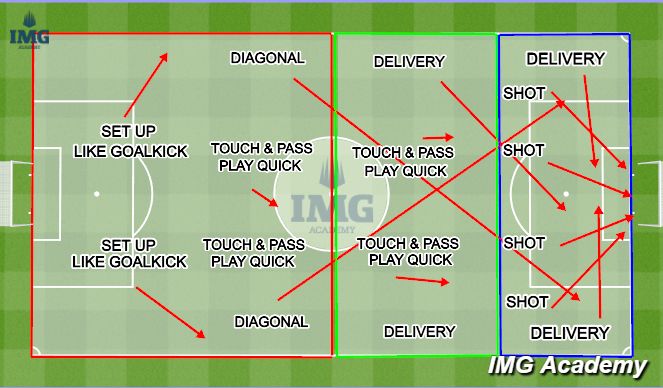
This training drill illustrates the flow from one phase to another, including the transition to a shot.
Conclusion
In this lesson, we have established a foundational four-phase framework for understanding set pieces.
Key Takeaways:
- Every set piece can be broken down into four distinct phases: Preparation, Delivery, Execution, and Transition.
- Preparation is the strategic blueprint, including the game plan and player setup.
- Delivery is the technical act of serving the ball.
- Execution is about the synchronised movements to win the first contact.
- Transition deals with the aftermath: competing for the second ball and managing counter-attacks.
As a coach, you must analyse each phase independently to understand why a routine succeeded or failed. Was the plan flawed? Was the delivery poor? Was the execution sloppy? Or was the team vulnerable in transition?
Preview of the Next Lesson:
Now that you have a framework for the sequence of events (the "what"), our next lesson will focus on the people involved (the "who"). We will describe the primary player roles during attacking and defensive set pieces, assigning specific responsibilities within the four-phase structure we've learned today.