Hello! Welcome to the final lesson in our module on game planning. In our last session, you did excellent work translating a tactical game plan into a clear and engaging video presentation for the players. You've mastered the art of pre-match preparation.
But as any coach knows, no plan survives first contact with the opponent. The best-laid schemes can be undone by an unexpected tactical switch or a change in momentum. A crucial skill for an elite set piece coach is the ability to react and adapt in real-time.
This lesson focuses on the learning outcome: Identify potential in-game tactical adjustments for set piece situations. We'll move beyond the pre-match script and into the dynamic, problem-solving environment of a live game. You'll learn how to spot the need for a change and what adjustments you can make to regain the advantage.
1. The Analyst's Mindset: From Planning to Problem-Solving
Your work doesn't stop at kick-off. During the match, you transition from a planner to a live analyst. Your role is to continuously evaluate whether the plan is working and to identify moments where an adjustment could be decisive.
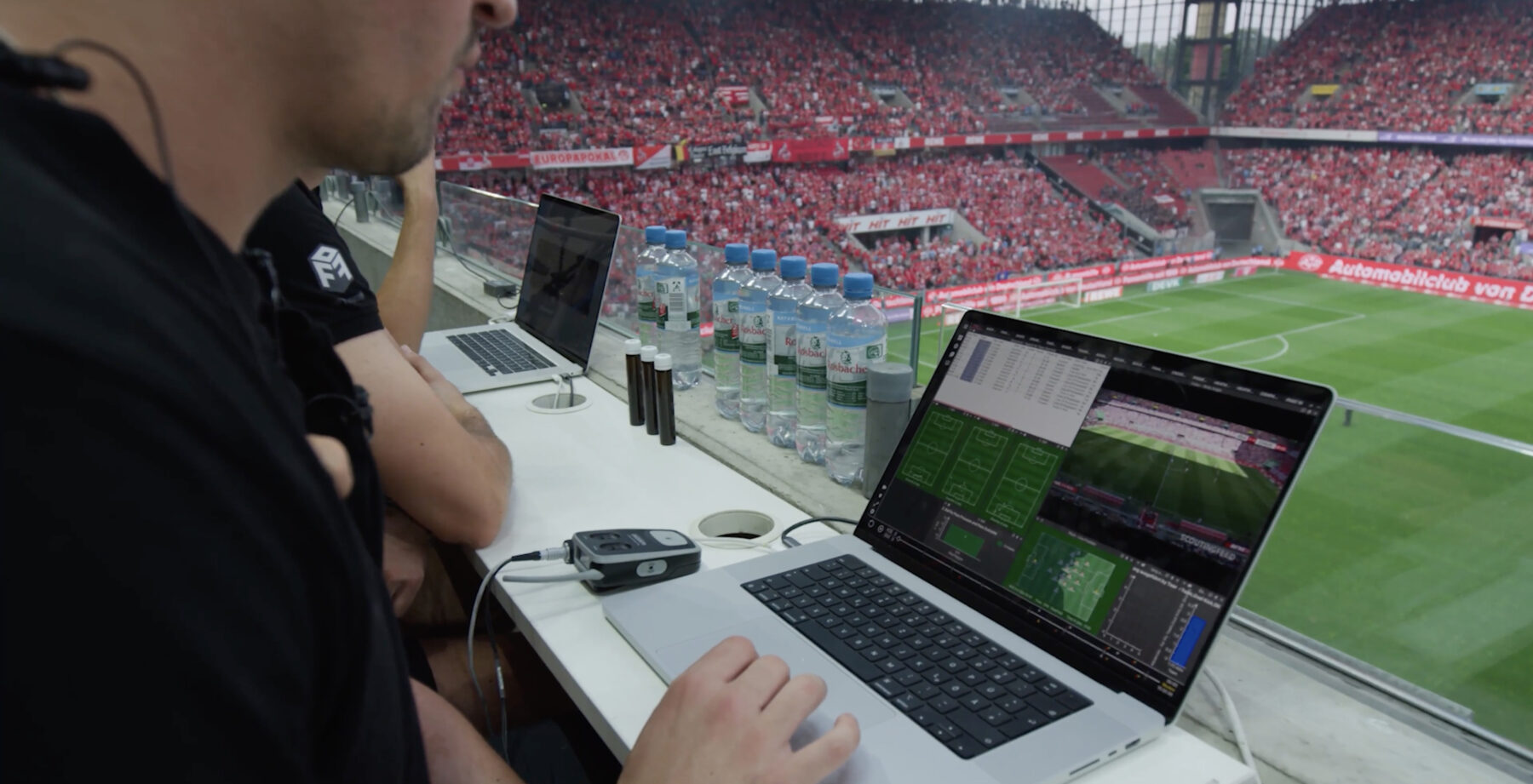
To make effective decisions under pressure, you need a mental framework. A powerful one used in many high-stakes fields is the OODA Loop: Observe, Orient, Decide, Act.
Identifying Tactical Patterns and Recognizing Key Moments in Soccer
The article 'Identifying Tactical Patterns and Recognizing Key Moments in Soccer' provides an excellent overview of the OODA loop and its application in football coaching.
Please read 'Section 3: Observation Frameworks for Coaches' and focus on the description of the OODA Loop. Think about how each step would apply specifically to a corner kick situation.
Let's break down the OODA loop for a set piece scenario:
- Observe: Your team wins a corner. You scouted the opponent and expected a zonal marking system. However, you see them setting up in a man-to-man system. You also notice their tallest defender is marking your second-best aerial threat, not your primary target.
- Orient: You place this observation in context. Your planned routine, designed to exploit gaps in a zonal system, is now less likely to work. However, the man-marking assignment has created a potential mismatch in your favour. This is a "key moment" – an opportunity to deviate from the plan.
- Decide: You decide to abandon the initial routine. The best adjustment is to switch to a play that isolates your primary aerial threat against their weaker defender. This could involve a simple, direct delivery to the back post, using other players' runs as decoys.
- Act: You (or the head coach) use a pre-arranged signal or verbal cue to the corner taker. The taker understands the change and signals it to the players in the box. The new play is executed.
This loop happens in seconds and repeats for every set piece. Mastering it is what separates good planners from great in-game tacticians.
2. The 'What': A Toolkit of In-Game Adjustments
Your ability to 'Decide' and 'Act' effectively depends on having a toolbox of adjustments ready. Let's explore some common tactical shifts you can make based on your observations.
Adjusting Attacking Corners
The opponent's defensive choice—zonal, man-marking, or hybrid—is the most common trigger for an adjustment.
WHAT ARE THE BEST WAYS TO COACH SET-PIECES??
In this video from Modern Soccer Coach, analyst Istvan Beregi explains a fundamental principle for adjusting against different defensive orientations.
Watch from 03:38 to 05:06. Pay close attention to the distinction he makes about when a short corner is most effective versus when a 'layoff to shoot' routine is more optimal. This is a perfect example of a simple, rule-based adjustment.
Based on this principle, here's a simple decision tree:
- If they defend zonally: Their shape is vulnerable to being pulled out of position. A short corner can force defenders to leave their zones, creating space to attack with a subsequent cross.
- If they defend man-to-man: Their defenders are focused on their assigned player, not the ball. A layoff for a shot from the edge of the box can be effective because you can use decoy runs to drag markers away, opening a shooting lane.
Let's go deeper into exploiting these systems using a brilliant tactical breakdown.
Tactical Theory: Set-Pieces - Spielverlagerung.com
The tactical theory article from Spielverlagerung.com is a masterclass in set piece detail. We'll use it to explore specific ways to manipulate both man-marking and zonal systems.
First, read the section titled 'Strategies against man-marking'. Focus on the concepts of 'Blocking/screening' and using 'Tricks to create space/separation' like body feints or crossing routes. \nNext, read the section 'Strategies against zonal-marking'. Focus on how 'Overload', 'Move to manipulate' (misdirection runs), and 'Short corners – to move the shape' can disrupt a zonal defence.
Your In-Game Adjustment Toolkit (Corners):
| If you Observe... | You can Adjust by... |
|---|---|
| Man-Marking: A key attacker is tightly marked. | Calling a 'block' or 'screen' where another attacker impedes the marker, freeing up your target. |
| Man-Marking: Defenders colliding or getting tangled. | Calling for 'crossing routes' where two attackers run in intersecting paths to create confusion and separation. |
| Zonal Defence: A specific zone is under-manned. | Signalling an 'overload' by having multiple attackers make runs into that single zone. |
| Zonal Defence: The first defender is aggressive. | Using a 'misdirection run' towards the near post to draw that defender out, opening space behind them for others to attack. |
| Hybrid Defence: They leave your least threatening player unmarked at the back post. | Changing the delivery to target that player, hoping to create a chance for a header back across goal for the 2nd ball. |
Adjusting Attacking Free Kicks (Indirect)
For indirect free kicks, the key observation is the behaviour of the opponent's defensive line.
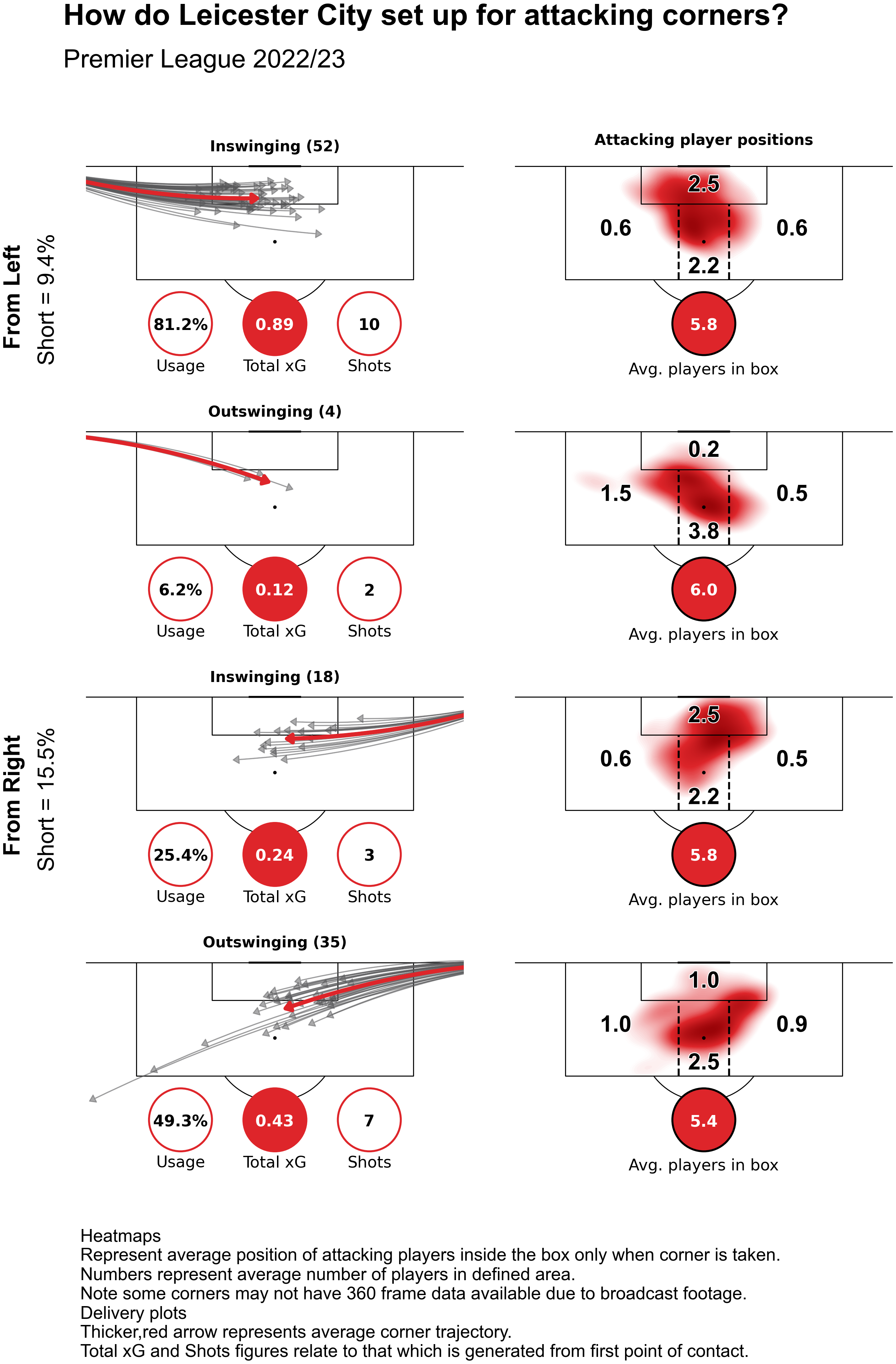
The Spielverlagerung article provides an exceptional guide for this.
Tactical Theory: Set-Pieces - Spielverlagerung.com
Let's return to the 'Tactical Theory: Set-Pieces' article to build our free kick adjustment toolkit.
Read the section 'Strategies against a zonal-oriented setup' under the 'Free-kicks' heading. Pay special attention to how the delivery (inswing vs. outswing) should be adjusted based on the 'height of the line' and the 'timing of their movement'.
Your In-Game Adjustment Toolkit (Free Kicks):
| If you Observe the Defensive Line is... | You can Adjust by... |
|---|---|
| Holding a high line (far from goal) | Using an outswinging cross, delivered with pace into the space behind them for attackers to run onto. |
| Dropping deep (close to goal) | Using an inswinging cross, aimed in front of the line, forcing defenders to deal with the ball while moving backward. |
| Moving out early (before the ball is kicked) | Using a fake run from one taker to trigger their movement, then having the second taker deliver the ball into the newly created space. |
| Moving out late (trying to play an offside trap) | Having attackers time their runs from deep to arrive with momentum as the ball is played, making the offside trap difficult. |
3. The 'How': Communicating Adjustments
Identifying the right adjustment is only half the battle. You must have a system to communicate it. This is a topic we will explore more in Module 8, but for now, understand that communication must be simple and pre-arranged.
Common methods include:
- Coded Signals: The corner taker raises one arm for Routine A, two arms for Routine B.
- Verbal Cues: A specific word shouted from the bench (e.g., "SCREEN!") tells the players to execute a pre-practiced block.
- "If-Then" Rules: Players are coached on automatic adjustments. "If they put two players out to defend a short corner, we don't play it short and deliver to the back post instead."
The goal is to make complex adjustments feel simple on the pitch. The Modern Soccer Coach video provides a great example of a pre-planned play that looks like an in-game adjustment, demonstrating how scouting can prepare you for these moments.
WHAT ARE THE BEST WAYS TO COACH SET-PIECES??
Let's watch one more clip, this time focusing on a routine born from scouting that contains an adjustable trigger.
Watch from 10:27 to 13:03. Notice how the coach talks about using a 'stutter' run from a second player at the corner. This was designed because they knew the opposition line was 'inconsistent' and 'individual based.' This is a pre-planned trigger designed to exploit a likely in-game behaviour. It's a proactive adjustment.
Conclusion
You have now completed the match week cycle, from initial scouting and game planning to player briefings and, finally, to making live, in-game adjustments. You understand that a set piece plan is not a static document but a dynamic strategy that must evolve with the flow of the game.
Key Takeaways:
- Adopt a problem-solver's mindset: Use a framework like the OODA loop (Observe, Orient, Decide, Act) to process information and make decisions quickly.
- Build your adjustment toolkit: Know how to counter different defensive setups (man vs. zone) and behaviours (line height, timing) for both corners and free kicks.
- Preparation enables improvisation: The best in-game adjustments are often pre-practiced variations that can be triggered by a simple cue or signal.
- Observation is everything: Your ability to make the right adjustment hinges on your ability to spot small but significant deviations from the opponent's expected patterns.
Preview of the Next Lesson:
This lesson concludes Module 7. You have developed a comprehensive understanding of the tactical cycle of a set piece coach. In our next module, "Professional Practice & Career Development," we will zoom out. Our first lesson will be "Describe the typical roles and communication hierarchy within a professional coaching staff." This will help you understand where your role fits within a club and how to communicate your brilliant tactical ideas effectively to the head coach, other analysts, and players.