Hello! Welcome to the first lesson of our final module, "Professional Practice & Career Development."
In our last lesson, you learned how to make crucial in-game tactical adjustments for set pieces—a skill that requires sharp observation and decisive action. But making the right call is only part of the job. To implement it effectively, you need to communicate it clearly to the right people at the right time. This raises a fundamental question: who are those people, and where do you fit into the bigger picture?
This lesson addresses the learning outcome: Describe the typical roles and communication hierarchy within a professional coaching staff. We'll step back from the tactical details on the pitch to understand the professional environment you aim to work in. By the end, you will have a clear map of a typical club's structure, the key roles you'll interact with, and the communication channels that make a coaching team function.
1. The Blueprint of a Club: Organizational Structures
Before we zoom in on the coaching staff, it's helpful to understand the overall structure of a professional football club. It's not just a team of players and coaches; it's a complex organization with many moving parts. The way these parts are arranged defines how the club operates, makes decisions, and communicates.
To get a foundational understanding of these structures, please read the following article.
Football Team Organizational Structure – How to Create One
The article 'Football Team Organizational Structure' from Organimi provides a clear overview of why structure matters and introduces the most common models used in football.
First, read the introduction and the section 'What Is a Football Team’s Organizational Structure?' to grasp the core concept. \nThen, move to the section 'Types of Football Team Organizational Structures'. Focus on understanding the differences between the Hierarchical, Functional, and Matrix structures. Think about how a set piece coach's interactions might differ in each model.
As you've read, the hierarchical model is a traditional top-down chain of command, while functional and matrix structures allow for more specialization and cross-departmental collaboration. In a matrix structure, for example, a set piece coach might report vertically to the Head Coach but also work horizontally with the Head of Performance Analysis and the Scouting department. Understanding your club's model is the first step to navigating it effectively.
2. The Top of the Pyramid: Leadership Roles
Regardless of the specific structure, a few key leadership roles sit at the top of the footballing side of the club. These are the individuals who set the strategy and whom the head coach and, by extension, the entire coaching staff report to.
The main roles to understand are:
- Club President / CEO: The top executive, responsible for the entire club's business and sporting direction, reporting to the owners.
- Sporting Director / Director of Football: Leads the football operations. This person oversees long-term strategy, player recruitment, and the hiring of the head coach. They are the crucial link between the boardroom and the training ground.
- Head Coach / Manager: The leader of the first team. They are responsible for training, tactics, team selection, and match-day decisions.
The distinction between a "Manager" and a "Head Coach" is important, as it defines the scope of their responsibilities and how the coaching staff is built around them. Let's explore this difference.
Coaches or managers: In football, what's the difference? | Football Now
This clip from euronews features a discussion that clearly defines the roles of a Head Coach versus a Manager in modern football.
First, watch from 00:36 to 01:20 to understand the core differences. \nThen, watch from 04:38 to 05:37 to see how modern clubs are moving towards a more collaborative model, with specialist departments for analysis, sports science, and recruitment working together.
To summarize:
- A Manager (in the traditional British sense, like Sir Alex Ferguson) has broad control over many aspects of the club, including transfers and contracts.
- A Head Coach is more narrowly focused on the first team—tactics, training sessions, and match performance. They typically work under a Sporting Director who handles recruitment.
As the video highlighted, the trend is towards specialization. Clubs now build large, collaborative support teams around a Head Coach. This is the environment where a specialist like a set piece coach thrives.
3. Inside the Bubble: The First-Team Coaching Staff
Now, let's zoom in on the group you'll work with day-to-day: the first-team coaching staff, led by the Head Coach. While the exact titles vary, a typical professional setup includes a range of specialists.
This video from Wolves provides a great real-world example of the roles you might find.
MEET THE COACHING STAFF 🤝 An introduction to the newest members of our team
In 'MEET THE COACHING STAFF', Wolves introduces the key members of their backroom team. This gives you a concrete look at the different titles and roles in a Premier League club.
Watch the video and note the different roles mentioned, such as Assistant Head Coach, Head of Coaching Strategy, Senior Professional Development Coach, Goalkeeping Coach, and First Team Analyst. Think about how a set piece coach would interact with each of them.
The roles introduced in the video form a typical coaching hierarchy. An organizational chart helps visualize these relationships clearly.
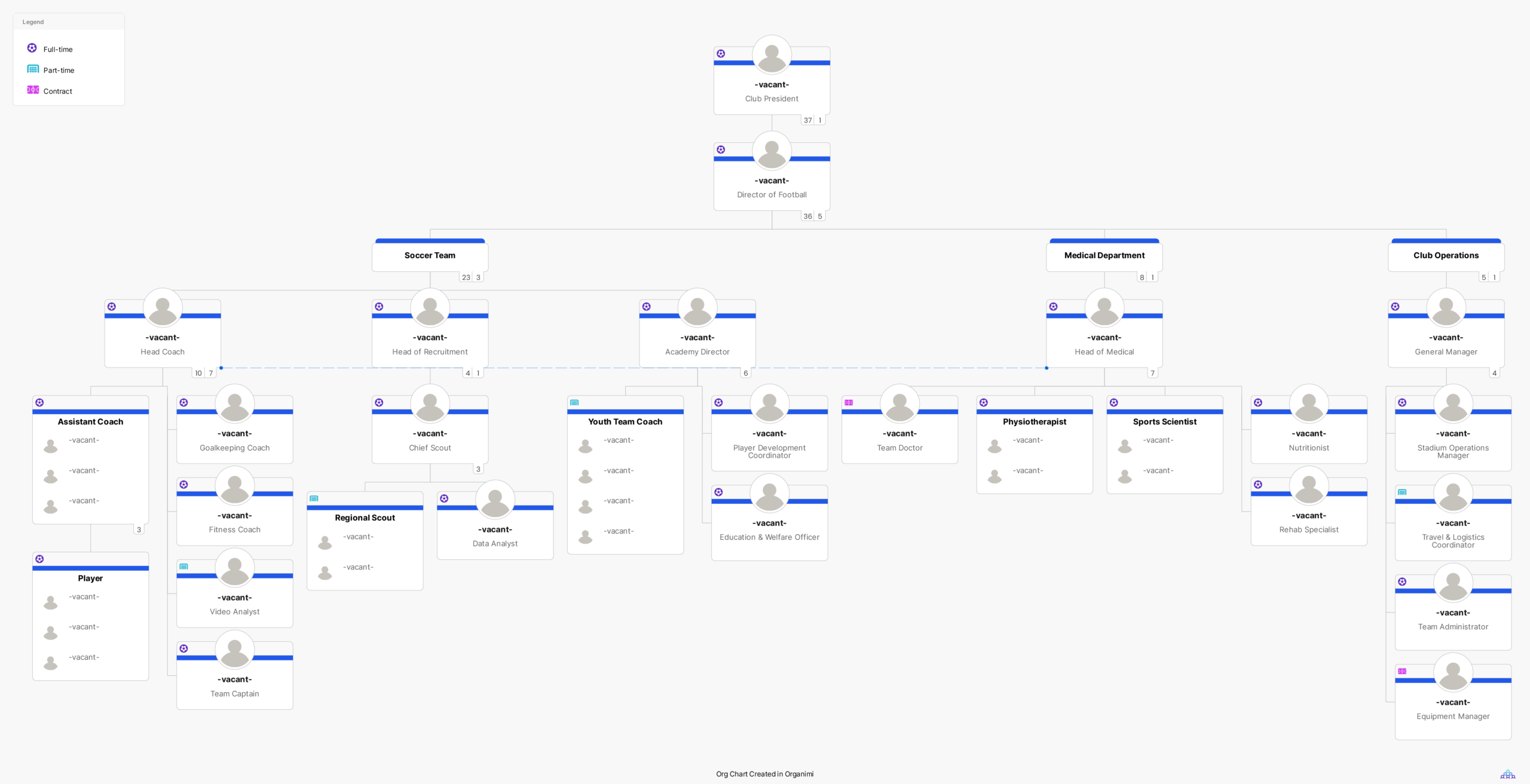
As you can see from the chart and video, the Head Coach is supported by:
- Assistant Head Coach(es): The head coach's right-hand person, often leading parts of training sessions and providing tactical input.
- First-Team Coaches: Generalist coaches who support training drills and player development.
- Specialist Coaches: Experts in a specific area, such as a Goalkeeping Coach or, increasingly, a Set Piece Coach.
- Analysts: Staff who work with video and data to support the coaches, including Performance Analysts and Recruitment Analysts.
Your role as a set piece coach would be as a specialist within this structure, reporting to the Head Coach and collaborating closely with the Assistant Coaches and Analysts.
4. Your Place in the Machine: The Set Piece Specialist
Given your goal, it's vital to understand exactly what the role of a set piece coach entails and how it differs from a set piece analyst. These are two distinct, though closely linked, positions that have emerged at the elite level.
The following article is essential reading, as it breaks down these two roles in detail.
Set Play Coaches vs Set Play Analysts: What's the Difference?
The article 'Set Play Coaches vs Set Play Analysts: What's the Difference?' from Creative Set Plays provides a fantastic, detailed comparison of these two emerging specialist roles, drawing on real-world job specifications.
Read the entire article, but pay special attention to the sections on 'Core Objectives', 'Skills & Tools', 'Integration & Collaboration', and 'Match-Day Roles'. The summary table at the end provides a brilliant side-by-side comparison.
The article makes the distinction crystal clear. Here is a summary of the key differences based on the table provided in the resource:
| Category | Set Piece Coach | Set Piece Analyst |
|---|---|---|
| Core Objective | Translates analysis into on-pitch coaching. Designs and implements routines. | Provides the analytical foundation. Interprets data and identifies trends. |
| Primary Skill | Strong coaching pedigree (e.g., UEFA A License), on-pitch delivery. | Proficiency in data analysis, video software, and visualization. |
| Key Task | Leading training drills, instructing players, making live adjustments. | Scouting opponents, producing video reports, post-match analysis. |
| Collaboration | Receives insights from the analyst to create drills and tactics. | Provides insights to the coach for practical implementation. |
The most common pathway, as mentioned in the article, is for an analyst to develop their skills and transition into a coaching role. Your journey through this course, learning both analysis (Modules 1-4) and coaching/drill design (Module 5), prepares you for this exact trajectory.
Your communication flow would look like this:
- The Set Piece Analyst provides you with a report on the upcoming opponent's set piece vulnerabilities.
- You, the Set Piece Coach, use this analysis to design 2-3 specific attacking routines.
- You present these routines to the Head Coach and Assistant Coach for approval.
- You lead the on-pitch practice of these routines with the players.
- During the match, you communicate potential adjustments (like we covered in the last lesson) directly to the Head Coach.
Conclusion
Understanding the structure of a professional club is not just an administrative exercise; it's fundamental to being an effective coach. Knowing who holds which responsibilities and how information flows allows you to communicate your ideas efficiently, collaborate with other specialists, and ultimately, have your work implemented successfully on the pitch.
Key Takeaways:
- Professional clubs have deliberate organizational structures (e.g., hierarchical, matrix) that define reporting lines.
- The key leadership figures are the CEO, the Sporting Director (who sets long-term football strategy), and the Head Coach/Manager (who leads the first team).
- The modern coaching staff is a team of specialists, including assistants, analysts, and specific roles like Goalkeeping and Set Piece Coaches.
- As an aspiring Set Piece Coach, your role is to translate analysis into effective on-pitch practice, working in a tight loop with the Set Piece Analyst, the Head Coach, and the players.
Preview of the Next Lesson:
Now that you understand your place within the staff, our next lesson will focus on a core responsibility of that role: "Conduct a post-match performance review of set pieces using video and statistical evidence." You'll learn how to dissect your team's performance after a game, using the tools and knowledge you've built to provide objective, data-driven feedback to the coaching staff and players.