Hello! Welcome back.
In our last lesson, we focused on constructing a defensive corner system, breaking down the specific roles and responsibilities within man-marking, zonal, and hybrid setups. You learned how to turn a tactical system into an actionable plan for your players.
Today, we're flipping the script. As an aspiring set-piece coach, a huge part of your job is opposition analysis. Your goal for this lesson is to analyse a team's corner routines and defensive setup from video footage to identify patterns. We will move from being the architect of our own system to being the detective who deconstructs the opponent's. This is a core skill for scouting and preparing a game plan.
A Framework for Analysis
When you first start analysing set pieces, the action can seem chaotic. Players are moving everywhere, and it's hard to know what to focus on. A professional analyst needs a systematic approach to cut through the noise and spot the underlying patterns.
We'll use a simple but effective framework to guide our observation. It breaks down any set piece into key components to look for.
The Analysis of an Opponent's Set Pieces in Football - Nacsport
The article 'The Analysis of an Opponent's Set Pieces in Football' by Sergio Almenara for Nacsport provides an excellent structure for analysis. We'll adopt its core ideas to build our framework.
Read the sections under the headings 'Generalities' and 'Defensive Set Pieces'. Focus on the main bullet points, which provide a checklist of what to observe: Target Zones: Where is the ball intended to go? Types of Play: Is it a direct delivery or a short routine? Types of Movement: What are the attackers doing to create space (blocks, screens, etc.)? Types of Marking: How is the defence organised (zonal, man, hybrid)? Player Distribution (Defence): How many players are in the box, on the edge, or left upfield?
Based on that reading, here is the analysis checklist we will use:
-
Defensive Structure:
- What marking system is used (Zonal, Man, Hybrid)?
- How many players are in zonal positions? Where?
- How many players are man-marking?
- Are players positioned on the posts?
- How many players are on the edge of the box for second balls?
- How many players are left upfield for a counter-attack?
-
Attacking Routine:
- Delivery Type: Inswing, outswing, short, or driven?
- Target Zone: Near post, central, back post, or edge of the box?
- Key Movements: Are they using specific techniques to create space?
- Blocks/Screens: Players impeding defenders to free up a teammate.
- Decoy Runs: Players running to one area to draw defenders away from the real target zone.
- Goalkeeper Manipulation: Players standing on/blocking the keeper.
- Overloads: Concentrating more attackers than defenders in a specific zone.
By looking for these specific elements in every corner, you can quickly identify a team's recurring strategies and habits.
Case Study 1: Analysing Attacking Patterns (Arsenal)
Let's apply this framework to a team renowned for its attacking corner routines: Arsenal. We'll watch a video that breaks down their approach and identify the patterns.
Arsenal's CORNER TACTICS Explained | Tactical Analysis
This video, 'Arsenal's CORNER TACTICS Explained' from The Tactics Guy, provides a fantastic analysis of the specific movements and strategies Arsenal use to create scoring chances.
Watch the video from the beginning to 02:21. As you watch, try to match Arsenal's tactics to our analysis checklist. Specifically, look for: Pinning the front zone defender (0:38): A type of block. The 'shield' tactic (0:54): A more complex block/screen to protect a zone. Pinning the goalkeeper (1:24): A clear example of goalkeeper manipulation. Varying delivery zones (1:43): Using decoy plays to set up the real attack.
This analysis of Arsenal demonstrates how an elite team doesn't just "put the ball in the box." They execute a series of pre-planned movements designed to disrupt a specific defensive setup. As an analyst, your job is to spot these coordinated movements. For example, identifying the "shield" tactic isn't just about seeing players stand still; it's about understanding their purpose—to pin defenders and create an overload elsewhere.
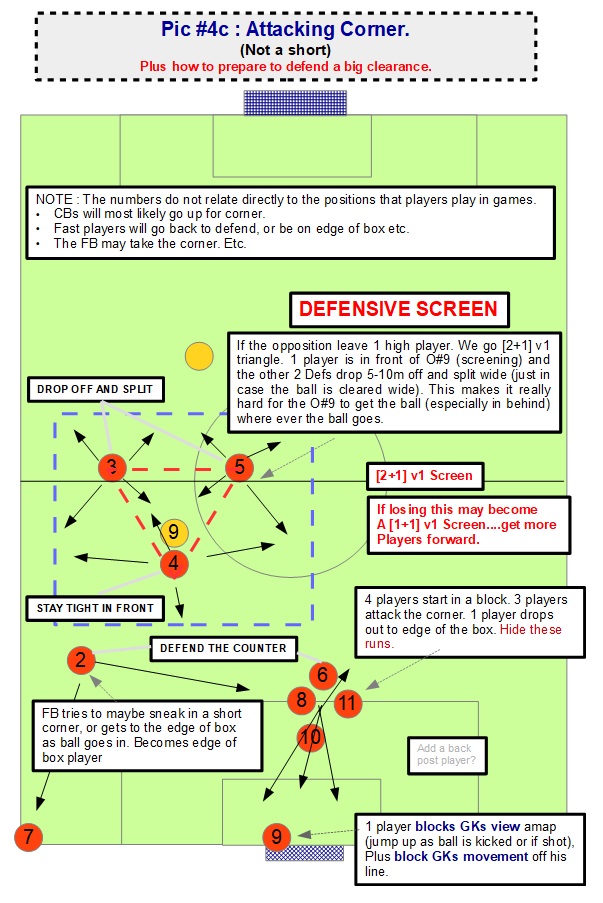
Case Study 2: Analysing Defensive Setups (Chelsea)
Now, let's use our framework to analyse a defensive setup and identify its potential weaknesses.
Analyzing Chelsea's Set-Piece Issues | Tactical Analysis by Nouman
This video, 'Analyzing Chelsea's Set-Piece Issues' by Nouman, examines a recurring defensive problem for Chelsea. It's a great example of how to spot a structural weakness.
Watch the segments from 03:26-04:46 and 08:01-08:15. Use our checklist to break down Chelsea's defensive system: Defensive Structure: How many zonal markers? How many man-markers? Where are they positioned? Identified Weakness: Which area of the box is consistently left free? Goalkeeper Behaviour: What does the analyst note about the goalkeeper's actions? Opponent Pattern: How do opponents adapt their attacking routines to exploit this weakness?
From this analysis, you can build a clear scouting report:
- Pattern: Chelsea defends with 3 zonal markers (near post, near 6-yard box, central) and 4-5 man-markers.
- Vulnerability: This structure consistently leaves space at the back post.
- Compounding Factor: The goalkeeper rarely comes off his line to claim crosses in that area.
- Exploitation: Opponents recognise this and intentionally overload the back post, creating high-quality chances.
This is the essence of opposition analysis: identifying the system, spotting the weakness, and noting how it's being exploited.
How to Practice Analysis: A Practical Guide
Knowing what to look for is the first step. The second is developing the skill to see it quickly and accurately, often under pressure during a live match.
How to analyze set piece details on "one look" - Opposition Scouting
The article 'How to analyze set piece details on 'one look'' from Opposition Scouting offers excellent, practical advice on how to train your analytical eye.
Read the sections from 'Set piece practice drill' to the end of 'Using pitch templates'. This is your guide to becoming a more efficient analyst. Focus on these key techniques: The Repetition Drill: The idea of watching a clip multiple times without writing, then trying to reduce the number of viewings. Efficient Note-Taking: Using numerical shorthand (e.g., '2-4-1') to quickly capture player distribution. The Post-Corner Checklist: Mentally reviewing key questions after the play to fill in any gaps in your notes (e.g., 'How did the keeper react?'). Pitch Templates: Using diagrams to visually represent setups.
Your Turn: Mini-Analysis
Let's put this into practice. Look at the four-panel image below, which shows an attacking corner routine.

Using the image, answer these questions in your head or in a notebook:
- Defensive Structure (Panel 1): Briefly describe the defensive setup. Does it look more zonal, man-marking, or hybrid? How many players are defending inside the six-yard box?
- Attacking Movement (Panels 2-4): Describe the attackers' movements. Where is the main group of attackers trying to go? Do you see any potential blocks or decoy runs?
- Target Zone: Based on the movements, what do you think the primary target zone is for the corner taker?
This quick exercise simulates the process you'd follow when breaking down footage. You start with the static setup, trace the dynamic movement, and infer the intention.
Conclusion
Today, you've learned the fundamental process of analysing corner kicks from video footage. This skill is the bedrock of creating effective, data-driven set-piece strategies for your team and countering your opponents.
Key Takeaways:
- Use a Framework: A systematic approach is crucial. Always check the defensive structure, delivery type, target zone, and key attacking movements.
- Identify Intent: Look beyond simple positions. Ask why a player is standing there. Are they blocking, pulling a defender away, or protecting a zone?
- Spot Weaknesses: Analyse defensive setups for unguarded spaces, unfavourable matchups, or passive goalkeeping that can be exploited.
- Practice Efficiently: Use drills, shorthand notes, and checklists to improve the speed and accuracy of your analysis.
Preview of the Next Lesson:
Identifying patterns is a qualitative skill. To make your analysis truly powerful for a professional coaching staff, you need to back it up with quantitative evidence. In our next lesson, you will learn to evaluate the effectiveness of a corner kick strategy using performance data, connecting your video observations to metrics like xG and goal contributions.