Welcome back. In our last lesson, we constructed a framework for designing effective drills to improve defensive organisation and reaction. We focused on the collective unit, progressing from unopposed walk-throughs to competitive, game-based scenarios.
Today, we shift our focus from the team to the individual specialist. The learning outcome is to design a drill for improving direct free kick shooting technique and accuracy. A potent free kick taker can single-handedly decide a match, and coaching this skill requires a specific approach that blends technical refinement with psychological pressure.
We will explore the fundamental mechanics of shooting, learn how to structure a drill that progresses from simple repetition to a competitive environment, and combine these elements into a complete session plan.
1. The Foundation: Technique and Accuracy
Before a player can score consistently under pressure, they must have a repeatable and reliable shooting technique. As a coach, your first job is to understand the key mechanical components of a clean strike. Power is often the most coveted attribute, but it's a byproduct of good technique and is useless without accuracy.
To build our understanding, let's look at an article that breaks down the essentials of shooting.
How To Improve Shooting In Football? (Power, Accuracy & Drills)
The article 'How To Improve Shooting In Football?' from Alicante Football Academy provides an excellent framework for developing shooting ability. It breaks down finishing into core skills and offers a clear progression plan.
Please read the following sections: Start with 'How To Improve Shooting In Football?'. Continue to 'How Can I Improve My Shooting In Football Through Proper Fundamentals?'. Then read 'How To Improve Shooting Accuracy In Football Consistently?'. Finally, read 'How Does Body Positioning Influence Shooting Accuracy?'. \nFocus on the checklist of fundamentals, the principle of 'accuracy over power,' and the simple drill for practicing accuracy.
The article gives us a clear coaching blueprint. Your role is not just to set up cones, but to observe, diagnose, and correct technical faults. Based on what you've just read, here is a practical checklist you can use on the training pitch:
Free Kick Technique Checklist:
- Approach: Is it controlled and at a slight angle to the ball?
- Plant Foot: Is it placed firmly beside the ball, with the toes pointing towards the target?
- Body Position: Is the player's chest and knee over the ball for a driven shot?
- Ankle: Is the ankle of the kicking foot locked and firm upon contact?
- Contact Point: Is the player striking through the horizontal midline of the ball?
- Follow-Through: Does the kicking leg swing through towards the target?
- Head: Does the player's head stay down and steady through the strike, rather than lifting early to see the result?
Mastering these fundamentals in an unopposed setting is the essential first step before adding the complexity of a wall or a goalkeeper.
2. Structuring a Progressive Free Kick Drill
A well-designed drill guides a player from focusing purely on technique towards executing that technique under match-like pressure. We can structure this progression in three phases.
Phase 1: Unopposed Technical Repetition
The goal of this phase is to build muscle memory for the correct technique. At this stage, there is no wall and often no goalkeeper. The focus is singular: striking the ball cleanly and hitting a target.
A simple way to implement this is through a circuit station, as described in the following resource.
The specialist - Advanced Football & Soccer Training Drills & Skills
The article 'The specialist' from Soccer Coach Weekly outlines a session for identifying and training set-piece takers. Its circuit-based approach is ideal for our first phase of drilling.
Read the section 'What you get your players to do'. Pay attention to 'Station 3', which is a simple, repetitive free kick practice.
In this phase, you can use the accuracy drill idea from the Alicante Academy article: mark out corners of the goal with cones or tape and have players aim for specific targets. This provides immediate, tangible feedback on their accuracy.
Phase 2: Introducing Obstacles and Objectives
Once the player can strike the ball consistently, it's time to add realistic obstacles. This means adding a defensive wall (mannequins are perfect for this) and a goalkeeper. The player must now not only execute the technique but also make a decision: how to get the ball over or around the wall and past the keeper.
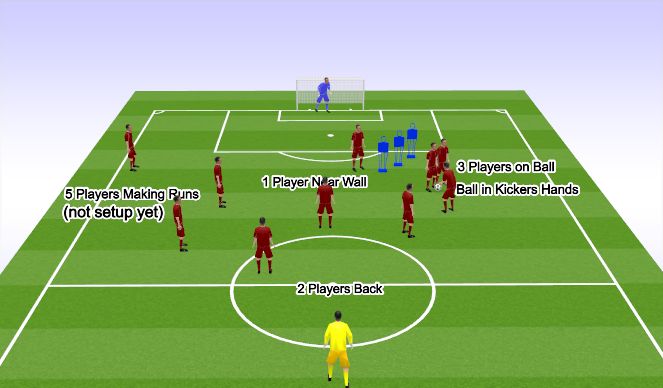
In this phase, you can introduce a scoring system to increase focus and create a sense of competition, even when practicing alone. For example:
- 3 points: Ball goes in a top corner.
- 2 points: Ball goes in a bottom corner.
- 1 point: Shot is on target but saved.
- 0 points: Shot is off target or hits the wall.
This simple gamification encourages players to value accuracy and thoughtful shot selection.
Phase 3: Competitive, Game-Like Scenarios
The final phase is to simulate the psychological pressure of a real match. Technique can falter when the outcome matters. Competitive drills force players to perform when it counts.
A fantastic way to achieve this is by turning the practice into a direct competition.

Another way to create high-repetition, game-like scenarios is to modify a small-sided game. The "kick-in" rule mentioned in "The specialist" resource (in the 'Game situation' section) is a creative method to generate frequent free kick opportunities from various angles and distances, forcing players to adapt quickly.
3. A Complete Drill Design
Now, let's combine these phases into a coherent 40-minute drill that you could run as a set-piece coach.
Drill: Direct Free Kick Mastery
- Objective: To improve the technique, accuracy, and consistency of direct free kick shooting under increasing pressure.
- Players: 2-6 designated free kick takers, 1-2 goalkeepers.
- Equipment: 1 full-size goal, 10+ balls, 5 mannequins, cones/markers.
Part A: Technical Grooving (10 minutes)
- Setup: No wall, no goalkeeper. Players take shots from various positions around the penalty arc. Place cones in the four corners of the goal as targets.
- Instructions: Players focus solely on the technical checklist. They should aim for specific corners of the goal on each shot.
- Coaching Points: Provide constant, individual feedback on technique. "Keep your chest over the ball." "Lock your ankle through contact." "Follow through towards your target."
Part B: Accuracy Under Pressure (15 minutes)
- Setup: Place the 5-mannequin wall 10 yards from the ball. A goalkeeper is now in the goal. Balls are placed at 3 different central/off-centre locations outside the box.
- Instructions: Players rotate through the 3 stations. They use the scoring system (3 points for top corner, etc.) to track their performance. The goal is to achieve the highest score after a set number of shots (e.g., 5 from each station).
- Coaching Points: "Read the goalkeeper's position." "Can you use the wall to hide the ball's flight path?" "Which technique is best for this distance: power, or curl?"
Part C: The Knockout Game (15 minutes)
- Setup: Same as Part B, but now it's a direct competition.
- Instructions: Use the format from the 'Direct Free Kick Game' image. All players take a free kick from the first station. Anyone who scores or hits the post/crossbar moves to the next round. Players who miss are eliminated (or perform a task like collecting the balls). The wall position or shooting spot is changed slightly each round. Continue until one winner remains.
- Coaching Points: Minimal technical coaching here. The focus is on performance. Observe who handles the pressure best. Who makes smart decisions? Who reverts to bad habits?
Conclusion
Today, we've broken down the art of coaching direct free kicks into a structured, progressive process. You've learned that elite shooting isn't just about power; it's built on a foundation of solid technique, honed through deliberate practice, and tested under pressure.
Key Takeaways:
- Technique First: Master the fundamental mechanics—from the approach to the follow-through—before adding complexity.
- Progressive Overload: A successful drill moves from unopposed repetition (building muscle memory) to practice with obstacles (adding decision-making) and finally to competitive scenarios (adding psychological pressure).
- Gamify Practice: Using scoring systems and competitive games increases engagement, replicates match intensity, and provides clear benchmarks for improvement.
- Observe and Diagnose: Your role as a coach is to be an expert observer, identifying technical flaws and providing concise, actionable feedback.
Preview of the Next Lesson:
So far in this module, we've learned how to design attacking drills, defensive drills, and now individual specialist drills. In our next lesson, we will learn how to adapt training exercises and player roles based on upcoming opposition analysis. This is where your skills as a coach and an analyst truly merge, as you'll learn to tailor these drills to exploit a specific opponent's weaknesses or nullify their strengths.