Hello! Welcome back to the course.
In our last lesson, we focused on the attacking side of set pieces, learning how to design and progress drills from unopposed patterns to fully opposed, game-like scenarios. You learned how to build a routine from a blueprint and test it under increasing pressure.
Today, we're flipping the perspective. This lesson is all about defence. Our goal is to address the learning outcome: Design drills to improve defensive organisation and reaction to attacking variations. A successful set-piece coach is just as adept at neutralising an opponent's threat as they are at creating their own. We will build on the principles from our last session, applying them to create a resilient, organised, and adaptable defensive unit.
1. Foundations of Defensive Drill Design
Just like with attacking routines, coaching defensive organisation requires a structured approach. It's not enough to simply tell players to "defend the goal." You need to provide them with a clear system and then drill them to execute it under pressure.
The core idea is to train both the organisation (where to be and when) and the reaction (what to do when the attack does something unexpected).
To start, let's read about the fundamental principles of training set-piece defence.
More goals, fewer goals conceded: Training set pieces correctly
This article, 'More goals, fewer goals conceded: Training set pieces correctly' from zone14, makes a crucial point about training set pieces holistically—practicing attack and defence together.
Please read the introduction, up to the 'Foundations for successful set-piece situations' heading. The key takeaway is that attackers learn from real resistance, and defenders improve under real pressure.
This idea of training both sides simultaneously is central to our work today. An effective defensive drill is one where the attack is actively trying to score, forcing your defenders to make realistic decisions.
2. Phase 1: Installing the Defensive System (Unopposed/Passive)
Before you can test your defence against variations, every player must know their basic role and position within your chosen system (zonal, man-to-man, or hybrid). This is done through unopposed or passive "walk-through" drills. The goal here is clarity and repetition, not competition.
The article "Corner Kick Defense" provides an excellent template for how to structure these initial drills.
Corner Kick Defense | Coaching American Soccer
We'll look at the 'Corner Kick Defense' article from Coaching American Soccer to see how to build a defensive drill from the ground up, starting with getting players to their assigned positions.
Please read the sections titled 'ZONE SET-UP and DRILL' and 'MAN SET-UP and DRILL'. Focus on the step-by-step process described in the drill section, particularly steps one and two, which are about introducing the concept and getting players to their spots on a whistle.
As the article outlines, the first step in coaching any defensive system is to drill the initial setup:
- Define the System and Assign Roles: Clearly explain the responsibilities for each player. In a zonal system, who owns which space? In a man-marking system, how do players decide who to mark? In a hybrid system, who is zonal and who is man-marking?
- Drill the "Get Set" Phase: From a normal run of play, blow your whistle and call out "Corner kick!" Players must sprint to their designated positions or find their marks. This should be repeated until the reaction is instant and correct. This phase is purely about organisation.
- Introduce the Ball (Passively): The coach or a player serves balls into the box. At this stage, there are no aggressive attacking runs. The goal is for defenders to practice their responsibilities:
- Zonal defenders: Attack the ball when it enters their zone.
- Man-markers: Stay goal-side of their opponent and practice winning the ball.
Only once this base is solid can you move on to testing the defence against realistic attacking movements.
3. Phase 2: Drilling Reactions to Attacking Variations (Opposed)
A well-coached attacking team will never be static. They will use blocks, screens, decoy runs, and short corners to disrupt your defensive shape. Your drills must therefore prepare your players to solve these problems.
The key is to create drills that are competitive, realistic, and force decision-making under pressure. Let's explore some formats for achieving this.
Ask Gary: How to make set piece practices engaging, competitive, and realistic
Coach Gary Curneen provides some fantastic ideas for making set-piece practice competitive and realistic in this video from Modern Soccer Coach. These game-based drills are perfect for training defensive reactions.
Watch the following three segments: The 'Training Game' with a clearance lane (00:41 - 01:28). Note how the defensive team has objectives (clear or find the forward). The 'Five Different Sets' game (01:28 - 02:12). This forces the defense to reorganise quickly under time pressure. The 'Playing Within the Game' concept (02:41 - 02:57). This is the most realistic way to test defensive reactions.
These game-based drills move beyond simple pattern repetition. They create a chaotic, pressurised environment where defenders must communicate and self-organise to deal with whatever the attacking team presents.
Designing Your Opposed Drill
Let's combine these ideas into a structured process for designing your own defensive drills.
1. Isolate a Specific Problem (Pattern Play Drill)
Sometimes, you need to repeatedly expose your defence to a specific attacking tactic they struggle with, such as defending against a block or screen. In this case, a more controlled, pattern-based drill is useful.
Look at this example of a drill designed to test man-marking and covering.
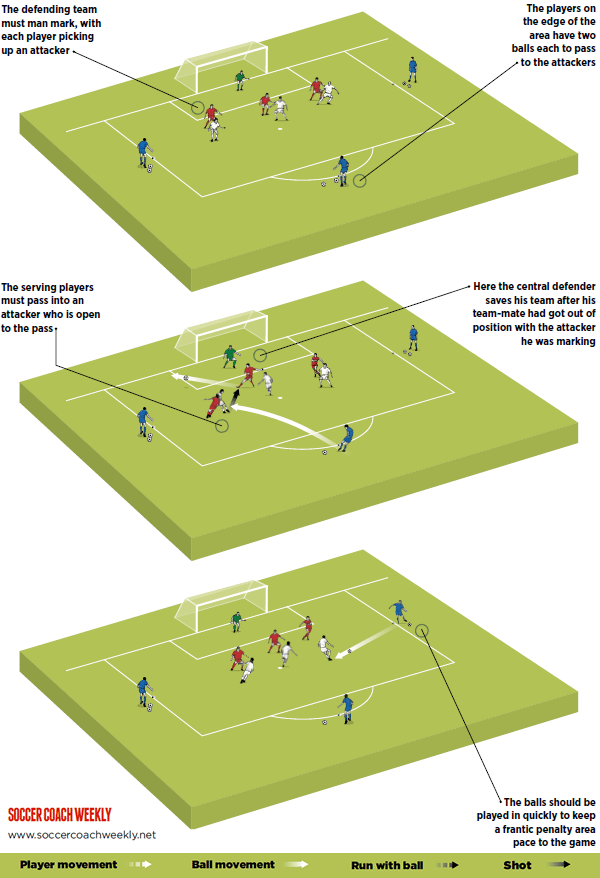
In a drill like this, you would instruct the attacking team to perform a specific action (e.g., "Player A2, try to block the defender marking A3"). This allows you to coach the specific defensive response you want to see.
2. Create a Problem-Solving Environment (Game-Based Drill)
For testing overall organisation and reaction speed, game-based drills are superior. They give the attacking team the freedom to try different routines, forcing the defence to adapt on the fly.
This drill is a great example.
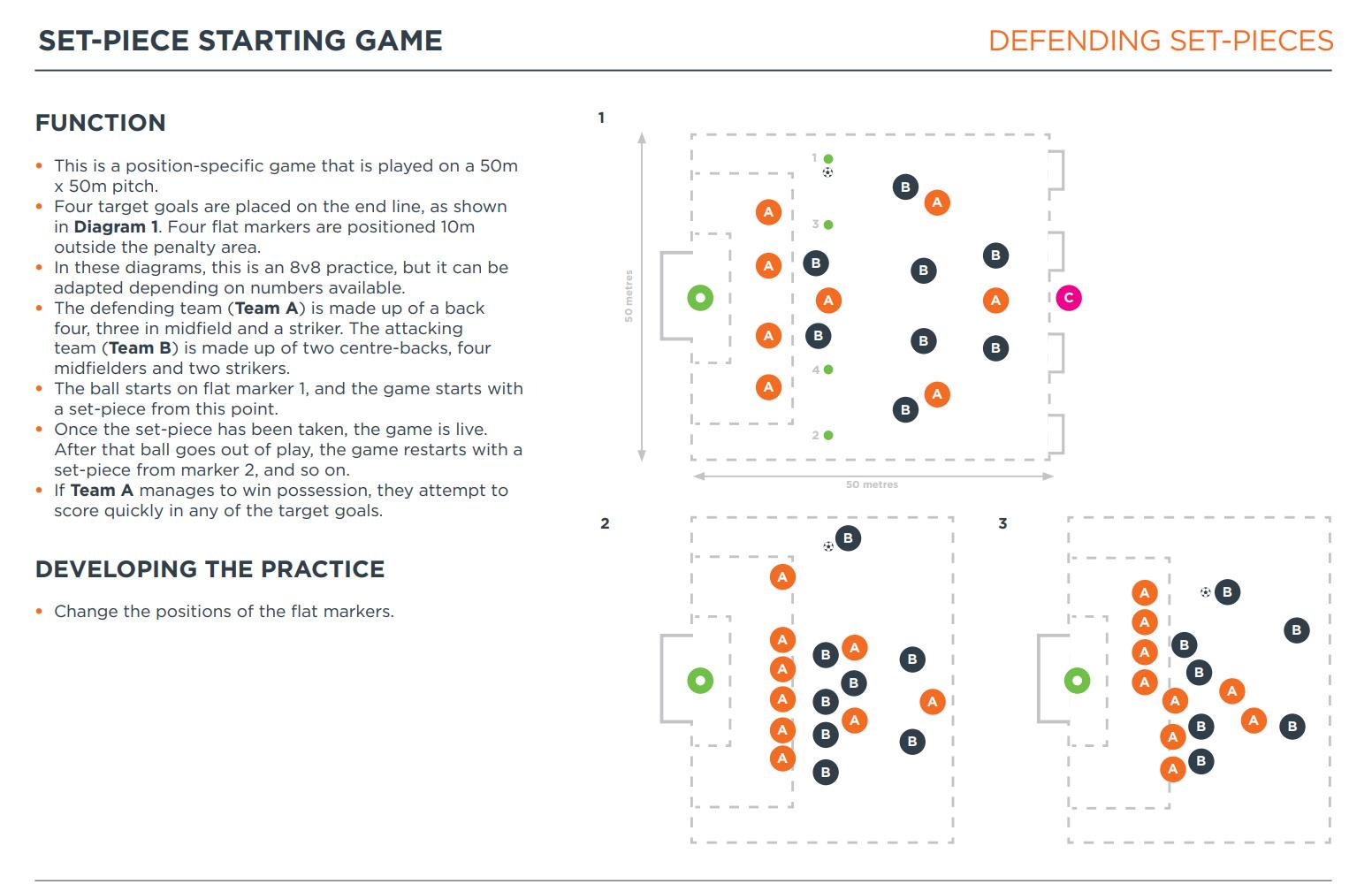
When designing your drill, consider these elements:
- Starting Point: How does the drill begin? Is it a corner? A wide free kick? Does the coach restart play randomly, as Gary Curneen suggested?
- Objectives for Both Teams: The attacking team wants to score. What does the defending team need to do to "win"?
- Clear the ball past a certain line? (As in Curneen's first game).
- Maintain a clean sheet for a certain number of set pieces?
- Win possession and score in a counter-attacking goal? (As in the 'Set-Piece Starting Game').
- Conditions and Constraints: You can manipulate the drill to focus on certain outcomes. For example:
- Overload: Give the attacking team a numerical advantage (e.g., 7v5) to put extra stress on the defensive organisation.
- Time Limit: Give the attacking team 2 minutes to score from 5 corners, forcing the defence to reset quickly.
By combining walk-throughs to install the system with competitive, game-based drills to test reactions, you build a defence that is both organised and adaptable.
Conclusion
Today we've focused on constructing the other half of your set-piece coaching expertise: defensive organisation. By understanding how to design drills that test your team's structure and ability to adapt, you can prepare them for the variety of challenges they'll face in a match.
Key Takeaways:
- Follow the Progression: Start with unopposed "walk-throughs" to teach players their roles and positions within your defensive system.
- Train Both Sides: The most effective defensive drills involve an active attacking team trying to score, creating realistic problems for the defence to solve.
- Design for Reaction: Your drills should go beyond static defending. Use game-based scenarios, random restarts, and varied attacking routines to train your players' adaptability and communication.
- Make it Competitive: Adding objectives, scoring systems, and transition elements for the defensive team increases engagement and replicates match intensity.
Preview of the Next Lesson:
Having covered the design of both attacking and defensive team drills, our next lesson will shift focus to individual technique. We will learn how to design a drill for improving direct free kick shooting technique and accuracy, an essential skill for any team's set-piece arsenal.