Welcome back. In our previous lessons in this module, we've focused on the "how" of coaching set pieces—designing attacking routines, organising a defence, and honing an individual's free kick technique. We now have a toolkit of training exercises.
Today's lesson connects your analytical mind to your coaching practice. We will address the learning outcome: Adapt training exercises and player roles based on upcoming opposition analysis. This is where you transition from a general plan to a specific, opponent-focused strategy. You will learn to identify an opponent's habits and vulnerabilities and then tailor your drills and player instructions to exploit them on match day.
This skill is at the heart of a modern set-piece coach's role, blending opposition scouting with practical on-pitch preparation.
1. The Foundation: Building an Analytical Framework
Before you can adapt, you must first understand. Effective opposition analysis isn't about watching a match and looking for "something"; it's a systematic process of identifying patterns, structures, and personnel tendencies.
A great starting point is to have a checklist of what to look for when scouting an opponent's set pieces. This article provides an excellent, structured approach.
The Analysis of an Opponent's Set Pieces in Football - Nacsport
The article 'The Analysis of an Opponent's Set Pieces in Football' from Nacsport provides a professional framework for scouting. It breaks down what to look for when analysing both attacking and defensive set pieces.
Please read the sections titled 'Generalities', 'Structure and Intention' (for Offensive Set Pieces), and 'Defensive Set Pieces'. \nAs you read, focus on creating a mental checklist of the key defensive characteristics you would scout: What type of marking system are they using (zonal, man-to-man, mixed)? How many players do they commit to different zones (the 6-yard box, the penalty spot, the edge of the box)? Are there any obvious patterns in their movements or structure?
This framework gives you a clear lens through which to view your opposition. The goal is to move from general observations to specific, exploitable insights. For example, instead of just noting "they defend zonally," you should aim to identify that "they defend with a 4-player zonal line, but their near-post player is often drawn towards the ball, opening a gap between the first and second defender."
At the elite level, some teams build their entire set-piece identity around this principle of adaptation. Brentford FC, under their set-piece coach Bernardo Cueva, are a prime example.
Why Brentford are the best set-piece takers in football
This Tifo Football video, 'Why Brentford are the best set-piece takers in football', explains how a team's entire set-piece plan for a match can be built around exploiting the specific weaknesses of their opponent.
Watch the segment from 02:48 to 03:28. Pay close attention to how the narrator describes Brentford's approach as a series of routines designed to target a pre-identified opposition weakness.
As the video highlights, set pieces are not isolated events. They are a series of opportunities to test and exploit a weakness you've found through your analysis.
2. The Tactical Toolbox: How to Exploit a Weakness
Once you've identified a vulnerability, you need the right tool to exploit it. Your tactical adaptations will differ significantly depending on the opponent's primary defensive system: man-marking or zonal marking.
Case Study: Swansea City's Adaptations
Let's watch a fantastic practical example from Swansea City's set-piece coach, Andy Parlo. He breaks down two specific routines that were designed to exploit the weaknesses of two different opponents.
WHAT ARE THE BEST WAYS TO COACH SET-PIECES??
In this clip from Modern Soccer Coach, Andy Parlo demonstrates exactly how opposition analysis translates into a game-winning set-piece design.
Watch the section on 'Preparation' from 09:10 to 13:06. Notice how he explains the logic behind each routine. Against Oxford: What weakness did they identify and how did they design a routine to exploit it? Against Swindon: What was the opponent's behavioural tendency and how did a simple 'stutter' step take advantage of it?
Let's break down these two examples, as they perfectly illustrate our learning outcome:
-
Exploiting Personnel (vs. Oxford):
- Analysis: Oxford had their key aerial players in the middle, but a winger—who was not strong in the air—defending the back-post area.
- Adaptation (Routine & Roles): Swansea designed a routine to create a 2v1 against this weaker player.
- Player Role (Blocker): One player (
Dapo) was tasked with blocking the winger's nearest supporting defender. - Player Role (Attackers): Two of Swansea's best headers (
WillandBen) were tasked with attacking the space created at the back post.
- Player Role (Blocker): One player (
- Result: The block created the 2v1, leading to a clear heading opportunity and a goal.
-
Exploiting Behaviour (vs. Swindon):
- Analysis: Swindon's defensive line was inconsistent. The players dropped individually rather than as a coordinated unit.
- Adaptation (Taker's Action): They used a "stutter" run-up, where one player fakes taking the kick.
- Player Role (Taker): The takers' coordinated action was designed to trigger the premature, individual dropping movements of the defenders.
- Result: The uncoordinated drop created massive separation, leaving an attacker completely free at the back post.
These examples show that adaptation isn't always about complex choreography. It can be as simple as changing one player's target area or adding a small movement at the start of the delivery.
Building Your Repertoire
To build your own tactical toolbox, it's essential to understand the common methods for defeating different marking systems. This next resource is a masterclass in set-piece theory and provides a deep dive into specific strategies.
Tactical Theory: Set-Pieces - Spielverlagerung.com
The article 'Tactical Theory: Set-Pieces' from Spielverlagerung.com is an advanced and comprehensive guide. We will focus on the sections that provide a menu of options for attacking both man-marking and zonal systems.
This is a detailed text. For now, skim through the sections 'Strategies against man-marking' and 'Strategies against zonal-marking'. You don't need to memorise everything. \nInstead, focus on understanding the types of solutions available: Against Man-Marking: Notice how the tactics are about creating separation for an individual (e.g., Blocks, Screens, Dismarking, Body Feints, Crossing Routes). Against Zonal-Marking: See how the tactics are about manipulating the defensive shape (e.g., Overloads, Misdirection runs to pull a defender out, Blocking a specific zonal player).
Think of these tactics as recipes. Your opposition analysis tells you what "ingredients" (vulnerabilities) you have to work with, and this toolbox gives you the recipe to cook up the perfect routine.
3. From Plan to Pitch: Adapting Your Training
You've done the analysis and designed the perfect routine on your tactics board. How do you transfer it to the players in a training session?
You don't need to reinvent your entire training methodology. Instead, you adapt the content of the drill structures we've already discussed (unopposed, opposed, game-based).
Let's use the Swansea vs. Oxford example: Exploiting a weak back-post defender.
Step 1: The Briefing
Start by showing the players the "why." Use video clips from your analysis to show the Oxford players in their defensive shape. Use telestration to highlight the target player and the space you intend to attack. This builds understanding and buy-in.
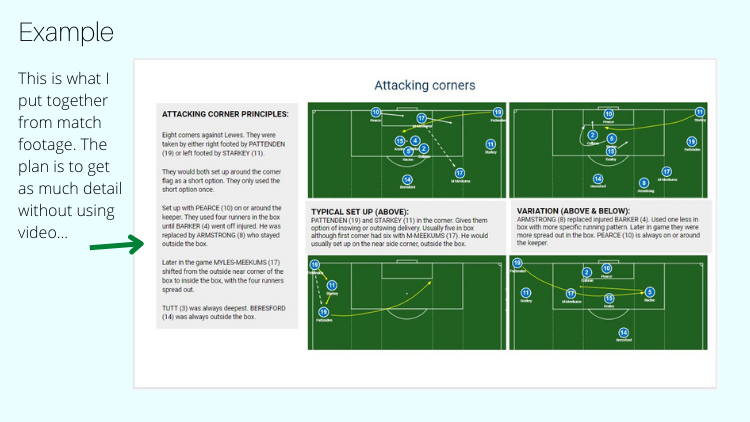
Step 2: Unopposed Walkthrough
- Setup: Position your players on the pitch as they would be for the corner. No defenders needed yet.
- Adaptation: This is purely about role-specific coaching.
- Coach the blocker on their starting position, timing, and angle of the block.
- Coach the two attackers on the specific timing and curve of their runs to the back post.
- Coach the taker on the precise weight and trajectory of the delivery required to hit the target area.
- Run through it at walking pace until everyone understands their adapted role.
Step 3: Opposed (Passive/Pattern) Drill
- Setup: Use mannequins or passive opposition players and position them in the exact defensive structure used by Oxford.
- Adaptation: The drill's focus is now testing the routine against the specific shape you expect to face. You are not just practicing a generic corner; you are rehearsing a solution to a specific problem. Run the routine at 75% speed. Does the timing work? Does the block create the required space?
Step 4: Opposed (Live) Drill
- Setup: Use your own players (a "scout team") to act as the opposition.
- Adaptation: Instruct the scout team to defend exactly as Oxford does. Tell their "winger" to defend the back post. Now, you run the routine in a live, competitive scenario. This is the final test before match day. Does the routine still work when the opposition can react dynamically?
By progressing your training session in this way, you take the team from understanding the idea to flawlessly executing the adapted plan under pressure.
Conclusion
Adapting your training based on opposition analysis is the hallmark of a high-level set-piece coach. It transforms set pieces from a game of chance into a calculated tactical battle.
Key Takeaways:
- Analyze with Purpose: Use a systematic framework to scout your opponent's defensive structure, personnel, and habits to find specific, exploitable weaknesses.
- Choose the Right Tool: Your tactical solution must match the problem. Use separation tactics (blocks, screens) against man-marking and shape-manipulation tactics (overloads, misdirections) against zonal-marking.
- Adapt Player Roles: A new routine requires clear, adapted roles. Players must understand not just what to do, but why they are doing it in the context of the opponent's weakness.
- Train the Specific Scenario: Modify your existing drill structures (unopposed, opposed) to rehearse the adapted routine against a replication of the opponent's defensive setup.
Preview of the Next Lesson:
We have now covered how to design and adapt drills for every phase of set pieces. But how do these specific, detailed practices fit into the limited time of a team's overall training week? In our next and final lesson of this module, we will learn how to integrate set piece practice into a larger team training session.