Hello! Welcome back to our course on AI Agent Development Kits.
In our last lesson, we established a clear definition of an AI agent, distinguishing it from both traditional software and simple LLM applications. We learned that an agent is an autonomous system that uses an LLM as a reasoning engine to achieve a goal, leveraging tools and memory.
Today, we will dissect that definition further by focusing on the three essential characteristics that make a system truly agentic: autonomy, goal-directedness, and adaptability. Understanding these pillars is crucial for recognizing when an agent is the right tool for a job and for designing systems that are robust and effective.
The Three Pillars of Agentic Behavior
While the terms are sometimes used interchangeably, autonomy, goal-directedness, and adaptability represent distinct, though related, capabilities. A system that possesses all three is what we consider a modern AI agent.
To start, let's get a clear definition for each of these core characteristics.
What Is Agentic AI? Autonomous AI Agents Explained
This article from Aerospike, 'What Is Agentic AI? Autonomous AI Agents Explained', provides an excellent, concise explanation of the three most important traits that define an agentic system.
Please read the section titled 'Characteristics of agentic AI'. It is divided into three subsections: 'Autonomy', 'Adaptability', and 'Goal orientation'. As you read, consider how these concepts move beyond the simple request-response pattern of an API call.
Now that you have a high-level overview, let's explore each characteristic in more detail from a developer's perspective.
1. Autonomy: The Spectrum of Independence
As a software engineer, you write code that executes specific, predefined instructions. Autonomy is about moving away from this explicit instruction model. However, it's not an all-or-nothing concept; it exists on a spectrum.
AI Agents in 38 Minutes - Complete Course from Beginner to Pro
An agent's level of autonomy can range from being tightly controlled by a script to having the freedom to make its own decisions about its workflow. The video 'AI Agents in 38 Minutes' by Marina Wyss explains this spectrum clearly.
Please watch the segment from 05:50 to 06:30. Notice the contrast between a 'scripted agent,' where you hardcode every step, and a 'highly autonomous agent,' where the LLM decides what to do next. Most production agents sit somewhere in the middle.
- Scripted (Low Autonomy): The workflow is fixed. For example: "1. Search for a keyword. 2. Summarize the top result. 3. Translate the summary." This is closer to a traditional script that happens to use an LLM for certain steps.
- Semi-Autonomous (Medium Autonomy): The agent has a defined set of tools and guardrails but can decide which tools to use and in what order to achieve its goal. This is the most common pattern for production-ready agents today, as it balances flexibility with predictability and safety.
- Highly Autonomous (High Autonomy): The agent has maximum freedom. It might decide to search the web, write and execute new code, or interact with various APIs without a predefined sequence. While powerful, this is harder to control and debug.
Your role as an agent developer often involves defining the "sandbox" for a semi-autonomous agent: providing the right tools and setting the right constraints.
2. Goal-Directedness: From Instructions to Intent
This characteristic is about the fundamental shift we discussed in the last lesson: you give an agent a goal, not an instruction. Goal-directedness is the agent's ability to understand that high-level intent and formulate a plan to achieve it.
This planning capability is what truly separates an agent from a simple tool. An agent doesn't just execute a function; it reasons about why it should execute that function as part of a larger strategy.
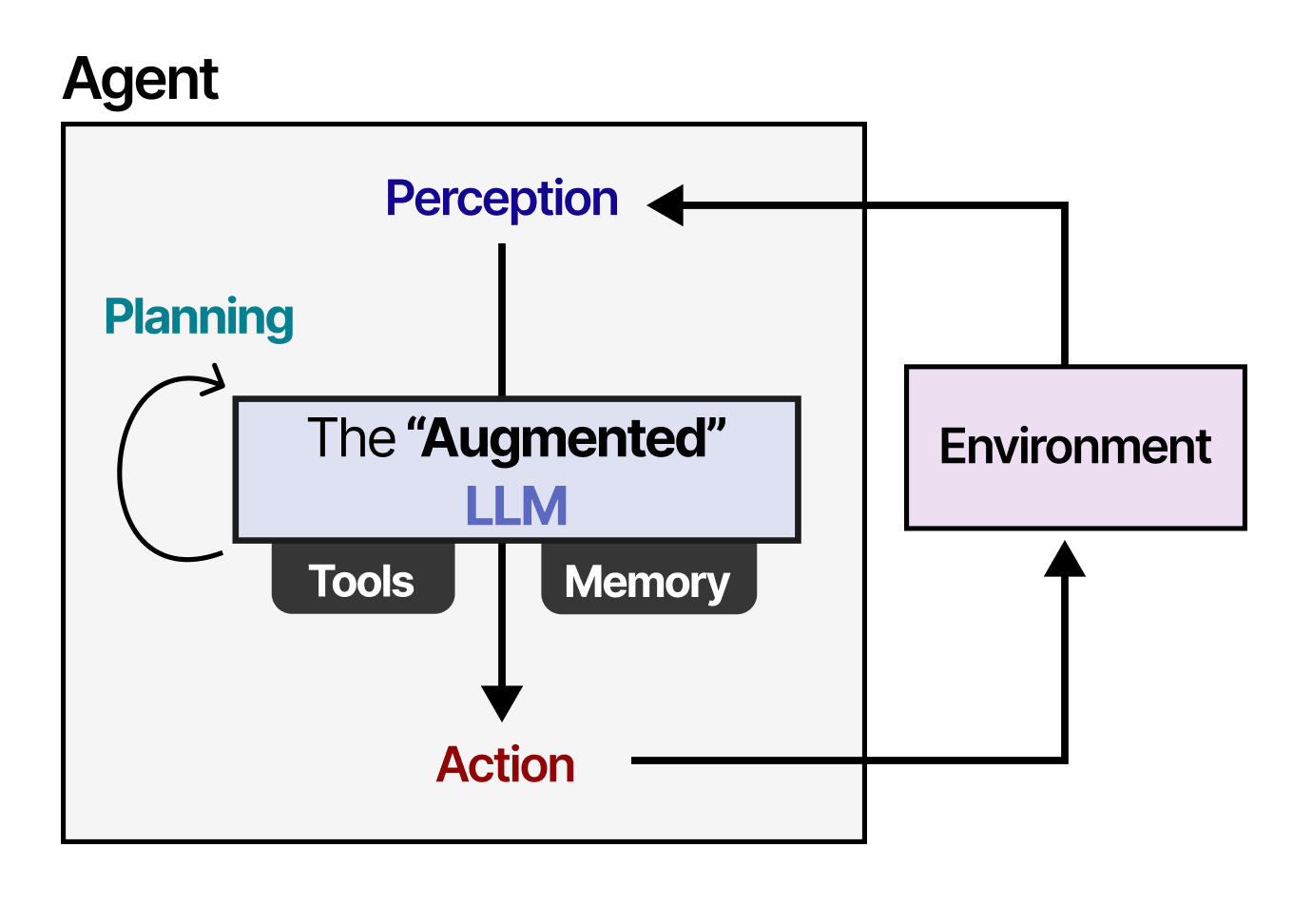
To see how this fits into a more formal framework, let's look at how industry analysts break down agent capabilities.
Implementing Agentic Architectural Patterns with Google ADK
This article, 'Implementing Agentic Architectural Patterns with Google ADK', summarizes research from Gartner that lists several characteristics defining agent capability. We'll focus on just this list for now.
Read only the short section titled 'Characteristics of AI Agency'. Note how it separates capabilities like 'Goal Seeking' and 'Planning', which are the core components of what we call goal-directedness.
As the article highlights, goal-directedness involves the agent actively pursuing objectives (Goal Seeking), breaking down tasks (Planning), and gathering information (Acting (Sensing)) to move toward its goal.
3. Adaptability: Responding to a Dynamic World
Traditional software is often brittle. If an API fails or returns an unexpected format, the program crashes or throws an exception. An adaptable agent, however, can adjust its strategy in response to its environment.
Adaptability is the agent's ability to:
- Handle unexpected errors or obstacles.
- Incorporate new information.
- Learn from feedback to improve its performance.
This is powered by the agent's core operational loop: perceive -> reason -> act -> learn. The agent acts, observes the result, and if the result is not what it expected (e.g., an error), it feeds that observation back into its reasoning engine to generate a new plan.
Test your understanding!
You are building a travel booking agent. The user gives it the goal: "Book me the cheapest flight from NYC to LAX next Tuesday."
The agent's initial plan is:
- Search Kayak for flights.
- Find the cheapest option.
- Book it.
During execution, the Kayak API returns an error. How would an adaptable agent respond, versus a non-adaptable one?
Show answer
A non-adaptable system (like a simple script) would likely fail and stop, returning an error to the user.
An adaptable agent would recognize the failure and adjust its plan. It might:
- Retry the action: Attempt to call the Kayak API again, perhaps with an exponential backoff strategy.
- Use a different tool: Switch to searching on Google Flights or another airline aggregator it has access to.
- Modify the sub-goal: If all flight searches fail, it might inform the user about the API issue and ask if it should try again later or search for a different day.
This ability to dynamically replan in response to unexpected environmental feedback is the essence of adaptability.
Bringing It All Together: The Spectrum of Agency
These three characteristics are not independent; they build on one another to create increasingly sophisticated systems.
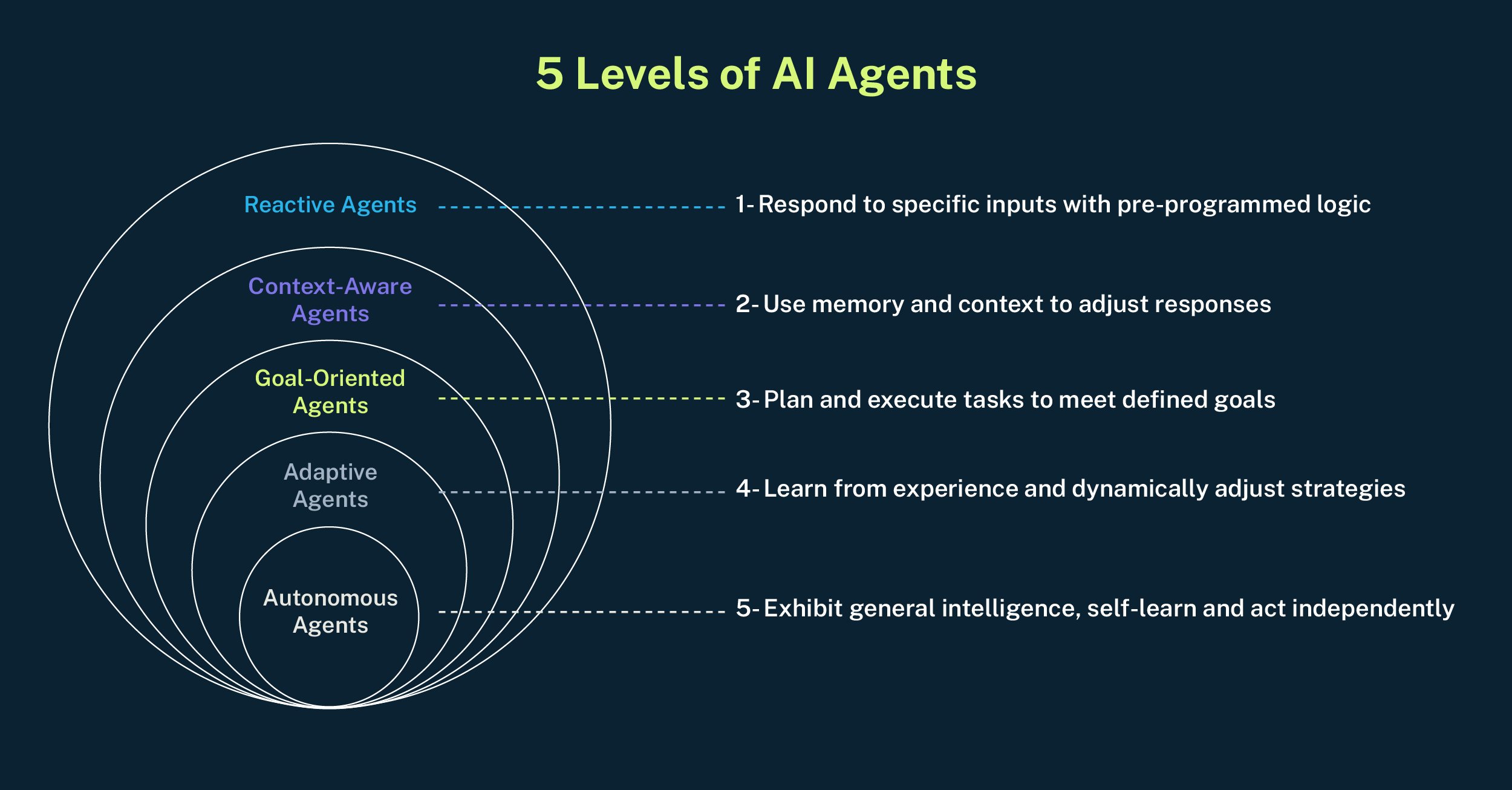
We can map the levels in this diagram to the concepts we've discussed:
- Reactive Agents have minimal autonomy; they are purely reactive.
- Context-Aware Agents add memory but may still follow fixed logic.
- Goal-Oriented Agents are where we see true goal-directedness. The agent can now create a plan to achieve an objective.
- Adaptive Agents introduce adaptability, allowing the agent to learn and modify its behavior based on experience.
- Autonomous Agents represent a high degree of all three characteristics, combining independent action, complex planning, and continuous learning.
Conclusion
In this lesson, we moved from a general definition of an agent to a more precise understanding of its core behavioral characteristics.
Key Takeaways:
- Autonomy is the agent's independence, which exists on a spectrum from fully scripted to highly autonomous. Most production agents are semi-autonomous.
- Goal-Directedness is the ability to take a high-level goal, create a multi-step plan, and execute it, distinguishing agents from simple instruction-following tools.
- Adaptability is the capacity to handle errors, respond to new information, and learn from outcomes, making agents robust in dynamic environments.
These three characteristics are what make agentic AI a powerful new paradigm in software development. They enable us to build systems that can tackle complex, real-world problems that are intractable for traditional, rigidly-coded software.
In our next lesson, we will see these characteristics in action by exploring real-world use cases. We'll look at specific examples where agents provide significant value precisely because of their autonomy, goal-directedness, and adaptability.