Hello! Welcome to your first lesson in our course on AI Agent Development Kits.
As a software engineer who's already comfortable using LLM APIs, you have a solid foundation. This course will build on that by taking you from being a user of LLMs to a builder of agentic systems that orchestrate them.
Today, we'll start with the most fundamental question: What exactly is an AI agent? Our goal is to define what makes a system an "agent" and clearly distinguish it from the two types of systems you're already familiar with: traditional software and simple LLM-powered applications. Mastering this distinction is the first and most crucial step toward understanding why agent development kits exist and how to use them effectively.
From LLM Applications to Agentic Systems
You're already experienced in calling an LLM through an API. This is the foundation for many modern AI applications. Typically, this involves a simple, stateless interaction:
- A user provides a prompt.
- Your application sends this prompt to an LLM.
- The LLM generates a text response based on its training data.
- Your application displays the response.
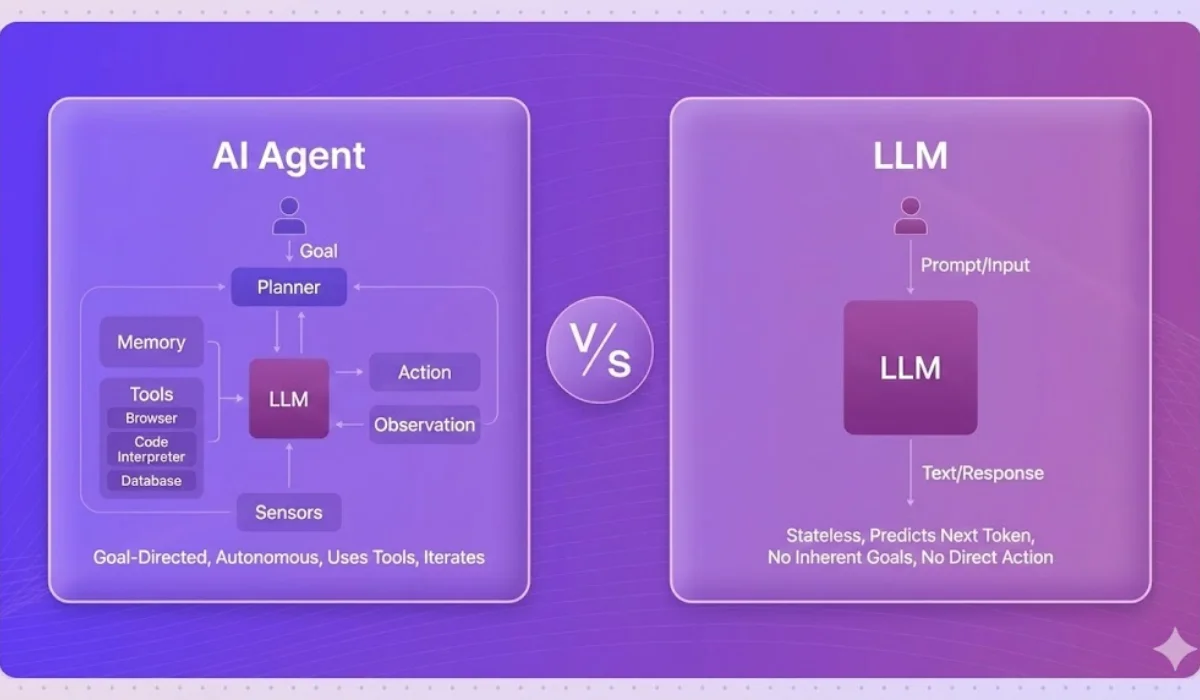
This model is powerful but has clear limitations. The LLM is passive, has no access to real-time or private data, and can't perform actions in the real world. AI agents are designed to overcome these limitations.
To see this evolution in action, let's watch a video that breaks down the progression from basic LLMs to AI agents.
The video 'AI Agents, Clearly Explained' from Jeff Su provides an excellent, step-by-step explanation of this shift. It introduces the idea of an 'AI workflow' as an intermediate step before defining what makes a system a true agent.
Please watch from the beginning of 'Level 1: Large Language Models' up to the end of the main explanation of 'Level 3: AI Agents' (timestamp 00:58 to 07:58). Pay close attention to the distinction between an 'AI workflow,' where a human sets a predefined path, and an 'AI agent,' where the LLM itself becomes the decision-maker.
The most critical takeaway from that video is the conceptual leap from a system that follows human-programmed logic to one that creates its own logic to achieve a goal.
- In a simple LLM app or workflow, the LLM is a tool used within a fixed process (e.g., "Summarize this article, then translate the summary"). The developer defines the
if-thenlogic. - In an AI agent, the LLM is the reasoning engine. It is given a goal (e.g., "Create a social media post about today's AI news") and it autonomously decides which tools to use, in what order, to achieve that goal.
This architectural difference is fundamental.
So, What Defines an AI Agent?
Now that we've established the high-level difference, let's formalize the definition. An AI agent is more than just a chatbot. It's an autonomous system designed to achieve goals.
The following reading provides a developer-focused breakdown of the key capabilities that distinguish an agent from a standard LLM-based application.
The article 'AI Agents vs LLM-based APPs' from Uptiq.ai clearly outlines how agents address the core limitations of simpler LLM applications.
Please read the introduction and the sections titled 'Why AI Agents Are the Next Step Beyond LLM-Based Apps'. Focus on the four key areas discussed: context retention, interaction with external systems, ability to take action, and handling multi-step tasks.
Based on that reading, we can distill the definition of an AI agent down to four key characteristics that set it apart from a simple LLM app:
- Autonomy and Goal-Directedness: You give an agent a high-level goal, not just a specific instruction or prompt. It operates autonomously to achieve that goal with minimal human intervention.
- Environmental Interaction (Tool Use): An agent isn't confined to its pre-trained knowledge. It can interact with the outside world through tools, which can be anything from calling a weather API, searching a database, accessing your calendar, or running a piece of code.
- Statefulness (Memory): Unlike a stateless API call, an agent maintains a memory of past interactions and intermediate results. This allows it to maintain context over long, multi-step tasks.
- Reasoning and Planning: The agent uses its core LLM to reason. It can break down a complex goal into smaller sub-tasks, create a plan, execute it, observe the results, and adapt its plan if it encounters errors or new information.
Test your understanding!
You want to build a feature that allows users to ask questions about their own documents. You implement a system where a user uploads a PDF, the system extracts the text, injects it into a prompt along with the user's question, and sends it to an LLM to get an answer.
Is this system an AI agent? Why or why not?
Show answer
This system is an example of an AI workflow (specifically, a simple form of Retrieval-Augmented Generation or RAG), but it is not a true AI agent.
The reason is that the logic is fixed and deterministic, defined entirely by you, the developer:
- Receive PDF and question.
- Extract text.
- Format prompt.
- Call LLM.
- Return response.
The LLM is not making any decisions about how to answer the question; it's simply processing the text you provide. An agent, by contrast, might be given the goal "Answer the user's question about their documents" and decide for itself to search across multiple documents, synthesize information, or even ask the user for clarification if the initial query is ambiguous.
AI Agents vs. Traditional Software
Finally, let's distinguish agentic AI from the traditional software you build every day. Traditional software operates on explicit, deterministic logic. An agent operates on delegated intent.
This next resource provides a concise table comparing traditional AI/software, rule-based software agents, and modern agentic AI.
Comparing traditional AI to software agents and agentic AI
This AWS Prescriptive Guidance document, 'Comparing traditional AI to software agents and agentic AI,' offers a clear, tabular comparison that highlights the unique characteristics of modern agentic systems.
Focus on the main comparison table and the summary that follows. As you read, pay particular attention to the rows for 'Decision-making', 'Autonomy', and 'Delegated intent', as these are the most critical differentiators from traditional software development.
From a software engineer's perspective, here are the key shifts in thinking:
- From Programmed Logic to Delegated Intent: In traditional software, you write explicit code to handle every scenario (
if user.clicks(button) then execute(function)). With an agent, you delegate a goal ("book a flight") and trust the agent to figure out the necessary sequence of API calls, data handling, and user interactions. - From Deterministic to Probabilistic Execution: A traditional application's flow is predictable. An agent's path to a solution is not. Given the same goal, it might choose a different plan or set of tools based on its memory, the current state of the environment, or the probabilistic nature of the LLM at its core.
- From Passive Service to Proactive Actor: Your backend service waits for a request and responds. An agent can be proactive. For example, a project management agent might notice an upcoming deadline and proactively remind a team member and suggest re-prioritizing tasks, all without a direct user prompt.
Conclusion
In this lesson, we established a foundational understanding of what an AI agent is and how it represents a significant evolution from both simple LLM applications and traditional software.
Key Takeaways:
- A simple LLM application is a passive tool that generates text based on an input prompt.
- An AI agent is an autonomous system that uses an LLM as a reasoning engine to achieve a goal. It is defined by its ability to reason, use tools, maintain memory, and act autonomously.
- Unlike traditional software, which operates on fixed, deterministic logic, an agent operates on delegated intent, dynamically planning and adapting its actions to achieve a high-level objective.
This conceptual shift from writing explicit instructions to delegating goals is at the heart of agentic AI development.
In our next lesson, we will delve deeper into the core characteristics that make a system agentic—autonomy, goal-directedness, and adaptability—and explore some real-world use cases where this new paradigm provides significant value.