Hello! Welcome back to our course on AI Agent Development Kits.
In our last lesson, we identified the three pillars that make a system truly agentic: autonomy, goal-directedness, and adaptability. We established that these characteristics allow agents to move beyond simple instruction-following and tackle complex problems in a fundamentally new way.
Today, we will connect these abstract concepts to tangible business value. This lesson focuses on real-world use cases where AI agents provide a distinct advantage over traditional software and automation. By the end, you will be able to identify scenarios where an agentic approach is not just a novelty, but a necessity for building smarter, more effective systems.
The Paradigm Shift: From Fixed Workflows to Dynamic Problem-Solving
As a software engineer, you're accustomed to designing systems with well-defined logic. A traditional automated workflow is like a train on a set of tracks: it's efficient and predictable, but it can't deviate from its predefined route. If an unexpected obstacle appears, the train stops.
An AI agent, on the other hand, is like a car given a destination. It has a goal, a map (its knowledge), and a set of tools (the car's controls, GPS), but it chooses its own route. If it hits a roadblock, it can reroute. This flexibility is the core value proposition.
To solidify this concept, let's explore this analogy further.
AI agents vs traditional automation - why starting simple ...
The article 'AI agents vs traditional automation' from Crossfuze does an excellent job of explaining this fundamental difference in design philosophy.
Please read the section titled 'Autonomous AI agents vs. traditional workflows: what’s the difference?' and the following short section, 'Why does this matter?'. Focus on the 'train on tracks' versus 'car given a destination' analogy and how it relates to predictability and flexibility.
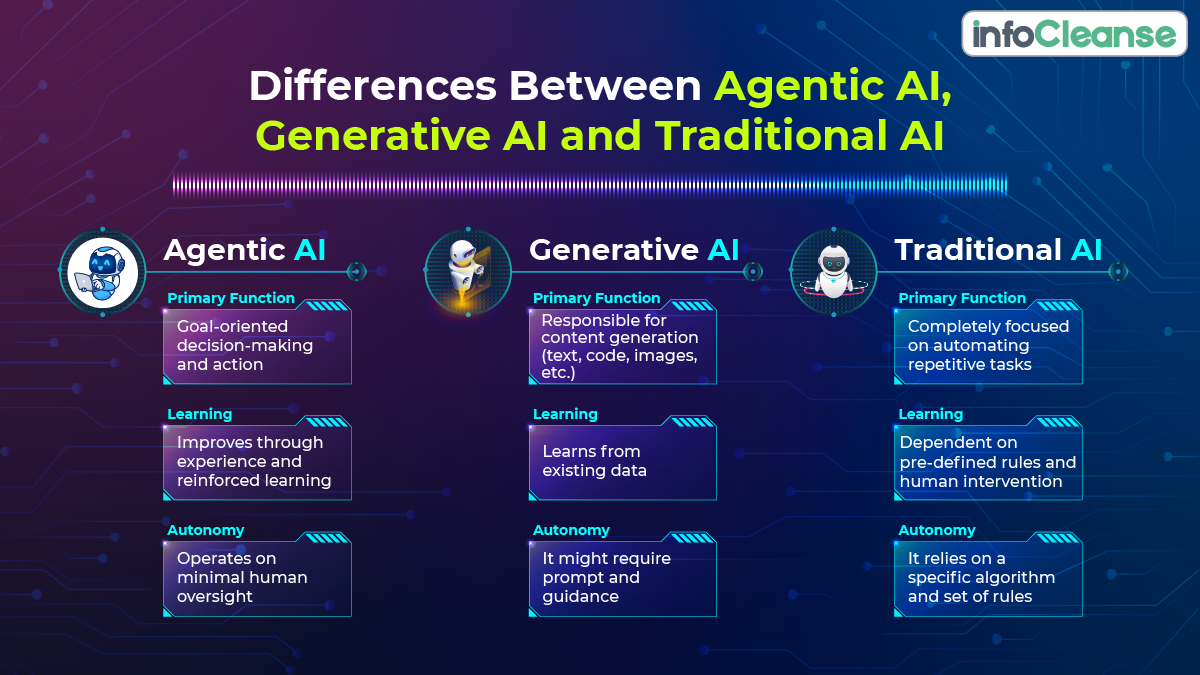
This distinction between a fixed process and a dynamic, goal-oriented one is key. Traditional automation excels at handling high volumes of predictable tasks. Agents shine when the path to the goal is not known in advance or when the environment is unpredictable.
Let's see this in action with a more concrete example.
AI Agents vs Traditional Software (What’s the Difference?)
The video 'AI Agents vs Traditional Software' provides a great visual explanation of how agents automate entire workflows, not just individual tasks.
Watch the segment from 03:20 to 05:00. The video uses an email campaign as an example. Notice how the agent doesn't just send emails (a task), but also pulls data, schedules, tracks responses, and makes optimizations—a full workflow.
Use Case 1: Complex B2B Process Orchestration
Imagine a common business process: a salesperson needs to generate a custom quote for a large enterprise client. This isn't a simple lookup. It requires:
- Accessing the CRM to get the customer's history and any negotiated terms.
- Consulting a product database for available SKUs and compatibility.
- Checking an inventory system for stock levels.
- Interfacing with a financial application to calculate pricing, applying the correct discounts.
- Pulling in legal terms and conditions that might vary by product or region.
A traditional approach using Robotic Process Automation (RPA) or custom scripts would be brittle. It would require stable APIs for every system and would likely fail if it encountered unstructured data (e.g., notes in a CRM field) or an unexpected system response.
An agentic system handles this differently. A "master" agent can be given the goal: "Create a complete and accurate quote for Customer X." It then orchestrates a team of specialized agents to achieve this.
Orchestrating Complex AI Workflows with AI Agents & LLMs
This video from IBM Technology, 'Orchestrating Complex AI Workflows with AI Agents & LLMs', walks through this exact quote-generation scenario. It's an excellent, in-depth example of agents providing value in a complex, multi-system workflow.
Please watch from 04:16 to 19:03. The presenter first describes the challenges of using traditional RPA (04:16 - 10:41) and then illustrates how a system of coordinated agents can solve the problem much more robustly (10:41 - 19:03). Pay attention to how the 'master agent' delegates tasks to smaller, specialized agents (e.g., a CRM agent, a product catalog agent).
As you saw, the agent-based system isn't just following a rigid script. It's using its reasoning abilities to:
- Decompose a complex goal into smaller, manageable sub-tasks.
- Delegate sub-tasks to the appropriate specialized agent (or "tool").
- Synthesize information from multiple, disparate sources.
- Handle ambiguity by interpreting data and making judgments (e.g., determining which SKUs are relevant based on past discussions).
This orchestration of multiple tools and data sources to achieve a high-level goal is a classic use case where agents dramatically outperform traditional automation.
Test your understanding!
Consider the process of onboarding a new employee at a large company. This involves HR, IT, and Finance departments. How might an agentic system streamline this process in a way that traditional automation couldn't?
Show answer
A traditional workflow might involve a series of static forms and tickets. If a step fails (e.g., a background check service is down), the whole process halts until a human intervenes.
An agentic onboarding system could be given the goal: "Fully onboard new hire Jane Doe." It could then:
- Coordinate across departments: Invoke an IT agent to provision a laptop and accounts, an HR agent to send welcome documents, and a Finance agent to set up payroll.
- Adapt to issues: If the primary background check service fails, the agent could automatically switch to a secondary provider or notify the hiring manager of the specific delay and its cause.
- Personalize the experience: The agent could analyze the new hire's role (e.g., 'Software Engineer') and proactively grant access to specific code repositories and developer tools, a step that might be missed in a generic, one-size-fits-all checklist.
Use Case 2: Personalized, Context-Aware Customer Interaction
Another powerful use case is creating highly personalized and dynamic customer experiences. Simple chatbots can answer FAQs from a knowledge base, but they lack the context and ability to act that define an agent.
Let's look at this from a developer's perspective. Imagine you're building a system for a fitness retail brand. The goal is to create a "virtual sales assistant."
A traditional microservices architecture would involve writing a significant amount of orchestration logic: an API gateway that calls a customer service, which in turn might call an inventory service and a communication service. You'd be responsible for the service discovery, inter-service communication, error handling, and timeout logic yourself.
An agent-based approach, especially one using an Agent Development Kit (ADK), simplifies this immensely.
Exploring Google ADK, a technical deep dive.
The article 'Exploring Google ADK, a technical deep dive' provides a fantastic side-by-side comparison of a traditional microservices implementation versus an agent-based one for the exact same task. It clearly demonstrates the value of agentic orchestration from a coding perspective.
Please read the following sections: 'First step, why not do everything on my own?', 'ADK approach, simple agent coordination', 'Agent-based architecture', and 'The ADK interface'. Contrast the code and complexity of the manual microservices approach with the streamlined ADK version. Note how the final 'Intelligent response generation' is far more than a simple database lookup; it's a synthesized, personalized message.
The value here is twofold:
- Development Efficiency: As you saw, the ADK abstracts away the complex orchestration logic, allowing you to focus on defining the capabilities of each agent (what tools they have) rather than the plumbing that connects them.
- Richer User Experience: The end result is not just data retrieval; it's intelligent synthesis. The agent doesn't just return a list of shoes. It combines knowledge of the customer ("I see you're training for a marathon"), brand preferences, and real-time inventory to craft a helpful, personalized, and context-aware recommendation. This is something a simple database query or a scripted chatbot cannot do.
Conclusion
In this lesson, we moved from theory to practice, exploring concrete examples of where AI agents deliver value beyond traditional approaches.
Key Takeaways:
- AI agents excel at automating entire workflows, not just discrete tasks. They are best suited for problems where the path to the solution is dynamic and requires flexibility.
- A key use case is the orchestration of complex processes that involve multiple, disparate systems and data sources, such as B2B quote generation or employee onboarding.
- Another powerful application is creating highly personalized and context-aware user experiences, where agents can synthesize information from various sources to act as intelligent assistants rather than simple information-retrieval bots.
- From a developer's standpoint, agentic frameworks can abstract away significant orchestration complexity, allowing you to build more powerful systems with less boilerplate code.
Now that we understand the "what" (agent characteristics) and the "where" (use cases), we are ready to dive into the "how." In the next lesson, we will begin dissecting the internal mechanics of an agent by exploring the fundamental agent loop: the perception, reasoning, and action cycle that powers all agentic behavior.