Hello. The previous lesson established that a PM2.5 concentration, such as , describes particle mass per volume of air—not an air-quality index. This lesson follows that measurement into an air-quality report. You will separate three things that can appear on the same screen: a pollutant concentration, a pollutant-specific index value, and an overall AQI.
A measurement becomes a score
A monitor measures a concentration of a pollutant in outdoor air. For PM2.5, the unit is commonly . A gas such as ozone may instead be reported in parts per million, abbreviated ppm. The concentration needs a time period as well as a unit: a value averaged over a day does not describe the same interval as one averaged over eight hours.
An AQI system then assigns a pollutant-specific index value to each eligible concentration using rules for that pollutant. The index value is a number on a health-communication scale; it is not another concentration. This allows the report to express different pollutants’ measurements on a common index scale, without pretending that their physical units are interchangeable.
For a completed daily report under the U.S. AQI system, the highest pollutant-specific index value becomes the overall AQI. “Overall” therefore means the highest reported pollutant index under that system’s rules—not the sum or average of all pollutant concentrations.
Read the relevant passages of AirNow’s A Guide to Air Quality and Your Health, an EPA brochure, for the distinction between measured concentrations and index values. The brochure is older, so use it for this reporting logic rather than as a source of current numerical conversion breakpoints.
A Guide to Air Quality and Your Health - AirNow.gov
AirNow’s guide explains both what the AQI scale communicates and how separate pollutant measurements contribute to a reported daily value.
On printed page 2, in “How does the AQI work?”, read the scale explanation. Then find “How is a community’s AQI calculated and reported?” on printed pages 2–3. Begin at the paragraph starting “These raw measurements are converted” and read the conversion description. Continue through the ozone example; notice that another pollutant can still matter even when it does not set the overall number.
The distinction is easiest to see when the labels remain attached to the numbers. “PM2.5: ” names a measured concentration. “PM2.5 AQI: 68” names an index value assigned from a PM2.5 concentration. Removing “PM2.5” from the second label changes its apparent meaning: a reader might mistake that pollutant-specific score for the overall report.
Reading all three levels in one report
Consider this illustrative U.S.-style completed-day report. The pollutant-specific index values are supplied here; calculating them from a dated breakpoint table is a later lesson.
| Pollutant | Concentration used for the report | Pollutant-specific AQI |
|---|---|---|
| PM2.5 | , 24-hour average | 68 |
| Ozone | , relevant 8-hour average | 115 |
Overall AQI: 115. Primary pollutant: ozone.
There are two different comparisons in this report. First, each pollutant’s concentration is interpreted using the rules appropriate to that pollutant. You cannot decide which is worse by comparing the raw numbers and : they have different units, represent different substances, and use different averaging periods. Second, you can compare the resulting index values, 68 and 115, on this reporting scale. Ozone has the higher value, so it sets the overall AQI of 115.
The EPA’s category chart places 68 in Moderate and 115 in Unhealthy for Sensitive Groups. The chart describes index ranges, not ranges of PM2.5 concentrations or ozone concentrations.
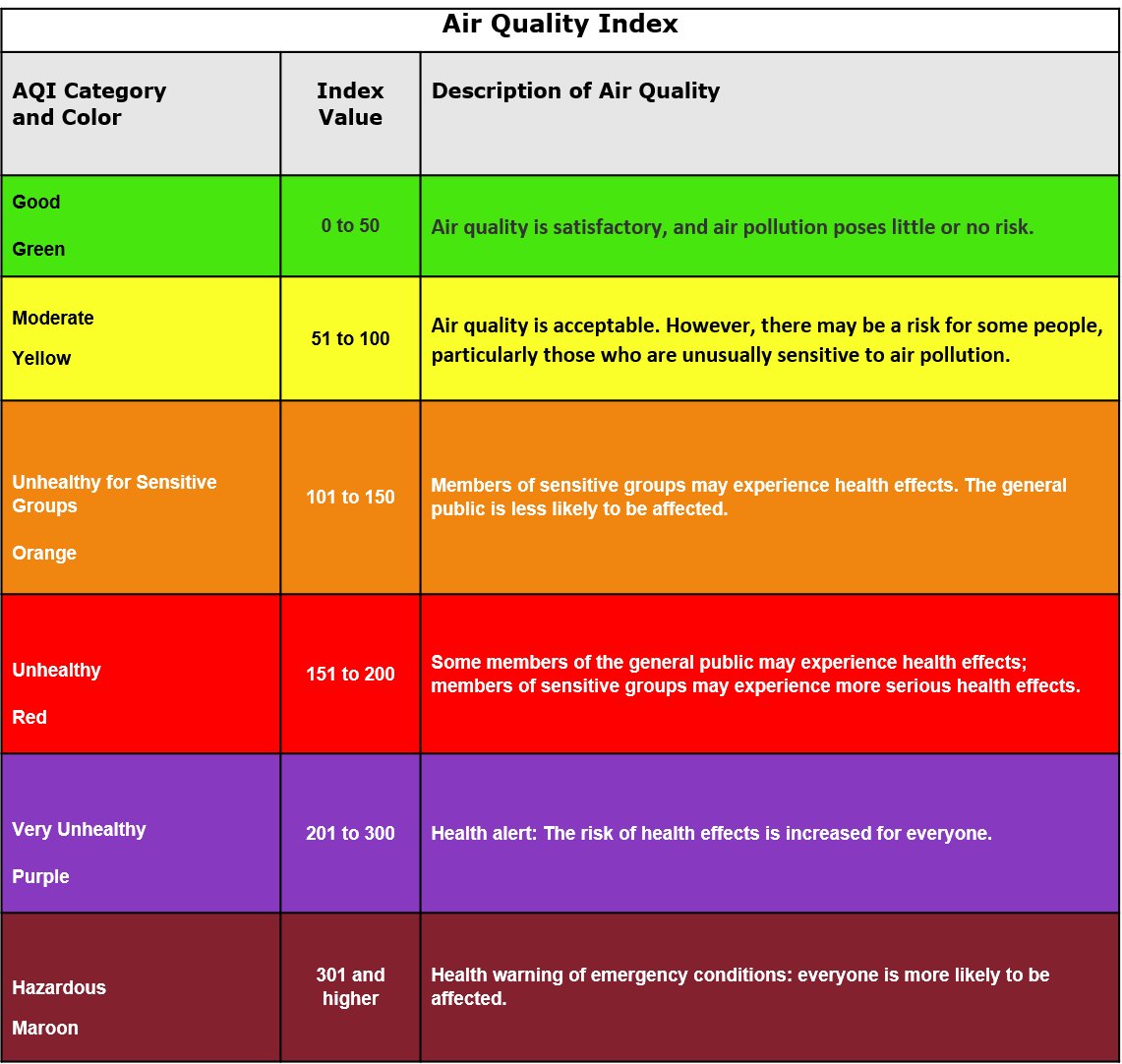
The overall number does not mean that PM2.5 was absent, that its concentration was 115, or that ozone and PM2.5 were added together. PM2.5 remains at its stated concentration and has its own index value of 68. Nor is “primary pollutant” necessarily the only pollutant worth noticing: a person sensitive to a non-primary pollutant may still need its information.
A headline reading “PM2.5 AQI 68” and another reading “overall AQI 115” could therefore both describe this report accurately. By contrast, “PM2.5 concentration 18.0” is incomplete unless its unit and measurement period are available. Keeping those labels prevents a difference in what is being reported from looking like a disagreement about one measurement.
Recognising the labels on a live display
A live air-quality page may show a prominent overall number while placing other pollutants farther down the page. AirNow’s site guide gives a concrete example of that layout.
How To Use This Site | AirNow.gov
AirNow explains what its prominent dial reports and where to find pollutants that do not currently have the highest index value.
In “The Dial”, begin with the opening description. Read the immediately following bullets identifying the NowCast AQI, update hour, and primary pollutant, stopping before “In the vicinity of the dial you can”. Then, in “Current Air Quality”, start at “Below the dial you’ll find:” and read through the other-pollutants bullet, stopping before “Air Quality Forecast”. Focus on the difference between the headline value and the additional pollutant information.
AirNow calls its recently updated dial value a NowCast AQI. Do not silently treat it as the completed daily AQI used in the illustrative report: those labels describe different reporting periods. Later lessons will examine how averaging and reporting time affect a displayed number. For now, the practical reading habit is to look for the pollutant, unit, time period, and index label before comparing figures.
There is also a limit to what “overall” promises. It summarises the pollutant information available to that reporting product under its rules. It is not a direct measurement of every substance in the air, nor of the air an individual has personally breathed.
Key takeaways
A concentration is a pollutant measurement with a physical unit and time period. A pollutant-specific AQI is that pollutant’s value on a reporting scale. In the U.S. completed-day example, the overall AQI is the highest of the reported pollutant-specific values; the pollutant responsible is called the primary pollutant. Reading all three labels makes seemingly conflicting numbers much easier to interpret.
The next lesson examines why even a correctly labelled outdoor AQI communicates a population-level health concern rather than an individual exposure measurement or a guarantee of safety.