The previous lesson separated a pollutant concentration from its pollutant-specific index value and the overall AQI. Those labels tell you what a report is reporting. They do not yet tell you how much pollution any one person has breathed.
This lesson explains the distinction. You will see why an outdoor AQI is useful for communicating health concerns across a population, while your own exposure depends on where you spend time, what you do there, and how susceptible you are. That distinction will help you use health guidance without treating a low number as a promise of safety—or a high number as a prediction that everyone will become ill.
What the AQI’s health categories communicate
The U.S. AQI translates outdoor pollutant measurements into categories intended to help the public respond to short-term health concerns. As the index rises, the guidance first draws attention to people more likely to be affected, then to the wider population. The categories are based on evidence about health effects across groups of people; they are not measurements of an individual’s body or personal air.
Read the EPA’s explanation with particular attention to its final paragraph on particle pollution and individual sensitivity.
Patient Exposure and the Air Quality Index | US EPA
Read the EPA’s “Patient Exposure and the Air Quality Index” to understand both the purpose and the limits of AQI health categories.
In “What is the Air Quality Index (AQI)?”, begin with the paragraph opening “The AQI focuses on health effects” and read through the section’s end. Follow the explanation of how concern broadens as AQI rises, then focus on why the particle-pollution discussion does not identify a sharp threshold below which no one can be affected.
A category is a general guide to the level of concern, not a verdict on each person. “Unhealthy for Sensitive Groups” does not mean everyone in a sensitive group will have symptoms, or that everyone outside those groups is immune. Likewise, “Good” does not mean the air contains no pollution.
This matters especially for particle pollution. The EPA notes little evidence of a population-wide threshold below which particle-associated effects are unlikely. Category boundaries make guidance usable, but crossing from one numbered category to another is not the moment at which biological risk suddenly switches on. People differ in susceptibility, and an index cannot capture every such difference.
Outdoor conditions versus personal exposure
An outdoor AQI starts with information about ambient air: the air represented by outdoor measurements and the reporting method. Your personal exposure concerns the pollutant concentrations in the air you actually encounter over time. Those are related quantities, but they are not identical.
The EPA’s outdoor-air discussion makes this distinction explicit.
Read the EPA’s “Outdoor Air Quality” for the central reason a fixed outdoor measurement cannot quantify one person’s exposure.
Under “Exposure to Outdoor Air Pollution”, read the full paragraph, from its opening sentence about pollution and activity patterns to its final sentence about the indoor and outdoor environments in which people breathe. Focus on the difference between characterizing outdoor air and following a person through those environments.
Consider two people looking at the same reported outdoor AQI. One spends much of the period indoors, where the air may differ from outdoors; the other spends it outdoors doing strenuous activity. They have received the same public signal but have not necessarily encountered the same concentrations for the same length of time. Indoor air is not automatically clean, either: outdoor particles can enter buildings, while indoor sources and ventilation can change indoor concentrations.
A displayed AQI also cannot certify the conditions at every nearby spot or instant. A brief, local source of smoke or exhaust could affect the air someone breathes without being fully represented by a broader outdoor report. Later lessons will examine reporting periods and monitoring locations in detail. For now, the key point is simpler: an outdoor index describes reported outdoor conditions, not a continuous record of your breathing environment.
Why activity and duration change what you inhale
Even if two people breathe air with the same particle concentration, they may inhale different amounts. The EPA illustrates this using an approximate intake-dose relationship for outdoor activity.
Patient Exposure and the Air Quality Index | US EPA
Return to the EPA’s “Patient Exposure and the Air Quality Index” for its explanation of how time and breathing rate affect the amount of pollution inhaled.
In “What can I advise my patients to do when the air quality is unhealthy?”, read the section’s paragraph, beginning with the advice about taking it easier and ending with the sentence about longer, more strenuous outdoor activity. Pay particular attention to the intake-dose formula and the distinction between inhaled and deposited particles.
In simplified form, the amount inhaled depends on the concentration in the air being breathed, the volume of air breathed per minute, and the time spent breathing it:
For an illustration, suppose the concentration in the air someone breathes stays at for one hour. At of air per minute, the estimated mass inhaled is . At per minute for the same hour, it is . The concentration has not changed; the amount of air breathed has. These hypothetical figures are not predictions of a health effect. They also assume the stated concentration is present where the person breathes throughout the hour.
There is a further distinction: inhaled mass is not necessarily the mass deposited in the respiratory tract, because some particles are exhaled. An outdoor AQI measures neither of those personal amounts. It helps people recognize when changes in activity or time outdoors may be worth considering; it cannot calculate their individual dose or health outcome.
Using the guidance without reading it as a guarantee
The EPA’s particle-pollution guide shows how this population-level signal becomes practical advice. It distinguishes people who may be unusually sensitive at Moderate levels from groups given stronger precautions as particle AQI rises. The recommendations also differ between sensitive groups and everyone else.
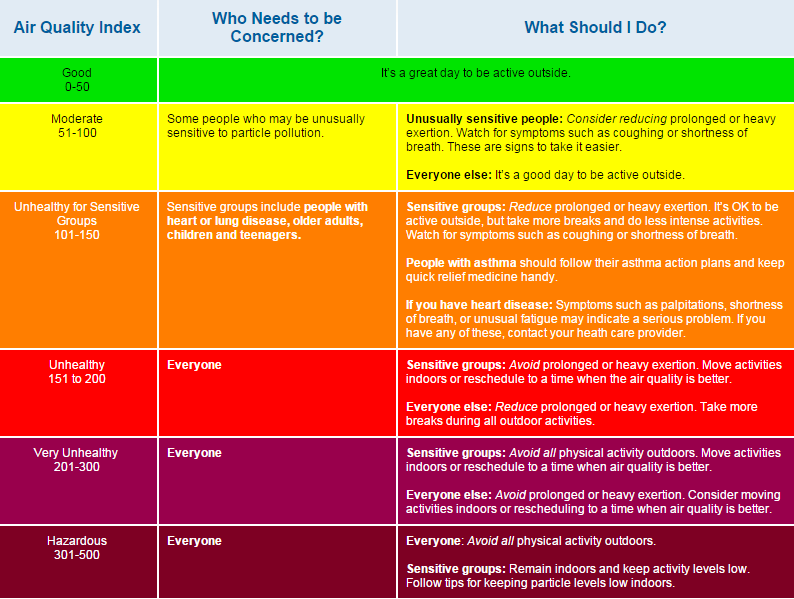
Notice the language of the chart: at some levels it recommends reducing prolonged or heavy exertion, rather than declaring that all outdoor activity must stop. At higher levels, its advice becomes more restrictive. That progression reflects increasing concern while leaving room for differences in susceptibility, activity intensity, and time outdoors.
Keep the pollutant label attached to this guidance. In the previous lesson’s illustrative report, PM2.5 had an index value of 68, while ozone set the overall AQI at 115. The particle-pollution chart helps interpret the PM2.5 value of 68; it should not be used as if the ozone-driven overall value of 115 were a PM2.5 value. The overall number draws attention to the leading reported concern, but pollutant-specific guidance still matters.
Finally, neither end of the scale makes an individual promise. A low AQI does not rule out sensitivity, a local exposure, or pollutants that a particular report does not represent. A high AQI signals greater health concern; it does not establish that every person received the same dose or will experience the same effect. The sound interpretation is increased or decreased reason for caution, not a guarantee about one person’s health.
Key takeaways
An outdoor AQI is a public health communication tool built from reported outdoor pollutant conditions. Its categories convey levels of concern across a population. Your exposure depends on the air you encounter, how long you encounter it, and your breathing rate; your response also depends on susceptibility. That is why AQI guidance is useful without being a personal exposure measurement or a safety certificate.
The next module turns to time: how averaging hourly measurements can smooth a short peak and make an AQI report change more slowly than conditions at a particular moment.