In our previous lesson, we established the crucial distinction between UX and UI design, clarifying how UX focuses on the strategic, problem-solving journey while UI handles the visual and interactive execution. We also saw how your graphic design background provides a strong foundation for a career in UI/UX. Today, we build directly on that foundation by exploring the core process that guides a UX designer's work.
This lesson will introduce you to Design Thinking, the five-phase framework that underpins modern, user-centered product development. You will learn to explain each of the five phases—Empathize, Define, Ideate, Prototype, and Test. Understanding this process is fundamental, as it provides the structured, yet flexible, approach needed to solve complex user problems effectively. This framework will serve as our roadmap for many of the topics we'll cover throughout this course.
What is Design Thinking?
At its heart, Design Thinking is a mindset and a methodology for solving complex problems in a highly user-centric way. It's a structured process for moving from a deep understanding of user needs to innovative, tangible solutions.
Designers often deal with what are called "wicked problems"—challenges that are ill-defined, ambiguous, and have interconnected factors. Think of a problem like "how to encourage healthier eating habits" versus a straightforward one like "build a login screen." The first is a wicked problem with no single "correct" answer; the second has established patterns. Design Thinking provides a way to navigate this ambiguity.
The following video provides an excellent introduction to this concept and gives a high-level overview of the process we'll be discussing.
The Design Thinking Process - An Introduction
This video from CareerFoundry, "The Design Thinking Process - An Introduction," explains the philosophy behind Design Thinking.
Please watch the first two segments. The first part, from the beginning, introduces Design Thinking and the concept of "wicked problems." Then, continue with the overview of the five phases, which lists the stages we are about to explore.
The most widely adopted model of Design Thinking, which we will focus on, comes from the Hasso Plattner Institute of Design at Stanford (often called the d.school). It consists of five phases:
- Empathize
- Define
- Ideate
- Prototype
- Test
It's crucial to understand from the outset that this process is not strictly linear. It is iterative, meaning you will cycle through the phases, and insights from a later phase can send you back to an earlier one.
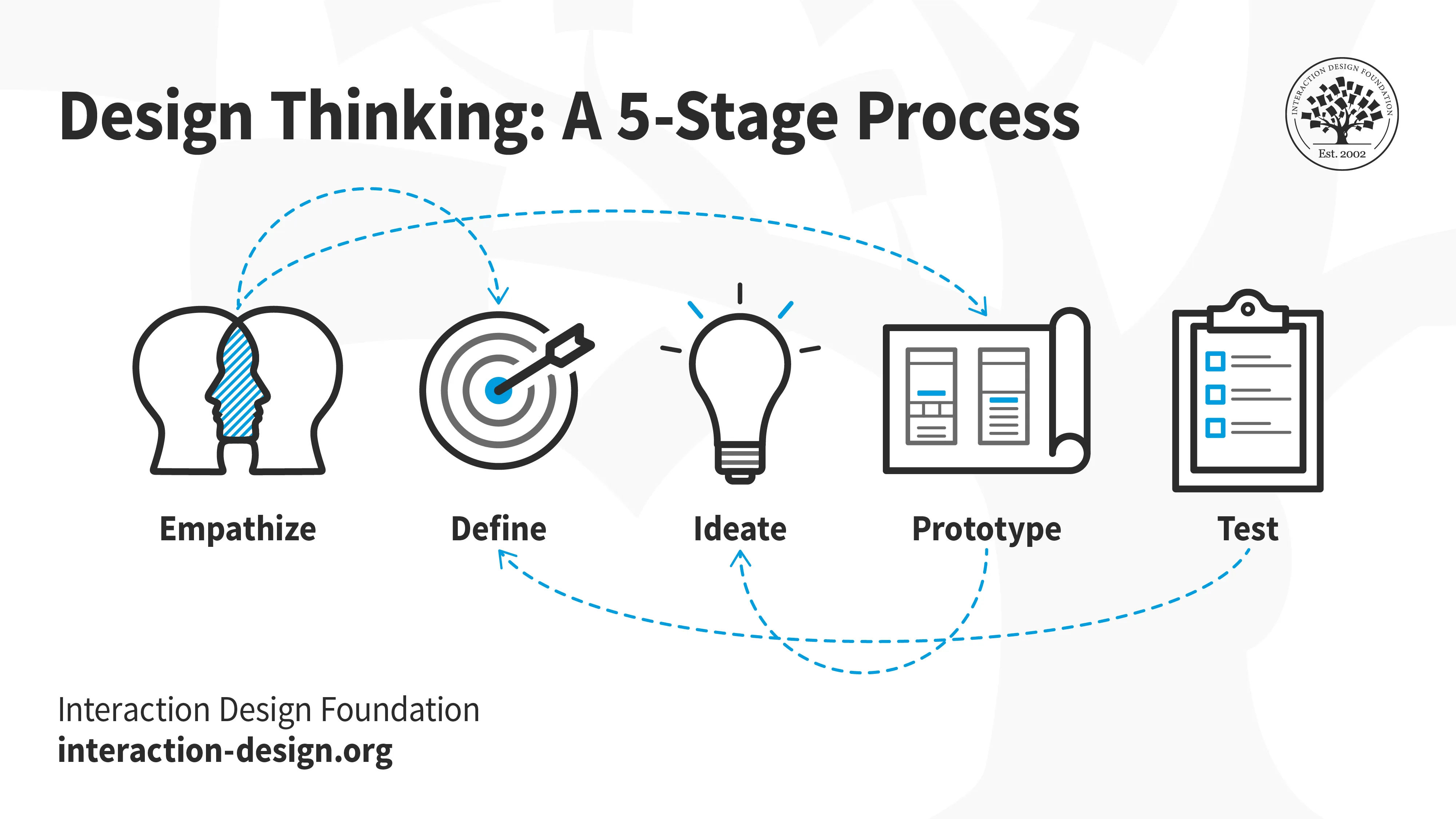
The Five Phases of Design Thinking
To get a comprehensive understanding of each phase, we'll use a foundational article from the Interaction Design Foundation, supplemented with practical advice from the original Stanford d.school guide.
The 5 Stages in the Design Thinking Process - IxDF
This article provides a thorough breakdown of each of the five stages. We will read through the description of each stage one by one.
For now, focus on the sections detailing each of the five stages. Start with Stage 1: Empathize, then read Stage 2: Define, followed by Stage 3: Ideate, Stage 4: Prototype, and finally Stage 5: Test.
Now that you've read the overview, let's delve a bit deeper into the "why" and "how" of each phase, using insights from Stanford's guide.
1. Empathize: Understanding Your Users
The entire Design Thinking process is built on this first phase. Empathy is the effort to understand people's needs, motivations, and the context of their lives. It's about setting aside your own assumptions to see the world through their eyes.
- Goal: To gain a deep, personal understanding of the user and their problem space.
- Activities: Conducting user interviews, observing people in their natural environment, and immersing yourself in their experiences.
- Why it's crucial: As a designer, you are rarely designing for yourself. The best solutions emerge from the best insights into human behavior.
This is a significant departure from a purely aesthetic-driven design process. Instead of starting with a visual idea, you start with people.
An Introduction to Design Thinking PROCESS GUIDE
This guide from the Stanford d.school gives practical advice on how to build empathy.
Read the section on the Empathize mode. Pay close attention to the three suggested methods under "HOW to empathize": Observe, Engage, and Watch and Listen.
2. Define: Framing the Problem
After gathering a wealth of information in the Empathize phase, the Define phase is about making sense of it all. You'll analyze your observations to synthesize them into a clear and actionable problem statement, often called a Point of View (POV).
- Goal: To frame the problem in a human-centered way that inspires action.
- Activities: Organizing research notes (we'll learn a technique called affinity diagramming later), identifying patterns, and crafting a POV statement.
- A good POV combines three elements: the user, their need, and an insight you've discovered. For example: "A busy professional [user] needs a way to eat healthy on the go [need] because they feel their demanding schedule is compromising their well-being [insight]."
An Introduction to Design Thinking PROCESS GUIDE
Let's return to the Stanford d.school guide to understand how to move from empathy to a defined problem.
Read the section on the Define mode. Focus on the explanation of the Point-of-View and the characteristics of a good POV listed in the bullet points starting with "Provides focus".
3. Ideate: Generating Solutions
With a clear problem statement, you can now focus on generating solutions. The Ideate phase is a process of "going wide" to explore as many potential solutions as possible. This is where your creative background will shine, but with a focused purpose.
- Goal: To generate a broad range of creative ideas that address the defined problem.
- Activities: Brainstorming, sketching, mind-mapping. The key here is to defer judgment. No idea is too wild or "bad" at this stage. The aim is quantity over quality initially, to push beyond the obvious solutions.
4. Prototype: Making Ideas Tangible
Prototyping is about bringing your ideas to life. However, unlike a final design, a prototype is a low-cost, scaled-down version of the product used for testing and learning. It’s not about perfection; it's about making an idea tangible enough to get feedback.
- Goal: To quickly and cheaply create artifacts that can answer specific questions about a potential solution.
- Activities: Creating paper sketches, building simple click-through models, role-playing a service. A prototype can be anything a user can interact with. The motto is "build to think."
5. Test: Learning from Users
The Test phase is where you put your prototypes in front of users and observe their reactions. The goal isn't to "sell" your idea but to learn what works and what doesn't.
- Goal: To solicit feedback on your prototypes, refine your solutions, and deepen your understanding of the user.
- Activities: Conducting usability tests, asking users to perform tasks with your prototype, and listening carefully to their feedback. The results of this phase almost always lead to iteration—revisiting earlier phases to refine the problem definition or generate new ideas.
The video below gives a very quick and clear recap of all five phases.
This short video from PlaybookUX, "Design Thinking in UX," provides a concise summary of the process.
Watch the segment from this timestamp, which walks through each of the five phases we've just discussed.
An Iterative, Non-Linear Cycle
As mentioned earlier and highlighted in the diagrams, it's a mistake to view Design Thinking as a rigid, linear checklist. It's a fluid and flexible process.
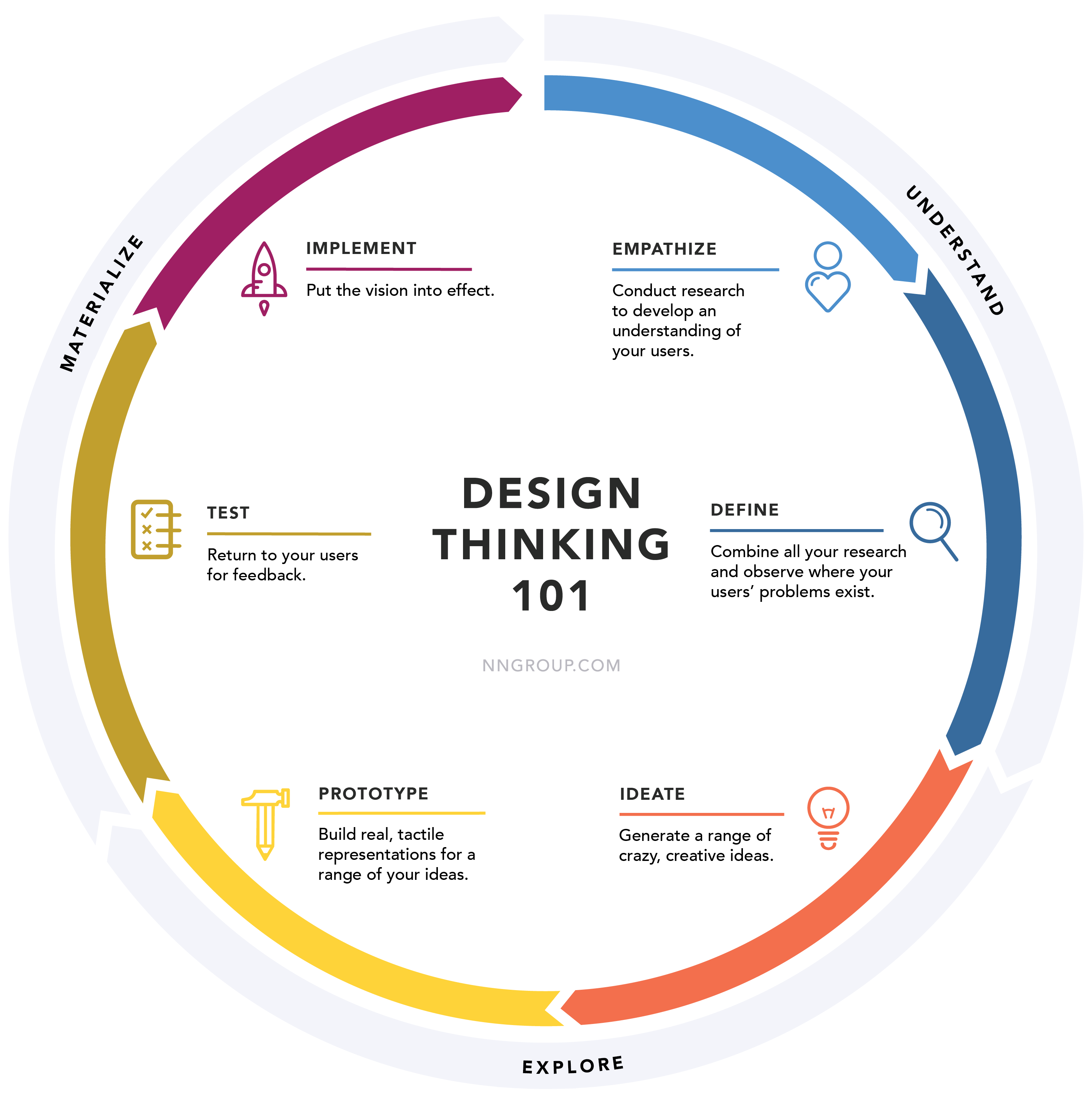
Knowledge gained in the Test phase might reveal that your initial problem statement in the Define phase was wrong, sending you back to redefine it. Or, a brainstorming session in the Ideate phase might uncover a gap in your understanding, prompting more research in the Empathize phase. This iterative nature is a core strength of the process.
The 5 Stages in the Design Thinking Process - IxDF
Let's revisit the IxDF article to solidify this important concept.
Please read the final section, "Did You Know Design Thinking is a Non-Linear Process?". It does an excellent job of explaining how the stages are flexible and can be repeated.
Conclusion
In this lesson, we've unpacked the Design Thinking process, a foundational framework for user-centered problem-solving. Let's review the key takeaways:
- Design Thinking is an iterative, solution-based process for tackling complex, human-centered problems.
- The five phases are Empathize (understand users), Define (frame the problem), Ideate (generate ideas), Prototype (build to learn), and Test (get feedback).
- The process is non-linear and iterative. Insights from any phase can inform and cause you to revisit earlier phases.
- This framework provides the "why" behind many of the specific UX tasks you'll learn, grounding them in a structured, empathetic, and creative methodology.
You now have a high-level map of the UX designer's journey from problem to solution. In our next lesson, we will begin our practical journey into this process by taking a deep dive into the Empathize phase. You'll learn how to formulate unbiased questions for user research interviews, which is the first step toward truly understanding your users.