Hello! In our last lesson, we explored the Design Thinking process, which provides a high-level map for navigating from a user's problem to a viable solution. We identified the five phases—Empathize, Define, Ideate, Prototype, and Test—and established that the entire process begins with empathy.
Today, we take our first concrete step into that process. This lesson focuses on a core skill for the Empathize phase: formulating unbiased questions for user research interviews. The quality of your entire design project rests on the quality of the insights you gather at the start. By learning to ask better questions, you learn to listen more effectively, ensuring the solutions you eventually design are grounded in genuine user needs, not your own assumptions.
The Goal: Uncovering Truth, Not Validating Assumptions
A user interview is not a sales pitch or a debate. Its purpose is to understand the user's world, their motivations, their behaviors, and their pain points. As a designer, you will naturally have ideas and hypotheses, but the interview is where you must set them aside. The goal is to collect honest, unfiltered feedback. The greatest risk is that the way you ask questions will unintentionally influence the user's answers, leading you to hear what you want to hear rather than what you need to hear.
This is where the concept of a leading question becomes critical.
Avoid Leading Questions to Get Better Insights from ...
This article from the Nielsen Norman Group (NN/g), a leader in UX research, is the definitive guide to this topic. It explains precisely why the wording of your questions is so important.
Read the first part of the article, from the beginning down to the section titled "What Makes a Question Leading". Pay close attention to the quiz at the start and the explanation of why the third question is the best choice.
As the NN/g article makes clear, leading questions contaminate your research because they suggest an answer or imply a feeling. This puts pressure on the participant to agree with you, robbing you of the chance to discover unexpected insights. Your work as a graphic designer involves using visual cues to guide a user; here, the challenge is to use verbal cues that don't guide them, but instead open up a space for them to share their own experience.
Open vs. Closed Questions: Unlocking Deeper Conversation
One of the simplest and most effective ways to avoid leading questions and encourage rich feedback is to favor open-ended questions over closed-ended ones.
- Closed-ended questions can be answered with a simple "yes" or "no," or a single piece of information. Example: "Do you use mobile dating apps?"
- Open-ended questions invite a story or a longer explanation. Example: "Can you tell me about your experience with mobile dating apps?"
While closed questions can be useful for gathering specific facts, open-ended questions are the engine of discovery in an interview.
The following short video provides a very clear distinction between these question types and reinforces the danger of leading questions.
UX Research - Get Started With Qualitative User Research (2023)
This clip from CareerFoundry's video on qualitative research gives clear, practical examples.
Watch the segment from this timestamp for a concise explanation of avoiding leading and closed questions.
A Toolkit of Unbiased Questioning Techniques
Beyond simply asking open-ended questions, skilled interviewers have a range of techniques to probe deeper without introducing bias.
The video below offers an excellent overview of these techniques. We'll watch it in segments to focus on each key idea.
UX Research: Asking The Right User Interview Questions
This video from "UX in the Head" provides a nuanced look at the art of asking questions, including how to handle different types of questions and conversational dynamics.
First, watch the section from the beginning, which introduces how to start with broad, open-ended questions using "How" and "W" words (What, When, Where, Who). Notice the caution about using the word "Why," as it can sometimes make participants feel defensive. Next, watch the segment on avoiding leading questions. This reinforces what we've already learned and offers a useful trick for what to do if you accidentally ask a leading question. Then, watch the part on avoiding hypothetical questions. This is a crucial point: asking people to predict their future behavior is highly unreliable. It's always better to ask about specific past behaviors. Finally, watch the explanation of open-ended vs. closed-ended questions, which provides a final, clear summary of this key distinction.
To summarize the key question types to avoid:
- Leading Questions: They suggest the answer you want to hear.
- Bad: "How frustrated were you when the app crashed?"
- Good: "Tell me about your experience when the app stopped working."
- Hypothetical Questions: They ask users to guess about the future.
- Bad: "Would you pay $5 a month for this feature?"
- Good: "Tell me about the last time you paid for a digital subscription."
- Closed-ended Questions (when you want a story): They can be answered with "yes" or "no."
- Bad: "Did you find the 'Save' button?"
- Good: "Walk me through how you saved your work."
Common Traps and How to Sidestep Them
Now that you have the basic principles, let's look at the common traps that even experienced researchers can fall into. Being aware of them is the first step to avoiding them.
Avoid Leading Questions to Get Better Insights from ...
Let's return to the NN/g article to review a checklist of common mistakes.
Find the section titled "What Makes a Question Leading" and read the four bullet points that explain the common traps: Rephrasing in your own words Suggesting an answer Naming an interface element Assuming what a user is feeling
Structuring Your Interview Questions
Knowing how to formulate individual questions is essential, but it's also helpful to have a structure for the interview itself. A typical user interview flows from broad questions to more specific ones.
The diagram below shows a common and effective structure for an interview guide.

This structure helps create a natural conversational arc:
- About the User (Warm-up): Start with easy, general questions about the person to build rapport.
- General/Broad Questions: Move to the topic at hand, asking about their past experiences and behaviors in that area.
- Specific Questions: This is where you might ask them to perform a task or ask about specific moments they mentioned earlier.
- Closing Questions: Always end by giving them a chance to share any final thoughts. Questions like "Is there anything else you'd like to share?" or "Is there anything I should have asked but didn't?" can lead to surprising insights.
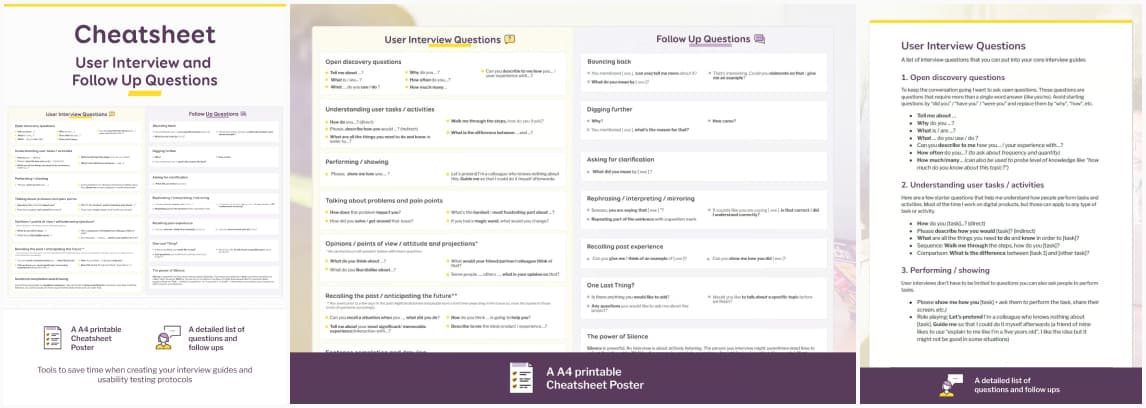
For a more detailed look at question types organized by their purpose, the following cheatsheet is an excellent resource to keep handy.
Conclusion
In this lesson, we moved from the abstract concept of "Empathy" to the concrete skill of formulating unbiased interview questions. This is a fundamental building block of user-centered design.
Here are the key takeaways:
- Your goal is discovery, not validation. Enter an interview to learn, not to confirm your own ideas.
- Avoid leading questions. Do not suggest an answer or emotion in your question.
- Favor open-ended questions about past behavior. Ask "Tell me about a time when..." instead of "Would you...?".
- Structure your interview. Move from broad, rapport-building questions to more specific inquiries.
- Listen more than you talk. Use techniques like probing questions and strategic silence to encourage the user to share more.
You now have the tools to craft questions that will help you genuinely understand your users. But what happens after you've conducted several interviews and have pages of notes? In our next lesson, we will learn how to make sense of all this qualitative data by synthesizing your research notes into key themes using a technique called affinity diagramming.