Hello! Welcome to your next lesson.
In our last session, we focused on identifying dehydration from a Basic Metabolic Panel (BMP), centering on the classic sign of a BUN/Creatinine ratio > 20:1. We saw how the rest of the panel gives clues about the cause of dehydration, such as hypokalemia in diarrhea or metabolic alkalosis with vomiting.
Today, we'll investigate a specific "can't-miss" diagnosis that can also present with dehydration and hypotension but has a very distinct and dangerous lab signature: adrenal insufficiency. Your goal for this lesson is to recognize the BMP patterns suggestive of adrenal insufficiency. This is a critical skill, as prompt recognition of this pattern can be life-saving.
The Adrenal Gland's Role in a Nutshell
To understand the lab abnormalities in adrenal insufficiency, we first need a quick, focused review of what the adrenal cortex produces. The two hormones most relevant to the BMP are aldosterone and cortisol.
Primary adrenal insufficiency (Addison's disease) - pathology, symptoms, diagnosis, treatment
The Osmosis video on primary adrenal insufficiency provides an excellent and concise review of the adrenal gland's function. Watching these short clips will clarify the roles of aldosterone and cortisol, which is essential for understanding the lab patterns we're about to discuss.
Please watch the sections from 01:06 to 02:39 (on aldosterone) and 02:39 to 04:32 (on cortisol). Focus on: Aldosterone's job: How does it affect sodium, potassium, and water in the kidney? Cortisol's job: How does it affect blood glucose and the body's stress response?
To summarize the key points from the video:
- Aldosterone (a mineralocorticoid) acts on the kidneys to reabsorb sodium (and water follows) while excreting potassium. Think of it as the body's main salt-retaining hormone.
- Cortisol (a glucocorticoid) is the primary stress hormone. It increases blood glucose by promoting gluconeogenesis and has many other systemic effects.
Adrenal insufficiency occurs when the adrenal glands don't produce enough of these hormones. This can happen for two main reasons:
- Primary Adrenal Insufficiency (Addison's Disease): The adrenal glands themselves are damaged and fail. This means both aldosterone and cortisol levels are low.
- Secondary Adrenal Insufficiency: The pituitary gland fails to produce adrenocorticotropic hormone (ACTH), the signal that tells the adrenals to make cortisol. Aldosterone production is often spared because it is mainly regulated by the renin-angiotensin system, not ACTH. This means cortisol is low, but aldosterone is normal.
This distinction is the key to interpreting the different BMP patterns.
The Classic BMP Pattern of Primary Adrenal Insufficiency
When the adrenal gland fails, the lack of aldosterone and cortisol creates a very specific set of lab abnormalities.
Adrenocortical Insufficiency & Addisonian Crisis - Medical Surgical - Endocrine | @LevelUpRN
This clip from Level Up RN gets straight to the point, clearly explaining the expected lab values in adrenal insufficiency and linking them directly back to the missing hormones.
Watch the section from 02:24 to 04:08. Pay close attention to the explanation for why sodium, potassium, and glucose are abnormal.
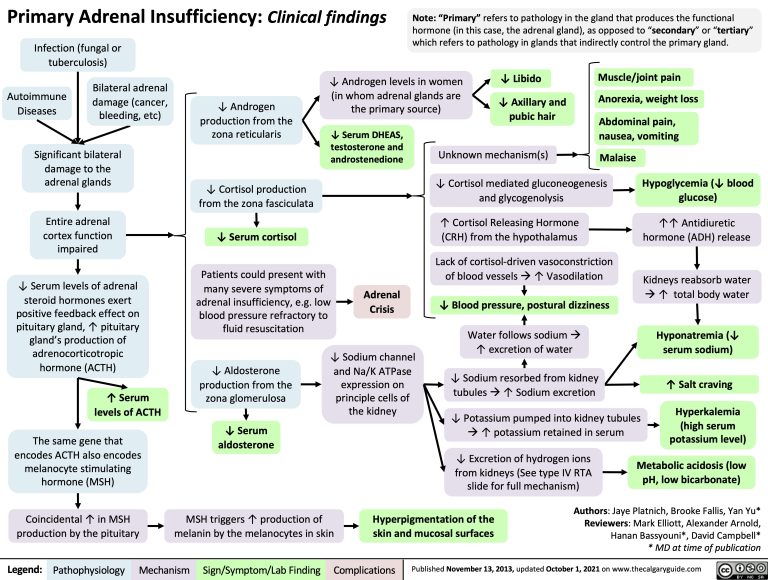
As the video highlighted, the pattern stems directly from the pathophysiology:
- Low Aldosterone leads to:
- Hyperkalemia (high potassium) because the kidneys can no longer excrete potassium effectively.
- Hyponatremia (low sodium) because the kidneys are wasting sodium.
- Metabolic Acidosis (low bicarbonate) because of reduced hydrogen ion excretion in the kidney.
- Low Cortisol contributes to:
- Hypoglycemia (low glucose) due to impaired gluconeogenesis.
- Hyponatremia (worsens it) because cortisol normally suppresses Antidiuretic Hormone (ADH). Without cortisol, ADH levels rise, causing the kidneys to retain free water, which further dilutes the blood's sodium concentration.
This combination of salt wasting and water retention also leads to volume depletion (dehydration), which causes a prerenal azotemia (elevated BUN and creatinine), often with the >20:1 ratio we discussed in our last lesson.
To see this all laid out, please review the following text.
Addison Disease - Merck Manual Professional Version
The Merck Manual provides a professional-level summary of these findings. It includes a very useful table that codifies the lab pattern you should learn to recognize.
First, read the subsection titled 'Mineralocorticoid deficiency'. Then, find the section 'Diagnosis of Addison Disease' and carefully study the table named 'Test Results That Suggest Addison Disease'. This table is a perfect summary of the BMP pattern.
So, the classic pattern of primary adrenal insufficiency on a BMP is:
- Hyponatremia
- Hyperkalemia
- Hypoglycemia
- Low Bicarbonate (non-anion gap metabolic acidosis)
- Elevated BUN/Creatinine (prerenal azotemia)
The simultaneous presence of hyponatremia and hyperkalemia in a hypotensive or dehydrated patient should immediately make you think of primary adrenal insufficiency.
Differentiating Secondary Adrenal Insufficiency on the BMP
What if the problem is in the pituitary gland (secondary AI)? Remember, in this case, aldosterone is usually normal. How does that change the BMP?
Addison Disease - StatPearls - NCBI Bookshelf
Let's turn to this concise explanation from StatPearls, which directly addresses the key difference in lab findings between primary and secondary adrenal insufficiency.
Please read the paragraph under the 'Comprehensive Metabolic Panel' heading. Focus on the sentence that explains why hyperkalemia does not occur in secondary disease.
As the text explains, since the renin-angiotensin-aldosterone system is intact in secondary AI, aldosterone levels are normal. Therefore, the kidneys can still excrete potassium properly.
This gives us the key differentiator on the BMP:
- Primary AI: Hyponatremia + Hyperkalemia
- Secondary AI: Hyponatremia + Normal Potassium
In both cases, you can see hypoglycemia and hyponatremia due to the lack of cortisol. But the potassium level is the critical clue to locate the problem.

Test your understanding!
A patient with a history of severe diarrhea has a BMP showing hyponatremia and a BUN/Cr ratio of 30:1. A patient with primary adrenal insufficiency also has hyponatremia and a BUN/Cr ratio of 30:1. What single value on the BMP would be the most important differentiator between these two conditions?
Show answer
The serum potassium (K+) level. The patient with severe diarrhea would be expected to have hypokalemia (low potassium) due to gastrointestinal losses. The patient with primary adrenal insufficiency would have hyperkalemia (high potassium) due to lack of aldosterone.
Clinical Application: An Addisonian Crisis
Let's analyze a case. A 68-year-old man with a history of autoimmune disease is brought to the emergency department with profound weakness, confusion, and nausea for two days. His blood pressure is 85/50 mmHg.
His BMP results are:
- Sodium: 124 mEq/L (Normal: 135-145)
- Potassium: 6.2 mEq/L (Normal: 3.5-5.0)
- Chloride: 92 mEq/L
- Bicarbonate (HCO3-): 17 mEq/L (Normal: 22-28)
- BUN: 58 mg/dL (Normal: 7-20)
- Creatinine: 1.6 mg/dL (Normal: 0.7-1.3)
- Glucose: 55 mg/dL (Normal: 70-100)
Your Task: Analyze this BMP. What pattern do you see, and what is the most likely diagnosis?
Click for analysis
- Electrolytes: The patient has significant hyponatremia (124) and life-threatening hyperkalemia (6.2).
- Acid-Base: The bicarbonate is low (17), indicating a metabolic acidosis.
- Glucose: The glucose is low (55), indicating hypoglycemia.
- Renal Function: The BUN/Cr ratio is 58/1.6 = 36. This is > 20:1, indicating a prerenal azotemia.
- Synthesis: The combination of hyponatremia, hyperkalemia, hypoglycemia, and metabolic acidosis in a hypotensive patient is the pathognomonic pattern for an acute adrenal crisis (acute primary adrenal insufficiency). This is a medical emergency requiring immediate IV fluids, glucose, and steroid replacement (e.g., hydrocortisone).
Conclusion
Today you learned to recognize one of the most important patterns on the BMP. While adrenal insufficiency is less common than simple dehydration, failing to recognize it can have severe consequences.
Key Takeaways:
- The classic BMP pattern of primary adrenal insufficiency is hyponatremia, hyperkalemia, and hypoglycemia, often with a non-anion gap metabolic acidosis.
- The combination of hyponatremia and hyperkalemia is the most specific clue.
- In secondary adrenal insufficiency, you expect hyponatremia and hypoglycemia, but potassium is typically normal because aldosterone secretion is preserved.
- This pattern recognition allows you to quickly identify a life-threatening endocrine emergency directly from the initial lab work.
In our next lesson, we will continue exploring electrolyte and water disorders by looking at the BMP patterns suggestive of the Syndrome of Inappropriate Antidiuretic Hormone (SIADH) and Diabetes Insipidus (DI). This will build directly on the concepts of sodium and water balance we've discussed today.