Hello! Welcome back to your course on clinical lab interpretation.
In our last lesson, we saw how the absence of cortisol in adrenal insufficiency can lead to increased Antidiuretic Hormone (ADH) secretion, causing water retention and hyponatremia. Today, we'll dive deeper into ADH by examining two primary disorders of water balance where ADH is the main character: the Syndrome of Inappropriate ADH (SIADH) and Diabetes Insipidus (DI). Your goal is to learn how to recognize the Basic Metabolic Panel (BMP) patterns suggestive of these conditions. While the BMP provides the initial clue (abnormal sodium), you'll see that pairing it with urine studies is the key to unlocking the diagnosis.
The Central Regulator: Antidiuretic Hormone (ADH)
Before we look at the abnormal patterns, let's quickly review the normal function of ADH (also known as vasopressin). Understanding its job is crucial to making sense of what happens when its regulation goes wrong.
The Dirty Medicine channel offers a very clear and concise explanation of normal ADH physiology, which will serve as our foundation for this lesson.
Please watch from 00:56 to 02:02. Focus on where ADH comes from and its specific action on the kidney's collecting ducts to reabsorb water.
As the video explains, ADH's primary role is to tell the kidneys to reabsorb water from the urine back into the blood. This concentrates the urine and helps the body hold onto water. Now, let's see what happens when there's too much or too little of this effect.
SIADH: The Pattern of Too Much ADH
SIADH stands for Syndrome of Inappropriate Antidiuretic Hormone secretion. The name says it all: the body is releasing ADH when it shouldn't be, leading to excessive water retention.
This excess water dilutes everything in the blood. The most important consequence you'll see on the BMP is hyponatremia (low sodium). But how do we prove the cause is SIADH? We look at the urine. Despite the blood being very dilute, the high ADH levels force the kidneys to continue reabsorbing water, making the urine paradoxically concentrated.
Let's return to the Dirty Medicine video to see the full picture of SIADH, including its causes and the classic lab findings.
Watch the section from 02:02 to 05:20. Pay close attention to the flowchart of the pathophysiology: Too much ADH -> Too much water reabsorption -> Hyponatremia & Low Serum Osmolality -> Concentrated Urine (High Urine Osmolality & High Urine Sodium).
An important clinical pearl is that patients with SIADH are typically euvolemic (they have a normal fluid volume on exam). While they are retaining water, it distributes throughout the body's total water space, and the body has mechanisms (like suppressing aldosterone) that prevent the development of overt hypervolemia with edema.
The classic lab pattern for SIADH is therefore:
- Serum: Hyponatremia (e.g., Na⁺ < 135 mmol/L) and low serum osmolality (< 275 mOsm/kg).
- Urine: Inappropriately concentrated urine with a high urine osmolality (often > 100 mOsm/kg, but usually much higher) and a high urine sodium (> 40 mEq/L).
- Clinical: Euvolemia.
Common causes to keep in mind include CNS disturbances, pulmonary diseases (especially small cell lung cancer), and medications (like SSRIs and carbamazepine).
Diabetes Insipidus (DI): The Pattern of Too Little ADH Effect
Diabetes Insipidus is the functional opposite of SIADH. It is not related to diabetes mellitus or blood sugar. The term "diabetes" refers to the large volume of urine produced (polyuria), and "insipidus" (tasteless) refers to the fact that the urine is dilute and free of sugar.
In DI, there is a lack of ADH effect, causing the kidneys to be unable to reabsorb water. This leads to the excretion of large volumes of dilute urine. The body loses massive amounts of free water, which concentrates the blood.
There are two main types:
- Central DI: The posterior pituitary fails to secrete ADH.
- Nephrogenic DI: The kidneys fail to respond to ADH.
Sodium Disorders | Clinical Medicine
The Ninja Nerd video provides a clear explanation of these two mechanisms.
Watch from 43:52 to 46:00. Focus on how both decreased ADH release (Central DI) and impaired kidney response (Nephrogenic DI) lead to the same final problem: decreased water reabsorption.
The resulting lab pattern for Diabetes Insipidus is:
- Serum: Hypernatremia (e.g., Na⁺ > 145 mmol/L) and high serum osmolality (> 295 mOsm/kg).
- Urine: Inappropriately dilute urine with a low urine osmolality (< 300 mOsm/kg) and low specific gravity.
- Clinical: Polyuria (e.g., > 3L/day), intense thirst (polydipsia), and signs of dehydration if water intake cannot keep up with losses.
Common causes include head trauma or surgery for Central DI, and drugs (especially Lithium) or electrolyte disorders (hypercalcemia, hypokalemia) for Nephrogenic DI.
Putting It All Together: SIADH vs. DI
Recognizing these patterns is about contrasting the serum and urine findings. The initial clue comes from the BMP sodium, which then guides your next diagnostic steps.
This image provides an excellent visual summary of the two opposing states.
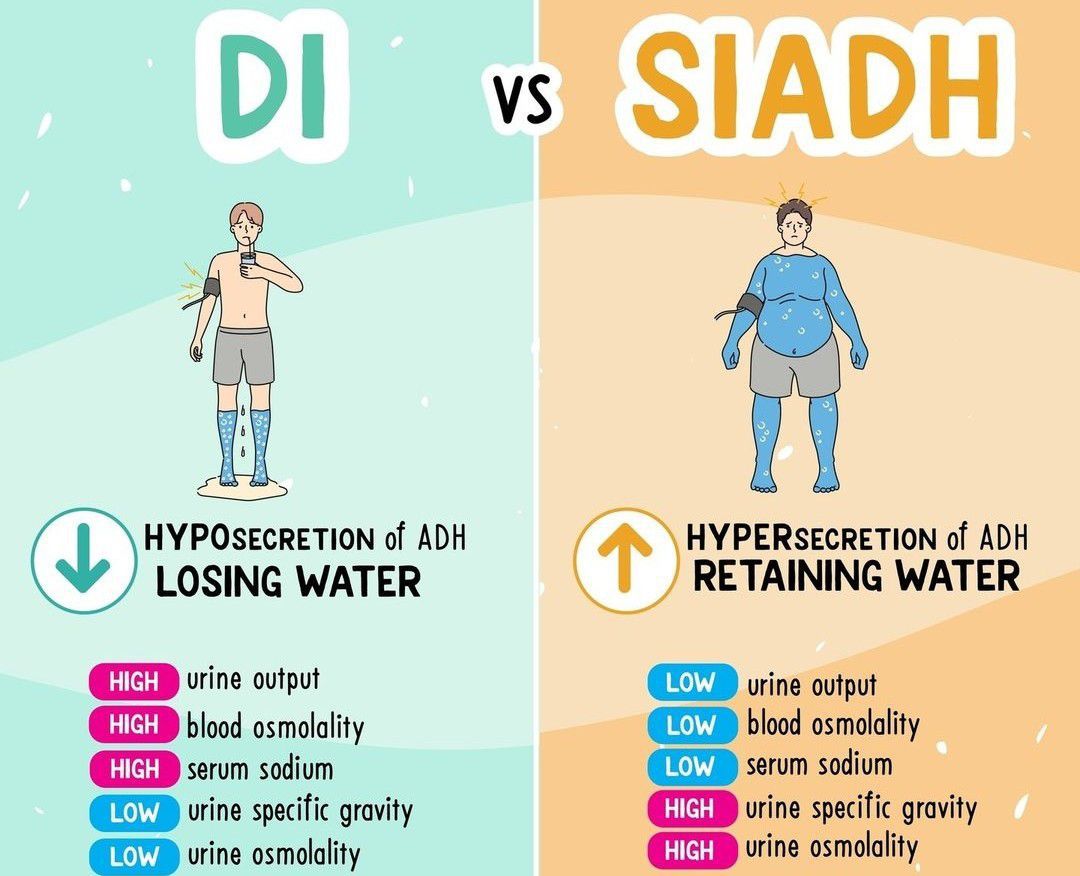
Here is a summary table to codify this pattern recognition.
| Parameter | Syndrome of Inappropriate ADH (SIADH) | Diabetes Insipidus (DI) |
|---|---|---|
| Primary Problem | Too much ADH effect | Too little ADH effect |
| Serum Na⁺ (BMP) | Low (< 135 mmol/L) | High (> 145 mmol/L) |
| Serum Osmolality | Low (< 275 mOsm/kg) | High (> 295 mOsm/kg) |
| Urine Volume | Low / Normal | High (Polyuria) |
| Urine Osmolality | High (> 100 mOsm/kg, usually > plasma) | Low (< 300 mOsm/kg, usually < plasma) |
| Urine Na⁺ | High (> 40 mEq/L) | Low or Variable |
| Volume Status | Euvolemic | Hypovolemic or Euvolemic (if drinking) |
Test your understanding!
A 55-year-old patient with a history of bipolar disorder treated with lithium is admitted with confusion. His BMP shows a sodium of 152 mEq/L. His urine output has been over 4 liters in the past 24 hours.
Based on this initial information, which diagnosis is more likely, SIADH or DI? What single lab test would be most helpful to confirm your suspicion, and what result would you expect?
Show answer
Diagnosis: Diabetes Insipidus is much more likely. The hypernatremia, polyuria, and history of lithium use (a classic cause of nephrogenic DI) all point strongly in this direction.
Most helpful test: A urine osmolality.
Expected result: You would expect the urine to be inappropriately dilute, with a very low urine osmolality (e.g., < 300 mOsm/kg). This would confirm that the kidneys are failing to concentrate urine despite the high serum sodium, which is the hallmark of DI.
Differentiating Central vs. Nephrogenic DI
Once you've identified DI, the next question is whether the problem is in the brain (central) or the kidney (nephrogenic). The classic way to determine this is with a water deprivation test, followed by administration of desmopressin (DDAVP), a synthetic form of ADH.
The Dirty Medicine video has a very straightforward explanation of how to interpret this test.
Watch from 10:48 to 13:46. Focus on the core logic: if you give ADH (desmopressin) and the kidneys start concentrating urine, the problem was a lack of ADH (Central DI). If the kidneys still don't respond, the problem is in the kidney itself (Nephrogenic DI).
Conclusion
You have now learned to identify the lab patterns of two fundamental disorders of water balance. By looking beyond the BMP and integrating serum and urine osmolality, you can effectively differentiate conditions of ADH excess from ADH deficiency.
Key Takeaways:
- Disorders of water balance present with abnormalities in serum sodium on the BMP.
- SIADH is a state of ADH excess, causing water retention. The pattern is hyponatremia with inappropriately concentrated urine (high urine osmolality).
- Diabetes Insipidus (DI) is a state of ADH deficiency/resistance, causing water loss. The pattern is hypernatremia with inappropriately dilute urine (low urine osmolality).
- The patient's clinical volume status and history provide critical clues to the diagnosis.
In our next module, we will shift our focus from water and electrolytes to acid-base balance. You'll learn the systematic approach to interpreting an Arterial Blood Gas (ABG) report, starting with its core components: pH, PaCO2, PaO2, and HCO3.