Hello! Welcome back. In our last lesson, you learned how to systematically identify the four primary acid-base disorders by analyzing pH, PaCO₂, and HCO₃⁻. You can now confidently diagnose a metabolic acidosis from a set of blood gas values (low pH, low HCO₃⁻).
Today, we'll answer the next logical question: why is the bicarbonate low? The answer to this question splits metabolic acidosis into two distinct categories, each with its own set of causes. To do this, we will focus on today's learning outcome: to calculate the anion gap and use it to differentiate between high anion gap and normal anion gap metabolic acidosis. This simple calculation is a cornerstone of clinical reasoning and will dramatically help you narrow down your differential diagnosis.
What Is the Anion Gap?
Your body is electrically neutral. This means the total concentration of positively charged ions (cations) must equal the total concentration of negatively charged ions (anions). However, in a standard lab panel (like a Basic Metabolic Panel or BMP), we don't measure all of these ions.
We measure the main cation, sodium (Na⁺), and the main anions, chloride (Cl⁻) and bicarbonate (HCO₃⁻). The "gap" is the difference between the measured cation and the measured anions. It represents the unmeasured anions that are present to maintain that electrical balance. These are primarily negatively charged proteins like albumin, as well as phosphates, sulfates, and organic acids.
To visualize this fundamental concept, please watch the following video.
Metabolic Acidosis Explained CLEARLY (Anion Gap vs. Non Anion Gap)
This video from MedCram provides an excellent visual breakdown of electroneutrality and how the anion gap is derived. The bar graph illustrations make the concept very intuitive.
Please watch from the beginning to 5:36. Focus on how the 'gap' is simply the unmeasured anions needed to balance the measured sodium.
Calculating the Anion Gap
As you saw in the video, the formula is straightforward:
A normal anion gap is typically in the range of 8 to 12 mEq/L. This range can vary slightly between laboratories, but this is a reliable range for clinical use.
The Two Types of Metabolic Acidosis
When a patient has metabolic acidosis, their HCO₃⁻ is low. This can happen for two main reasons, and the anion gap is the tool we use to distinguish between them.
- High Anion Gap Metabolic Acidosis (HAGMA): An unmeasured acid has been added to the system.
- Normal Anion Gap Metabolic Acidosis (NAGMA): Bicarbonate has been lost from the system.
Let's explore each of these in detail.
1. High Anion Gap Metabolic Acidosis (HAGMA)
In HAGMA, a new acid (let's call it 'HA') is introduced into the blood, either from an external source (like a toxin) or from abnormal metabolism (like ketoacids). This acid dissociates into a proton (H⁺) and its conjugate base (A⁻).
- The H⁺ is buffered by bicarbonate (HCO₃⁻), causing the HCO₃⁻ level to drop.
- The A⁻ is an unmeasured anion, which accumulates in the blood.
The result? The HCO₃⁻ (a measured anion) goes down, but it is replaced by A⁻ (an unmeasured anion). This causes the calculated anion gap to increase.
HAGMA = Addition of Acid
This flowchart from The Calgary Guide provides an excellent overview of the causes and pathophysiology of HAGMA.
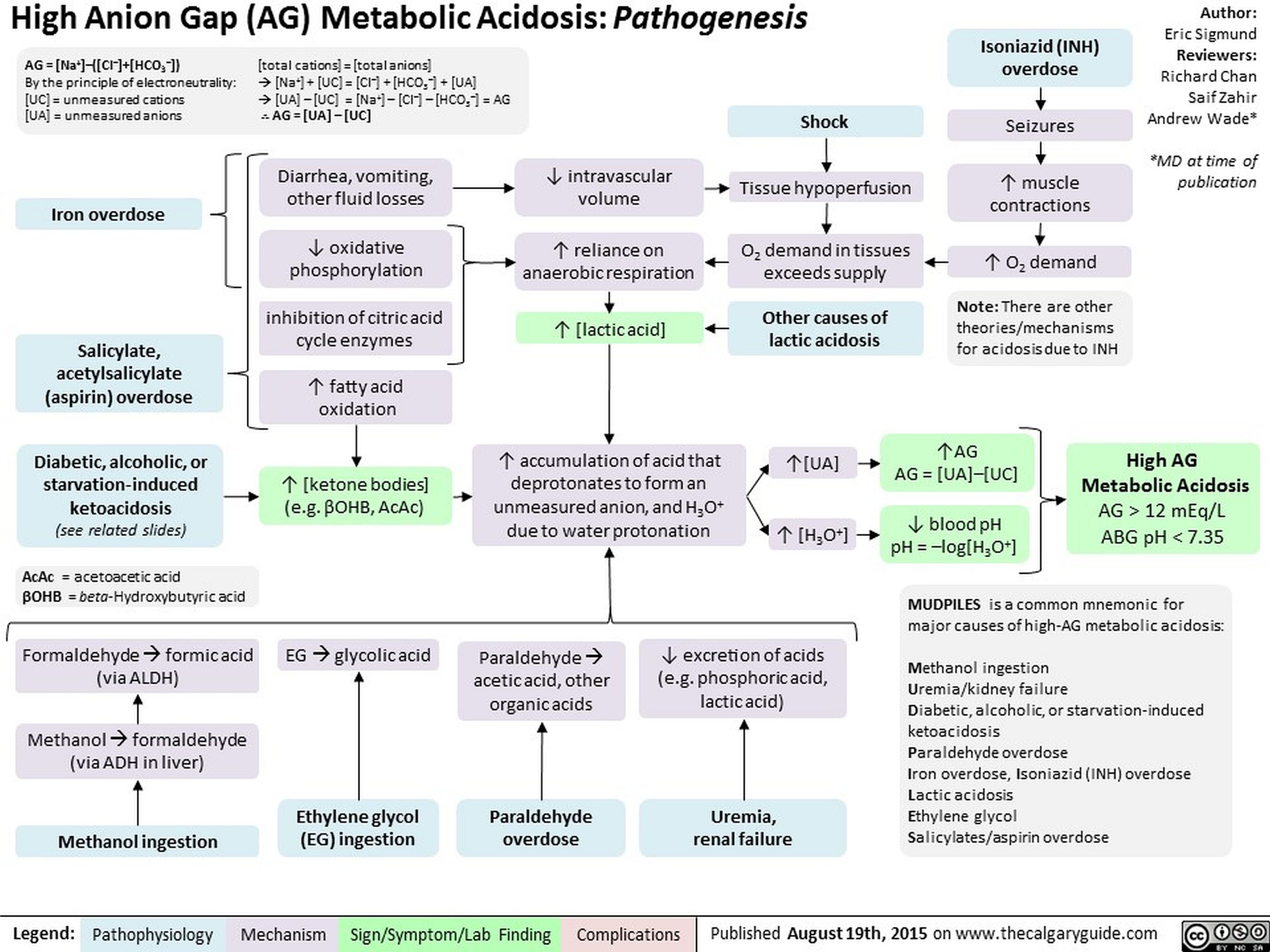
To build your differential diagnosis for HAGMA, it's helpful to use a mnemonic. A more modern and comprehensive one is GOLD MARKeT.
Anion Gap and Non-Anion Gap Metabolic Acidosis - NCBI
This StatPearls article from NCBI provides a clinically-focused review of metabolic acidosis. We'll focus on its excellent summary of the causes of HAGMA and NAGMA.
Please read the section titled 'High Anion Gap Metabolic Acidosis' and familiarize yourself with the 'GOLD MARKeT' mnemonic. Note the common clinical scenarios like lactic acidosis, ketoacidosis, and renal failure.
2. Normal Anion Gap Metabolic Acidosis (NAGMA)
In NAGMA, the primary problem is the direct loss of bicarbonate. This typically happens through the gastrointestinal tract (e.g., diarrhea) or the kidneys (e.g., Renal Tubular Acidosis).
To maintain electroneutrality, when the body loses a bicarbonate anion (HCO₃⁻), the kidneys compensate by retaining a chloride anion (Cl⁻).
The result? The HCO₃⁻ (a measured anion) goes down, but it is replaced by Cl⁻ (another measured anion). Because one measured anion simply replaces another, the calculated anion gap remains normal. This is why NAGMA is also known as hyperchloremic metabolic acidosis.
NAGMA = Loss of Bicarbonate
This second flowchart provides a clear visual for the mechanisms of NAGMA.
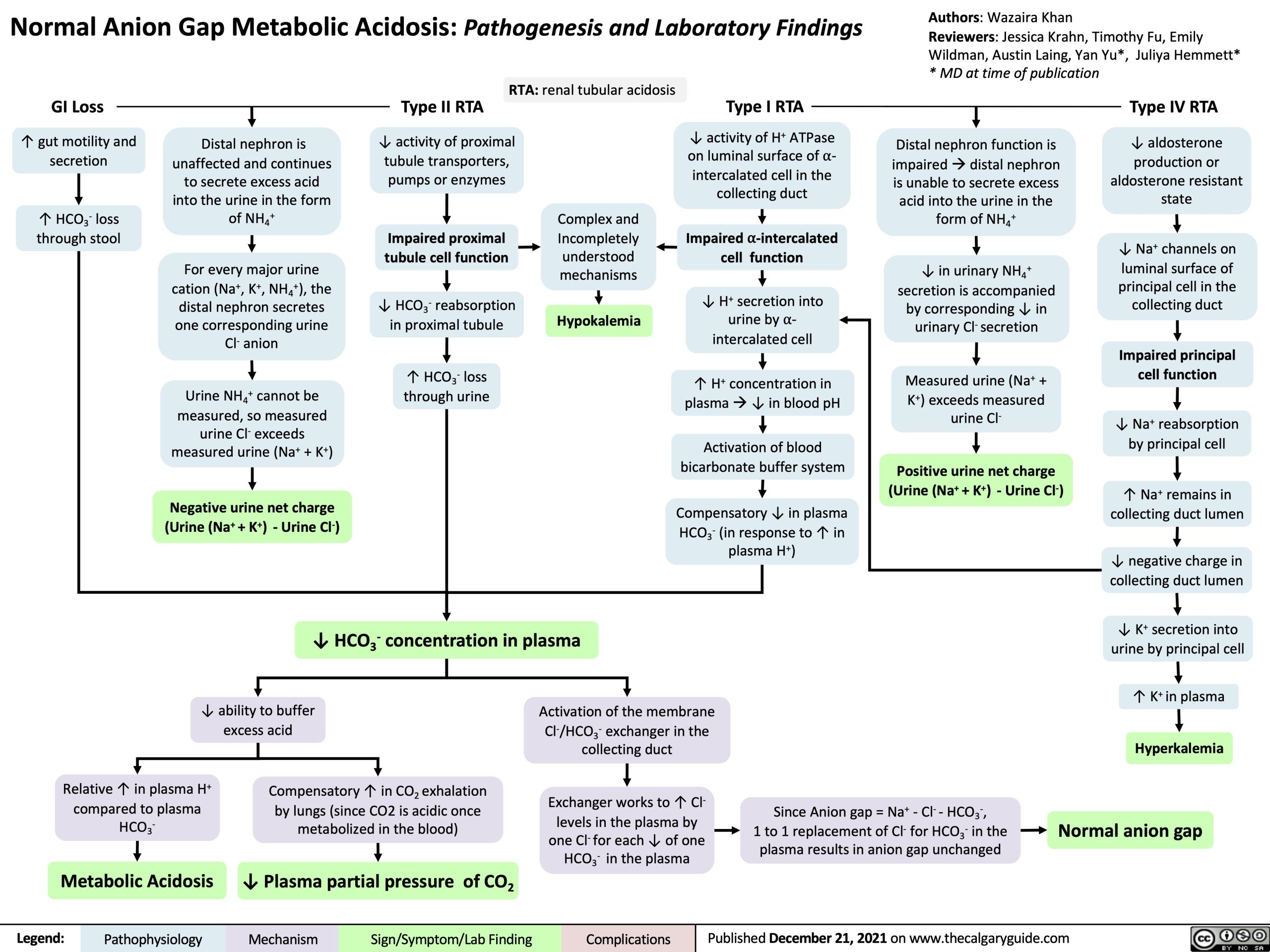
The most common causes of NAGMA are much fewer and easier to remember.
Anion Gap and Non-Anion Gap Metabolic Acidosis - NCBI
Now, let's look at the causes of NAGMA from the same NCBI article.
Please read the section 'Non–Anion Gap Metabolic Acidosis'. Focus on the two most common causes: bicarbonate loss from diarrhea and renal tubular acidosis. Also, note the common iatrogenic cause: administration of large volumes of normal saline.
A Critical Clinical Pearl: Correcting the Anion Gap for Albumin
The anion gap calculation has a major potential pitfall. The most abundant unmeasured anion in the blood is albumin. Many critically ill patients are malnourished or have conditions like liver disease or sepsis that cause low albumin levels (hypoalbuminemia).
If a patient's albumin is low, their baseline "normal" anion gap will also be low. This can cause you to miss a HAGMA, as the calculated gap might fall into the normal range of 8-12, even though it's actually elevated for that specific patient.
Therefore, you should always correct the anion gap for the patient's albumin level.
The rule of thumb is: for every 1 g/dL decrease in albumin below a normal of 4.0 g/dL, the anion gap decreases by about 2.5 mEq/L.
The formula to correct the measured anion gap is:
You can find this formula and a clear example in the "Hypoalbuminemia" subsection of the NCBI resource (LINK) you reviewed earlier, under the Pathophysiology heading.
Test your understanding!
A 65-year-old patient with a history of alcohol abuse and liver cirrhosis is admitted with sepsis. Their labs are as follows:
- pH: 7.25
- PaCO₂: 30 mmHg
- HCO₃⁻: 14 mEq/L
- Na⁺: 135 mEq/L
- Cl⁻: 110 mEq/L
- Albumin: 2.0 g/dL
- What is the primary acid-base disorder?
- Calculate the measured anion gap.
- Calculate the albumin-corrected anion gap.
- What type of metabolic acidosis does this patient have?
Show answer
-
Primary Disorder: The pH is low (7.25) and the HCO₃⁻ is low (14), so this is a Metabolic Acidosis.
-
Measured Anion Gap:
AG = Na⁺ - (Cl⁻ + HCO₃⁻)
AG = 135 - (110 + 14)
AG = 135 - 124 = 11 mEq/L.
At first glance, this appears to be a normal anion gap. -
Albumin-Corrected Anion Gap:
Corrected AG = Measured AG + 2.5 × (4.0 - Albumin)
Corrected AG = 11 + 2.5 × (4.0 - 2.0)
Corrected AG = 11 + 2.5 × (2.0)
Corrected AG = 11 + 5 = 16 mEq/L. -
Conclusion: The albumin-corrected anion gap is 16, which is elevated. This patient has a High Anion Gap Metabolic Acidosis (HAGMA), likely from lactic acidosis due to sepsis. Without correcting for the low albumin, this diagnosis might have been missed.
Conclusion
You have now learned to take a diagnosis of metabolic acidosis one crucial step further. By calculating the anion gap and correcting for albumin, you can confidently classify the acidosis and generate a targeted list of potential causes.
Key Takeaways:
- The anion gap represents the unmeasured anions in the blood and is calculated as Na⁺ - (Cl⁻ + HCO₃⁻).
- High Anion Gap Metabolic Acidosis (HAGMA) is caused by the addition of an acid (e.g., lactic acid, ketoacids), which consumes bicarbonate. Use the GOLD MARKeT mnemonic.
- Normal Anion Gap Metabolic Acidosis (NAGMA) is caused by the loss of bicarbonate (e.g., diarrhea), which is replaced by chloride.
- It is critical to correct the anion gap for hypoalbuminemia to avoid misclassifying a HAGMA as a NAGMA.
In our next lesson, we will complete our initial analysis of simple acid-base disorders by learning how to assess for appropriate compensation. For a metabolic acidosis, we'll use Winter's formula to calculate the expected respiratory response. This will allow us to determine if the body is compensating correctly, or if a second, co-existing acid-base disorder is also present.