Hello! Welcome back to our course on mastering lab interpretation.
In our last few lessons, we built a systematic approach to acid-base analysis. You learned to:
- Identify the primary disturbance (acidosis or alkalosis, metabolic or respiratory).
- In the case of metabolic acidosis, calculate the anion gap to determine if it's a High Anion Gap (HAGMA) or Normal Anion Gap (NAGMA) process.
Today, we add the final and crucial step in analyzing simple acid-base disorders: assessing the body's compensatory response. When an acid-base disturbance occurs, the body doesn't just sit idly; it tries to push the pH back toward normal. Your goal for this lesson is to learn how to assess for appropriate metabolic or respiratory compensation in simple acid-base disorders using established formulas, like Winter's formula.
By calculating the expected compensatory response and comparing it to the patient's actual values, you can determine two things:
- Is the body's response appropriate for a single, simple disorder?
- Or, is the compensation "off," suggesting that a second, co-existing acid-base disorder is also present?
The "Why" and "How" of Compensation
The fundamental principle is that the body uses one system to compensate for a disorder in the other.
- A metabolic disorder (a problem with HCO₃⁻) triggers a respiratory compensation (changing the PCO₂).
- A respiratory disorder (a problem with PCO₂) triggers a metabolic compensation (changing the HCO₃⁻ via the kidneys).
A key clinical point is the speed of these responses. Respiratory compensation by changing breathing rate is fast, beginning in minutes and maximizing within 12-24 hours. Metabolic compensation by the kidneys is slow, taking 3-5 days to reach its full effect. This distinction is vital for interpreting respiratory disorders, as we'll see.
To get a solid grasp of these core concepts, please watch the first part of the following video.
ABG Interpretation: Compensation and Mixed Disorders (Lesson 4)
This video from Dr. Eric Strong's 'Strong Medicine' series provides an excellent conceptual overview of compensation. It explains the mechanisms for each of the four primary disorders and discusses the different timeframes for respiratory versus metabolic compensation.
Please watch from the beginning to 5:02. Focus on understanding which system compensates for which disorder and the critical difference in timing between respiratory and metabolic compensation.
As the video explained, compensation aims to mitigate pH changes but never returns the pH completely to normal and never overshoots. If you see a normal pH (7.40) with significantly abnormal PCO₂ and HCO₃⁻, you should immediately suspect a mixed disorder, not a perfectly compensated simple one.
Calculating the Expected Compensation
Generations of clinicians and researchers have empirically derived formulas that predict the appropriate compensatory response for each primary disorder. Mastering these is key to advanced ABG interpretation.
Let's look at the standard formulas for each of the four simple disorders.
1. Metabolic Acidosis
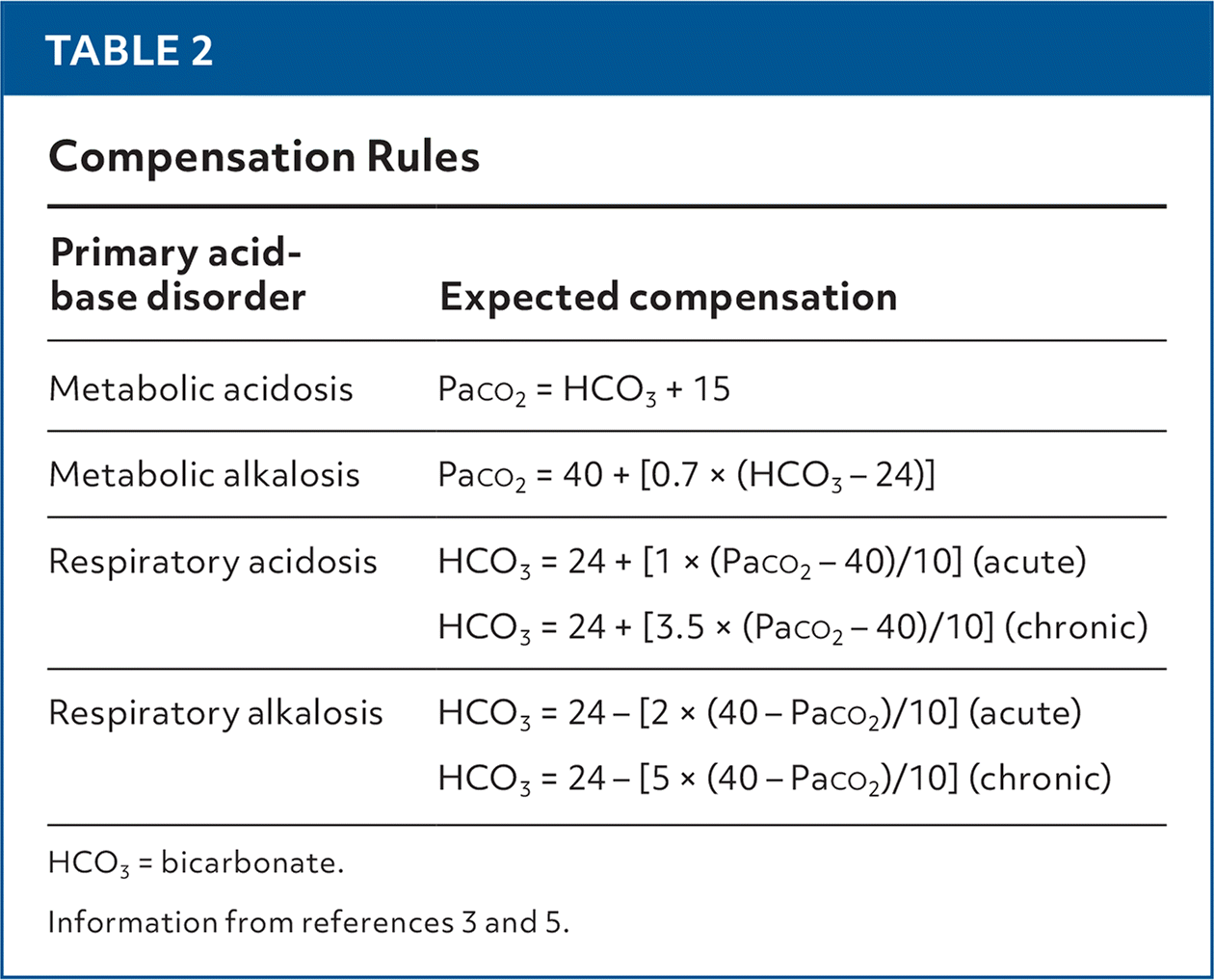
This is the most famous and frequently tested compensation. The respiratory system compensates by increasing ventilation to "blow off" CO₂, lowering the PCO₂. We use Winter's Formula to predict the target PCO₂.
Winter's Formula:
- If the patient's actual PCO₂ is within this calculated range, the respiratory compensation is appropriate. This is a simple, compensated metabolic acidosis.
- If the patient's actual PCO₂ is higher than expected, their ventilation is inadequate. This means they have a superimposed respiratory acidosis.
- If the patient's actual PCO₂ is lower than expected, they are hyperventilating even more than required. This means they have a superimposed respiratory alkalosis.
2. Metabolic Alkalosis
The respiratory system compensates by decreasing ventilation (hypoventilation) to retain CO₂, raising the PCO₂.
Compensation Formula:
A simpler rule of thumb is that the PCO₂ increases by about 0.7 mmHg for every 1 mEq/L increase in HCO₃⁻ above 24.
3. Respiratory Acidosis (Acute vs. Chronic)
The kidneys compensate by retaining HCO₃⁻. Since this is a slow process, we must distinguish between an acute event (e.g., opioid overdose) and a chronic condition (e.g., long-standing COPD).
- Acute: For every 10 mmHg increase in PCO₂ above 40, the HCO₃⁻ increases by 1 mEq/L.
- Chronic: For every 10 mmHg increase in PCO₂ above 40, the HCO₃⁻ increases by 3-4 mEq/L.
4. Respiratory Alkalosis (Acute vs. Chronic)
The kidneys compensate by excreting more HCO₃⁻.
- Acute: For every 10 mmHg decrease in PCO₂ below 40, the HCO₃⁻ decreases by 2 mEq/L.
- Chronic: For every 10 mmHg decrease in PCO₂ below 40, the HCO₃⁻ decreases by 4-5 mEq/L.
This set of rules can seem daunting at first. The following table provides a fantastic, clean summary that you may want to save for future reference.
A High-Yield Clinical Shortcut
For metabolic disorders, there's a wonderfully simple shortcut that works surprisingly well at the bedside.
In a simple, compensated metabolic disorder, the PCO₂ should be approximately equal to the last two digits of the pH.
- Example (Metabolic Acidosis): pH 7.25, PCO₂ 25. Compensation is appropriate.
- Example (Metabolic Alkalosis): pH 7.52, PCO₂ 50. Compensation is appropriate.
While the formal equations are the gold standard, this shortcut is invaluable for quickly assessing compensation during clinical rounds.
Putting It All Together: Worked Examples
Theory is one thing, but application is what matters. The next segment of the Strong Medicine video walks through three excellent clinical examples, applying these formulas to determine if compensation is appropriate or if a mixed disorder is present.
ABG Interpretation: Compensation and Mixed Disorders (Lesson 4)
Let's see these rules in action. Dr. Strong will now walk through three cases, applying the formulas we just discussed.
Please watch from 5:02 to 16:46. Pay close attention to how he first identifies the primary disorder and then uses the corresponding formula to check the compensation.
Test your understanding!
A 22-year-old female with type 1 diabetes presents to the emergency department with nausea and vomiting. Her ABG results are:
- pH: 7.28
- PCO₂: 26 mmHg
- HCO₃⁻: 12 mEq/L
- What is the primary acid-base disorder?
- Using Winter's formula, what is the expected PCO₂?
- Is the respiratory compensation appropriate, or is there a mixed disorder?
Show answer
-
Primary Disorder: The pH is low (acidosis) and the HCO₃⁻ is low. This is a metabolic acidosis. (Given her history, this is likely Diabetic Ketoacidosis, a cause of HAGMA).
-
Expected PCO₂:
Expected PCO₂ = (1.5 × 12) + 8 ± 2
Expected PCO₂ = 18 + 8 ± 2
Expected PCO₂ = 26 ± 2 (i.e., a range of 24 to 28 mmHg) -
Conclusion: The patient's actual PCO₂ is 26 mmHg, which falls perfectly within the expected range. This is a simple metabolic acidosis with appropriate respiratory compensation. You could also use the shortcut: the last two digits of the pH are 28, which is very close to the PCO₂ of 26.
Test your understanding! Part 2
A 68-year-old male with a long history of severe COPD presents for a routine check-up. His ABG shows:
- pH: 7.36
- PCO₂: 60 mmHg
- HCO₃⁻: 32 mEq/L
- What is the primary acid-base disorder?
- Is the compensation suggestive of an acute or chronic process?
- Is a second primary disorder present?
Show answer
-
Primary Disorder: The pH is on the low side of normal (7.36) and the PCO₂ is high (60 mmHg). This indicates a respiratory acidosis.
-
Acute vs. Chronic: The PCO₂ is 20 mmHg above the normal of 40.
- If acute, we'd expect the HCO₃⁻ to increase by 1 for each 10 mmHg rise in PCO₂. The expected HCO₃⁻ would be 24 + (1 × 2) = 26 mEq/L.
- If chronic, we'd expect the HCO₃⁻ to increase by ~4 for each 10 mmHg rise. The expected HCO₃⁻ would be 24 + (4 × 2) = 32 mEq/L.
The patient's actual HCO₃⁻ is 32 mEq/L, which perfectly matches the expected compensation for a chronic process.
-
Conclusion: The findings are consistent with a chronic respiratory acidosis with appropriate metabolic compensation. This is a classic "COPD retainer" pattern.
Conclusion
Congratulations on completing our module on acid-base balance! You have now mastered the complete four-step process for interpreting an ABG:
- Check the pH: Is it an acidosis or alkalosis?
- Determine the primary driver: Is it a respiratory (PCO₂) or metabolic (HCO₃⁻) problem?
- For metabolic acidosis, calculate the anion gap to narrow the differential.
- Assess compensation using the appropriate formula to see if the body's response is adequate or if a mixed disorder is present.
Key Takeaways:
- Compensation is the body's predictable response to an acid-base change, driven by the system not primarily affected.
- Comparing the patient's actual values to the calculated expected compensation is the key to identifying mixed acid-base disorders.
- The most important formulas to commit to memory are Winter's formula for metabolic acidosis and the "1, 4, 2, 5" rules for acute and chronic respiratory disorders.
In our next lesson, we will begin a new module focusing on the kidneys. We'll start by learning to interpret the fundamental markers of renal function: Blood Urea Nitrogen (BUN) and creatinine. This is a natural transition, as we've just seen how critical the kidneys are for metabolic compensation.