Hello and welcome back to our course on clinical lab interpretation.
In our previous lessons, we built a solid framework for analyzing the red blood cell lineage, using the MCV and reticulocyte count to systematically diagnose anemia. Today, we shift our focus from red cells to white cells, starting with the most abundant and important player in our innate immune system: the neutrophil.
Our goal for this lesson is to learn how to interpret neutrophilia (a high neutrophil count) and neutropenia (a low neutrophil count) in the context of infection, inflammation, and bone marrow suppression. Understanding the patterns and causes of these common abnormalities is a critical skill in daily clinical practice, from the emergency department to the oncology ward.
Part 1: Neutrophilia - The Body's First Responders on High Alert
Neutrophilia refers to an elevated absolute neutrophil count (ANC). While reference ranges vary slightly, an ANC above approximately 7,700 cells/µL is generally considered neutrophilia. This is one of the most common lab abnormalities you will encounter.
The key to interpreting neutrophilia is to understand why the count is high. Is it an appropriate response to a threat, or a sign of an underlying production problem?
The video below provides a fantastic overview of the main causes of an elevated white blood cell count, with a strong focus on neutrophils.
Complete Blood Count / CBC Interpretation (Leukocytosis)
This MedCram video introduces the four major categories of causes for leukocytosis: Infection, Steroids, Cancer, and Catastrophic Events. Pay close attention to the discussion on differentiating infection from steroid-induced neutrophilia.
Please watch the following segments: 04:02 to 06:11: This explains the classic signs of infection-driven neutrophilia, including the concept of a 'left shift'. 06:11 to 08:35: This covers how corticosteroids cause neutrophilia, primarily through demargination, and how this differs from an infectious pattern. 12:06 to 12:44: This explains how major physiological stress (like an MI or surgery) can cause a transient neutrophilia.
Understanding the "Left Shift" and Other Clues
As the video explained, one of the most important clues when evaluating neutrophilia is the presence of a "left shift." This term refers to an increase in the proportion of immature neutrophils, such as bands and sometimes even earlier forms like metamyelocytes.
Think of the bone marrow as a training camp for neutrophils. Under normal conditions, only mature, "graduated" neutrophils (also called segs or polys) are released into the bloodstream. During an acute bacterial infection, the demand is so high that the marrow is forced to release partially trained recruits—the bands. Seeing a significant number of bands tells you the marrow is under acute stress, most commonly from infection.
The peripheral blood smear can provide other clues:
- Toxic granulations: Darker-staining granules in the cytoplasm.
- Döhle bodies: Pale blue inclusions in the cytoplasm.
- Cytoplasmic vacuoles: Appear as "holes" in the cell.
These findings are morphological signs of neutrophil activation and rapid production, further strengthening the case for a reactive process like infection or severe inflammation.
Building a Differential Diagnosis for Neutrophilia
Let's organize the causes of neutrophilia into a clinical framework. The flowchart below provides an excellent visual summary of the mechanisms and causes.
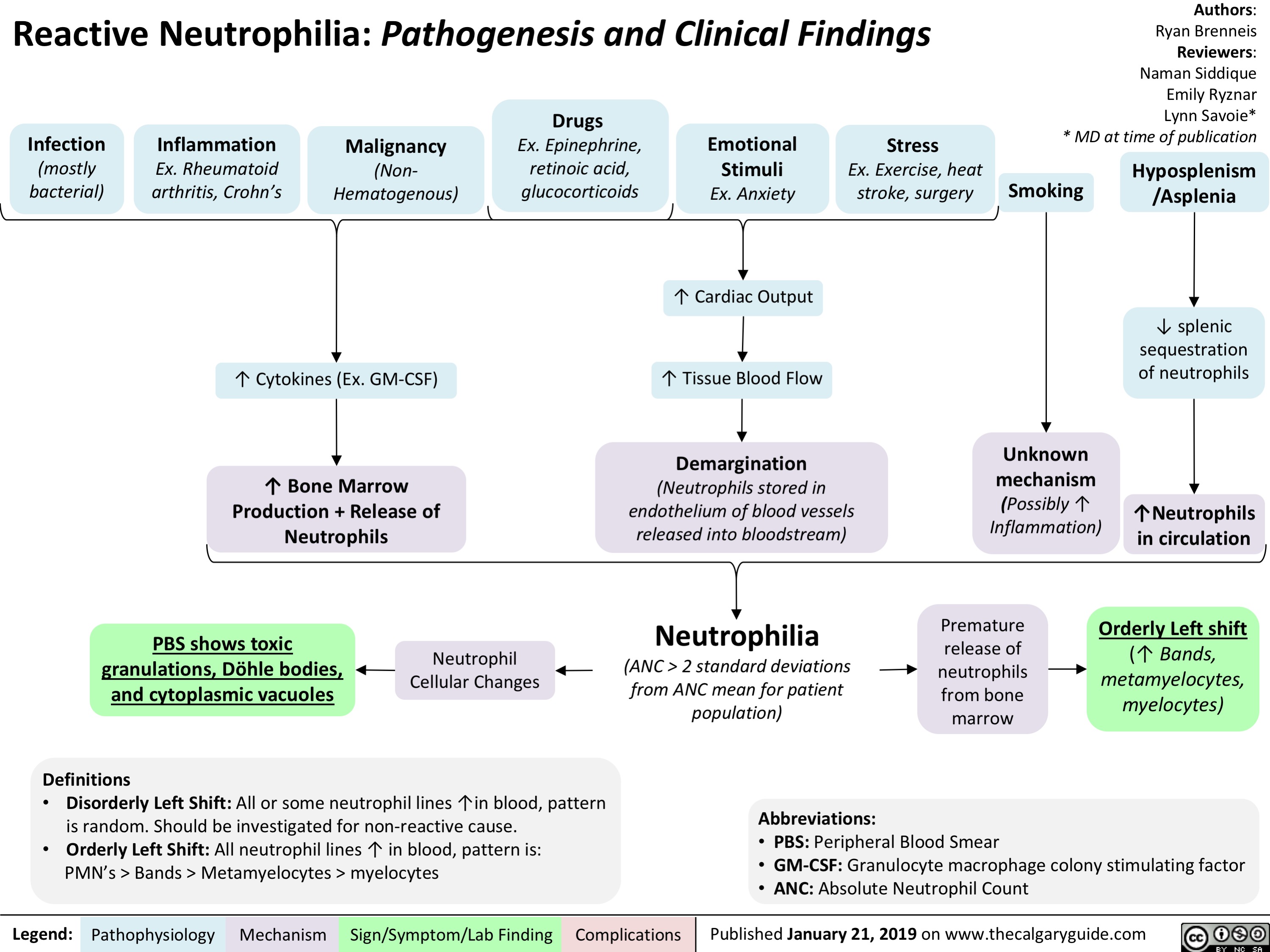
To dive deeper into this differential, the following resource provides a concise but comprehensive list of causes.
Why Does My Patient Have Leukocytosis?
This document, 'Why Does My Patient Have Leukocytosis?', contains a highly useful summary of the causes of neutrophilia.
Please read 'Box 1: Causes of neutrophilia'. This table neatly categorizes the causes into secondary (reactive) and primary (hematologic) etiologies. This is a high-yield list to be familiar with.
Synthesizing these resources, here are the key categories to consider:
- Infection: The most common cause. Typically acute bacterial infections (e.g., pneumonia, UTI, cellulitis, abscess). The classic pattern is neutrophilia with a left shift. Exceptionally high counts (>50,000/µL) should make you consider infections like Clostridium difficile.
- Inflammation & Tissue Necrosis: Any major stress or injury can trigger neutrophil release. This includes myocardial infarction, surgery, trauma, burns, and chronic inflammatory states like IBD or rheumatoid arthritis.
- Medications:
- Corticosteroids (e.g., prednisone): A very common cause. The primary mechanism is demargination—forcing neutrophils stuck to the blood vessel walls into circulation. This typically causes neutrophilia without a significant left shift, a key differentiating feature from infection.
- Lithium: Stimulates bone marrow production.
- G-CSF (e.g., filgrastim): A medication given specifically to boost neutrophil production.
- Malignancy: Can be a primary bone marrow disorder (e.g., Chronic Myeloid Leukemia - CML) or a secondary effect of a non-hematologic tumor that secretes growth factors.
- Other: Cigarette smoking (chronic mild neutrophilia), asplenia (reduced clearance), and acute physiologic stress (e.g., intense exercise).
Test your understanding!
A 72-year-old man is on Day 3 of high-dose IV methylprednisolone for a severe COPD exacerbation. His morning labs show a WBC of 18,500/µL with 88% neutrophils and 1% bands. He is afebrile and his breathing has improved. How do you interpret this neutrophilia?
Show answer
This is most likely a steroid-induced neutrophilia. The key features are the known use of high-dose corticosteroids, the significant elevation in neutrophils, and the lack of a significant left shift (only 1% bands). The absence of fever and clinical improvement also argue against a new, superimposed infection. The mechanism is primarily demargination.
Part 2: Neutropenia - When the Defenses Are Down
Neutropenia, a low absolute neutrophil count (ANC), is a much more alarming finding because it leaves the patient vulnerable to life-threatening infections. The risk of infection increases dramatically as the ANC falls.
Clinical Definitions:
- ANC: Calculated as
- Mild Neutropenia: ANC 1000-1500/µL
- Moderate Neutropenia: ANC 500-1000/µL
- Severe Neutropenia: ANC < 500/µL
An ANC below 500 is a critical threshold where the risk for severe bacterial and fungal infections skyrockets.
Febrile Neutropenia: A Medical Emergency
The combination of fever (typically >38.3°C or 101°F) and severe neutropenia (ANC < 500) is known as febrile neutropenia. This is an oncologic emergency. You must assume the patient has a life-threatening infection, even if a source isn't obvious, and act immediately.
The following video provides an excellent animated explanation of febrile neutropenia, its cause, and management.
What is febrile neutropaenia (neutropenia)? - neutrophil function, pathophysiology, treatment
This video from Armando Hasudungan clearly explains the pathophysiology of febrile neutropenia, focusing on its most common context: post-chemotherapy.
Please watch from the beginning to 06:35. Focus on: The role of neutrophils as the first line of defense. How chemotherapy causes neutropenia. The definition of febrile neutropenia and why it's an emergency requiring prompt, broad-spectrum antibiotics.
Building a Differential Diagnosis for Neutropenia
The causes of neutropenia can be broadly grouped into three categories:
- Decreased Production: The bone marrow isn't making enough.
- Increased Peripheral Destruction/Consumption: Neutrophils are being used up or destroyed faster than they can be made.
- Sequestration: Neutrophils are trapped, usually in an enlarged spleen.
The resource below is an excellent clinical guide that details the differential diagnosis and evaluation of neutropenia.
How we evaluate and treat neutropenia in adults | Blood
This article from the journal 'Blood', titled 'How we evaluate and treat neutropenia in adults', provides a practical, clinically-oriented approach.
Please review the section 'Differential diagnosis of neutropenia' and familiarize yourself with the tables: Table 1: Causes of neutropenia in adults: This gives a broad overview of acquired vs. congenital causes. Table 2: Drugs associated with neutropenia or agranulocytosis: This is a crucial list of common offenders beyond chemotherapy.
Here is a summary of the most important causes to remember:
- Medications:
- Chemotherapy: The most common cause of severe neutropenia. This is an expected effect of myelosuppressive agents.
- Other Drugs: Many medications can cause idiosyncratic neutropenia. Important examples include anti-thyroid drugs (methimazole), certain antibiotics (sulfonamides), antipsychotics (clozapine), and anti-epileptics (carbamazepine). Always take a thorough medication history.
- Infections:
- Severe Sepsis: Overwhelming infection can exhaust bone marrow reserves, leading to neutropenia. This is a very poor prognostic sign.
- Viral Infections: Viruses like HIV, EBV, and hepatitis can suppress the bone marrow.
- Bone Marrow Disorders:
- Aplastic Anemia: Failure of the entire bone marrow.
- Leukemia/Myelodysplastic Syndrome (MDS): Malignant cells crowd out normal neutrophil production.
- Marrow Infiltration: Cancers metastasizing to the bone.
- Autoimmune Disorders:
- Antibodies destroy circulating neutrophils. This can be seen in Systemic Lupus Erythematosus (SLE) or as a standalone condition.
- Felty's Syndrome: A specific triad of rheumatoid arthritis, an enlarged spleen (splenomegaly), and neutropenia.
- Nutritional Deficiencies: Severe Vitamin B12, folate, or copper deficiency can cause neutropenia, usually as part of a broader pancytopenia (low counts in all cell lines).
- Benign Ethnic Neutropenia: A common, benign condition seen in individuals of African, Middle Eastern, or West Indian descent who have a chronically lower, but stable, baseline ANC that does not increase their risk of infection.
The following algorithm provides a visual guide to the diagnostic workup.

Test your understanding!
A 35-year-old woman with Graves' disease, recently started on methimazole, presents to the emergency department with a fever of 39°C and a severe sore throat. Her labs show a WBC of 1,200/µL and an ANC of 150/µL. What is the most likely diagnosis and the most important next step?
Show answer
The most likely diagnosis is methimazole-induced agranulocytosis presenting as febrile neutropenia. The combination of a drug known to cause neutropenia, the presence of fever, and a severely low ANC (<500) is the classic picture.
The most important next step is to admit the patient, stop the methimazole, obtain blood cultures, and immediately administer broad-spectrum intravenous antibiotics. This is a medical emergency.
Conclusion
You have now learned to interpret the two most common and clinically significant abnormalities of the neutrophil count. This is a foundational skill for managing a wide range of patients.
Key Takeaways:
- Neutrophilia is commonly a reactive process. The presence of a "left shift" strongly suggests a bacterial infection. The absence of a left shift in a patient on steroids points towards a drug effect.
- Neutropenia's significance is directly related to the ANC. An ANC < 500/µL is a state of severe immune compromise.
- Febrile Neutropenia (fever + ANC < 500) is a medical emergency that requires immediate evaluation and empiric antibiotics.
- Medications are a frequent cause of both neutrophilia (corticosteroids) and neutropenia (chemotherapy, and many others idiosyncratically). A thorough medication review is non-negotiable.
Next Steps
We have covered the most abundant granulocyte, the neutrophil. In our next lesson, we will complete our tour of the CBC differential by focusing on the other key players. You will learn to interpret lymphocytosis and eosinophilia in common clinical scenarios, rounding out your ability to analyze the white blood cell count.