Hello! Welcome back.
In our last lesson, we established the first step in any anemia workup: classifying it by Mean Corpuscular Volume (MCV). This is the morphological approach, answering the question, "What do the red blood cells look like?" You learned to differentiate anemias into microcytic, normocytic, and macrocytic categories, which begins to narrow down the potential causes.
Today, we will add the second, equally crucial, layer to your diagnostic framework. We'll explore the kinetic approach, which answers the question, "How is the bone marrow responding to the anemia?" Our goal is to integrate the reticulocyte count to differentiate anemias caused by underproduction versus peripheral loss. This will allow you to distinguish a "factory" problem (the bone marrow) from a problem of loss or destruction happening elsewhere in the body.
What is a Reticulocyte? The Bone Marrow's Report Card
A reticulocyte is an immature red blood cell that has just been released from the bone marrow. It no longer has a nucleus, but it still contains residual ribosomal RNA, which it uses to synthesize hemoglobin for another day or two in the circulation before becoming a mature RBC.
Think of the reticulocyte count as a direct measure of your bone marrow's output. When a patient is anemic, the body senses the low oxygen-carrying capacity and signals the bone marrow (via the hormone erythropoietin) to ramp up production. A healthy bone marrow will respond by churning out new RBCs, which means releasing more reticulocytes.
Therefore, the reticulocyte count in the context of anemia tells you a story:
- A low count suggests an underproduction problem: The bone marrow isn't responding appropriately. The factory is failing.
- A high count suggests a peripheral problem: The bone marrow is responding vigorously, but the cells are being lost through bleeding or destroyed by hemolysis. The factory is working overtime to meet demand.
The following video provides an excellent overview of this fundamental concept.
This segment from the Ninja Nerd channel clearly explains how the reticulocyte count helps stratify anemia into two main categories: decreased production versus increased loss/destruction.
Watch from 4:04 to 10:27. Focus on how the reticulocyte index serves as a key decision point. The video introduces a practical cutoff of 2% to distinguish between an underproduction problem (reticulocyte index < 2%) and a loss/destruction problem (reticulocyte index > 2%).
Quantifying the Response: From Percentage to Index
As the video mentions, simply looking at the raw reticulocyte percentage can be misleading. In an anemic patient, the percentage of reticulocytes might appear high simply because the total number of mature red blood cells is low. To get a true sense of the marrow's production, we need to correct for the degree of anemia.
This leads to several calculations, starting with the Corrected Reticulocyte Count:
\text{Corrected Retic %} = \text{Retic %} \times \frac{\text{Patient's Hematocrit}}{\text{Normal Hematocrit (e.g., 45%)}}
Furthermore, in severe anemia, the bone marrow is under such high "stress" that it releases reticulocytes prematurely. These "shift" reticulocytes spend longer maturing in the peripheral blood, which can also falsely elevate the count. The Reticulocyte Production Index (RPI) corrects for both the anemia and this maturation time.

While the RPI is the most physiologically accurate measure, in clinical practice, many clinicians use a simplified Reticulocyte Index (RI) or a corrected percentage. The key is the interpretation of the final number.
02. Approach to Anemia | Hospital Handbook
The UCSF Hospital Handbook provides a very practical, clinically-focused summary of how to calculate and use the Reticulocyte Index.
Please read the section under the heading 'Evaluation of Reticulocyte Index (RI)' within the 'MACROCYTIC (MCV>100)' chapter. Focus on the formula and, most importantly, the table that interprets the clinical meaning of an RI > 3 and an RI < 2.
To summarize the key interpretation points:
- Reticulocyte Index < 2% (or RPI < 2): Inadequate bone marrow response. This points to an underproduction anemia.
- Reticulocyte Index > 2-3% (or RPI > 3): Adequate (or hyper-proliferative) bone marrow response. This points to anemia from peripheral RBC loss (bleeding) or destruction (hemolysis).
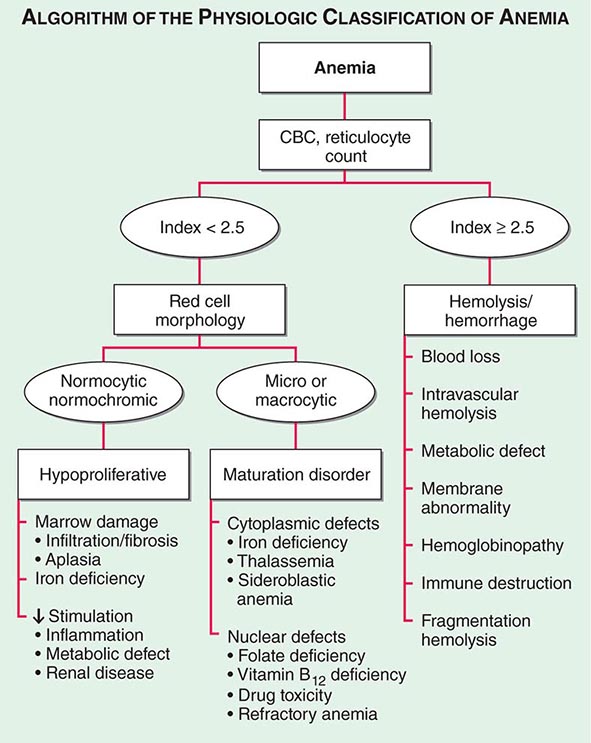
The flowchart below visualizes how the reticulocyte count serves as a major fork in the road for your diagnostic algorithm.
Building a Differential Diagnosis with the Reticulocyte Index
Now, let's apply this framework.
Branch 1: Low Reticulocyte Index (< 2%) - The Underproduction Anemias
If the bone marrow isn't producing enough cells, the causes generally fall into three categories:
- Lack of Building Blocks: The factory has no raw materials.
- Iron deficiency
- Vitamin B12 or Folate deficiency
- Bone Marrow Failure/Suppression: The factory itself is broken or suppressed.
- Aplastic anemia
- Myelodysplastic syndrome (MDS) or leukemia
- Marrow suppression from drugs, chemotherapy, or radiation
- Anemia of chronic inflammation/disease (multiple mechanisms, including impaired iron utilization)
- Lack of Stimulation: The factory isn't getting the order to produce.
- Chronic kidney disease (low erythropoietin)
- Hypothyroidism
This is where integrating the MCV from our last lesson is critical. For example, an underproduction anemia (low RI) with a low MCV strongly suggests iron deficiency, whereas a high MCV points toward B12/folate deficiency.
Branch 2: High Reticulocyte Index (> 2%) - The Destruction/Loss Anemias
If the bone marrow is pumping out cells, you know they are being lost somewhere. There are two main possibilities: they are being destroyed (hemolysis) or they are bleeding out.
Your next step is to distinguish between these two. You do this by checking hemolytic labs.
This clip from Ninja Nerd explains the next diagnostic step for a patient with a high reticulocyte index: checking hemolytic labs to differentiate destruction from simple blood loss.
Watch from 59:42 to 1:05:54. Pay close attention to the three key markers of hemolysis: Lactate Dehydrogenase (LDH): High (released from destroyed RBCs) Haptoglobin: Low (consumed by binding free hemoglobin) Indirect (Unconjugated) Bilirubin: High (a breakdown product of heme)
So, the logic is:
- High RI + Positive Hemolytic Labs = Hemolytic Anemia.
- High RI + Negative Hemolytic Labs = Blood Loss.
If the evidence points to blood loss, your job becomes a clinical search for the source.
When hemolysis is ruled out, the cause of a high-reticulocyte anemia is blood loss. This video discusses the common culprits.
Watch from 1:24:12 to 1:29:02. Note the common clinical scenarios mentioned, such as iatrogenic blood loss from frequent draws, surgical procedures, GI bleeds, and retroperitoneal bleeds.
Test your understanding!
A 68-year-old patient with chronic kidney disease presents with fatigue.
- CBC: Hgb 8.5 g/dL, Hct 26%, MCV 92 fL
- Reticulocyte Count: 0.5%
You calculate a Reticulocyte Index of approximately 0.3%. How do you interpret this finding, and what is the most likely cause of their anemia?
Show answer
The reticulocyte index is very low (<2%), indicating an underproduction anemia. The bone marrow is not responding appropriately to the low hemoglobin. Given the patient's history of chronic kidney disease and a normocytic anemia, the most likely cause is decreased erythropoietin production from the failing kidneys.
Clinical Synthesis: Putting it all Together
Let's walk through a case that perfectly illustrates this entire thought process.
This brief case study applies the algorithm we've just discussed to a realistic clinical scenario.
Watch this final clip from 1:29:02 to 1:30:39. Follow the logic: Anemia -> Check Retic Index -> It's high (>2%) -> Check Hemolytic Labs -> They're normal -> Diagnosis is blood loss -> Look for the source.
Conclusion
Congratulations! You have now mastered the two-axis system for anemia diagnosis. By combining the morphological approach (MCV) with the kinetic approach (reticulocyte index), you can rapidly and logically narrow down the cause of almost any anemia you will encounter.
Key Takeaways:
- The reticulocyte count assesses the bone marrow's response to anemia.
- A low Reticulocyte Index (< 2%) signifies an underproduction anemia, where the primary problem is in the bone marrow or its inputs (nutrients, hormones).
- A high Reticulocyte Index (> 2-3%) signifies a peripheral loss anemia, where a healthy marrow is trying to compensate for either hemolysis or blood loss.
- The key step to differentiate hemolysis from blood loss in a high-RI anemia is to check hemolytic labs (LDH, haptoglobin, indirect bilirubin).
Next Steps
We have now built a robust framework for evaluating the red blood cell component of the CBC. In our next lesson, we will shift our attention to the white blood cells. You will learn to interpret neutrophilia and neutropenia in the context of infection, inflammation, and bone marrow suppression.