Hello and welcome back to our course on clinical laboratory interpretation.
In our last lesson, we established the fundamental patterns for diagnosing primary thyroid disease by interpreting TSH and Free T4. We learned that in a healthy state, the hypothalamic-pituitary-thyroid (HPT) axis maintains a stable balance through negative feedback. This leads to the classic patterns:
- Primary Hypothyroidism: High TSH, Low Free T4
- Primary Hyperthyroidism: Low TSH, High Free T4
Today, we address a critical exception to these rules that you will frequently encounter in hospitalized patients. This lesson focuses on the learning outcome: Recognize the TSH and T4 pattern suggestive of sick euthyroid syndrome in critically ill patients. Understanding this phenomenon, also called Non-Thyroidal Illness Syndrome (NTIS), is essential to avoid misdiagnosing and inappropriately treating patients who are ill from other causes.
1. What is Sick Euthyroid Syndrome (SES)?
Sick Euthyroid Syndrome refers to abnormal thyroid function test (TFT) results in patients with acute or chronic systemic illnesses, who do not have a pre-existing thyroid gland disorder. Essentially, the patient is "euthyroid" (has a normal thyroid), but is "sick" from another cause, leading to altered TFTs.
This is not a rare finding; it's observed in up to 75% of hospitalized patients. It's thought to be an adaptive, energy-conserving response to severe physiologic stress.
When should you suspect SES?
This syndrome occurs in the context of significant non-thyroidal illnesses. As a medical student on rotations, you will see these conditions daily.
Euthyroid Sick Syndrome - StatPearls - NCBI Bookshelf - NIH
To understand the clinical context and basic definition of SES, please review the 'Introduction' and 'Etiology' sections of this StatPearls article. It provides a concise overview and a list of common underlying causes.
Read the 'Introduction' and 'Etiology' sections. Focus on the core definition and familiarize yourself with the list of triggering illnesses like sepsis, myocardial infarction, and major surgery.
The key takeaway is that when you see a patient with pneumonia, sepsis, DKA, or who is post-op from major surgery, you should have a high index of suspicion that any abnormal TFTs may be due to SES. The underlying mechanism involves inflammatory cytokines (like IL-6 and TNF-alpha) and stress hormones (like cortisol) that interfere with the HPT axis and the peripheral conversion of T4 to the more active T3.
2. The Dynamic and Evolving Lab Pattern
Unlike the static patterns of primary thyroid disease, the lab findings in SES change dynamically with the severity and phase of the underlying illness.
To understand this, let's watch a brief video that explains the initial and most common finding.
Diagnosis of Hypothyroidism, Subclinical Hypothyroidism, Euthyroid Sick Syndrome Investigation USMLE
This clip from MedNerd - Dr. Waqas Fazal clearly explains the foundational concept of SES, focusing on the initial drop in T3 levels while T4 and TSH may remain normal.
Watch from 05:31 to 06:59. Notice the explanation that decreased peripheral conversion of T4 to T3 is the primary event, leading to an isolated low T3.
As the video highlights, the first and most common abnormality is a low T3 level. As the illness worsens, the pattern evolves.
The graph below is one of the best ways to visualize the entire process.
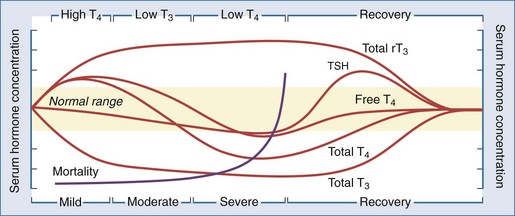
Let's break down the phases shown in the graph:
-
Mild-to-Moderate Illness (Low T3 Syndrome):
- T3: Decreases significantly.
- Reverse T3 (rT3): Increases (as T4 is shunted away from active T3 production).
- T4 and TSH: Usually remain within the normal range.
-
Severe Illness (Low T3-Low T4 Syndrome):
- T3: Remains very low.
- T4: Now also decreases.
- TSH: Can be low, or "inappropriately normal" (you would expect it to be high in response to a low T4, but it isn't).
-
Recovery Phase:
- As the patient's underlying illness improves, the HPT axis "wakes up."
- TSH: May transiently rise, sometimes even above the normal reference range, before settling back to normal.
- T4 and T3: Gradually return to normal.
This table provides a concise summary of the patterns.

3. Clinical Application: Differentiating SES from True Thyroid Disease
The central challenge on the wards is not to confuse SES with a true thyroid disorder.
-
SES vs. Central Hypothyroidism: In severe illness, both conditions can present with low T4 and low/normal TSH. This is a difficult distinction. Context is paramount: is the patient critically ill in the ICU? If so, SES is far more likely. A high reverse T3 level would also point towards SES, but this test is not routinely ordered.
-
SES (Recovery Phase) vs. Primary Hypothyroidism: During recovery from SES, the TSH can be high while T4 is still low or normal, mimicking primary hypothyroidism.
How do you tell them apart? The magnitude of the TSH elevation is a key clue.
Euthyroid Sick Syndrome - Endocrine and Metabolic ...
The MSD Manual offers a crucial clinical pearl for distinguishing the recovery phase of SES from true primary hypothyroidism.
Read the text starting 'Decreased triiodothyronine (T3) levels are most common...' through the 'Diagnosis' section. Focus on the statement that TSH in euthyroid sick syndrome is usually < 10 mIU/L.
As the manual points out, in the recovery phase of SES, TSH is typically only mildly elevated (e.g., 5-15 mIU/L). In contrast, a patient with significant primary hypothyroidism will often have a TSH well above 20 mIU/L, and frequently much higher.
Test your understanding!
A 68-year-old man is in the ICU on day 5 of treatment for severe sepsis from pneumonia. He is slowly improving. You check his labs and find:
- TSH: 8.5 mU/L (normal 0.4-4.2)
- Free T4: 0.9 ng/dL (normal 0.8-1.8)
How do you interpret these findings? Is this likely primary hypothyroidism or something else?
Show answer
This is most likely the recovery phase of sick euthyroid syndrome.
Reasoning:
- Clinical Context: The patient is critically ill with sepsis, a classic trigger for SES.
- Lab Pattern: The TSH is mildly elevated, and the Free T4 is in the low-normal range. This pattern is characteristic of the HPT axis "waking up" as the patient recovers from their severe illness.
- TSH Magnitude: A TSH of 8.5 mU/L is not as high as would be expected for new-onset, clinically significant primary hypothyroidism, where it would likely be much higher.
4. Prognosis and Management
The most important takeaways for your clinical practice relate to what these findings mean and what you should (and should not) do about them.
Prognosis: The degree of T4 reduction is not benign; it is a marker of the severity of the underlying illness and correlates with mortality. A lower T4 level in an ICU patient indicates a worse prognosis.
Management:
The core principle is to treat the underlying illness, not the numbers on the lab report. Thyroid hormone replacement (i.e., giving levothyroxine) has not been shown to improve outcomes in patients with SES and is not recommended.
The best clinical practice is often to avoid checking TFTs in critically ill patients unless you have a strong, independent reason to suspect a true thyroid disorder (e.g., a known history of thyroid disease, a goiter on exam, or classic signs of myxedema coma or thyroid storm).
This final video provides an excellent summary of the diagnostic challenge and offers this exact pragmatic advice.
Thyroid Hormones and Thyroid Function Tests
Let's conclude with this clip from Strong Medicine, which synthesizes the complexity of SES and provides a clear, practical takeaway for ordering TFTs in sick patients.
Watch from 14:56 to 19:31. The video discusses the various confusing patterns that SES can create and concludes with the crucial advice to defer testing unless your clinical suspicion for true thyroid disease is high.
Conclusion
You now have the framework to interpret one of the most common and potentially confusing lab abnormalities in hospital medicine. By understanding the context and the dynamic nature of sick euthyroid syndrome, you can avoid diagnostic pitfalls and focus your attention on the patient's primary illness.
Key Takeaways:
- Sick Euthyroid Syndrome (SES) describes abnormal TFTs in critically ill patients who have a healthy thyroid gland.
- The lab pattern evolves: it typically begins with a low T3, and in severe illness progresses to include a low T4 with a low or inappropriately normal TSH.
- The degree of T4 suppression is a prognostic marker for the underlying critical illness.
- The recovery phase can mimic primary hypothyroidism with a transiently elevated TSH, but the elevation is usually mild (< 20 mIU/L).
- Management: Treat the underlying disease. Do not give thyroid hormone. Avoid routine screening with TFTs in the ICU.
Preview of the Next Lesson:
Having discussed a major non-thyroidal cause of abnormal TFTs, we will now return our focus to the thyroid gland itself. In the next lesson, we will explore the autoimmune causes of thyroid disease, learning to interpret thyroid antibodies in the context of autoimmune thyroid disease (e.g., Hashimoto's, Graves').