Hello! Welcome back to our course on clinical laboratory interpretation.
In our last lesson, we focused on a common diagnostic challenge: distinguishing true thyroid disease from Sick Euthyroid Syndrome (SES), where abnormal TFTs are caused by a non-thyroidal illness. We learned that in SES, the thyroid gland itself is healthy.
Today, we shift our focus to diseases that are intrinsic to the thyroid gland—specifically, autoimmune disorders. This lesson will teach you how to interpret thyroid antibodies in the context of autoimmune thyroid disease, such as Hashimoto's thyroiditis and Graves' disease. After finding an abnormal TSH and T4, ordering the right antibody test is the next crucial step to pinpoint the underlying cause and guide management.
1. Autoimmune Thyroid Disease: The "Why" Behind the Abnormal TFTs
As you've seen on your rotations, finding a high TSH (hypothyroidism) or a low TSH (hyperthyroidism) is just the beginning. The next question is why. In many adults, the answer is autoimmunity—a process where the body's own immune system mistakenly targets the thyroid gland.
The two most common autoimmune thyroid diseases present with opposite effects:
- Hashimoto's Thyroiditis: An autoimmune attack that destroys thyroid tissue, leading to hypothyroidism.
- Graves' Disease: An autoimmune attack that stimulates thyroid tissue, leading to hyperthyroidism.
Therefore, antibody testing is not for screening; it's a second-line investigation used to confirm the autoimmune etiology after you've already established the presence of hypo- or hyperthyroidism with TSH and Free T4 tests.
Autoimmune Thyroiditis | Choose the Right Test
To set the stage, let's review the clinical context for when to suspect these conditions and why we test for antibodies. Please read the introductory sections from this excellent ARUP Consult guide.
First, read the two sections under 'Quick Answers for Clinicians' titled 'When should Hashimoto thyroiditis be suspected?' and 'When should Graves disease be suspected?'. Then, jump down to the 'Indications for Testing' section. This will reinforce the idea that antibody tests are used to differentiate the cause of an already-identified thyroid dysfunction.
2. The Key Players: An Introduction to Thyroid Antibodies
There are three main types of thyroid autoantibodies you will encounter in clinical practice. Each has a different target and, therefore, a different clinical significance.
Let's start with a quick video overview that introduces these antibodies.
Understanding Thyroid Function Tests
This short clip from Zero To Finals provides a clear and concise introduction to the three key thyroid autoantibodies and their primary associations.
Watch from 06:19 to 07:53. Pay close attention to the names of the three antibodies and the primary disease linked to each.
As the video explained, the main antibodies are:
- Thyroid Peroxidase Antibodies (TPOAb): These antibodies target thyroid peroxidase, a key enzyme in the production of thyroid hormones. Their presence signifies autoimmune-mediated inflammation and tissue destruction.
- Thyroglobulin Antibodies (TgAb): These antibodies target thyroglobulin, the protein scaffold on which thyroid hormones are synthesized.
- TSH Receptor Antibodies (TRAb): These antibodies are unique because they target the TSH receptor itself. They can either:
- Stimulate the receptor, mimicking TSH and causing hyperthyroidism. This type is often specifically called Thyroid-Stimulating Immunoglobulin (TSI).
- Block the receptor, preventing TSH from binding and causing hypothyroidism (this is less common).
3. Pattern Recognition: Differentiating Hashimoto's and Graves'
Your primary goal is to use these antibodies to distinguish between the two major autoimmune thyroid diseases.
A. Hashimoto's Thyroiditis: The Destructive Pattern
Hashimoto's is the most common cause of hypothyroidism in iodine-sufficient regions. The diagnostic pattern is straightforward:
- Pathophysiology: Lymphocytic infiltration and destruction of the thyroid gland.
- TFTs: High TSH, Low Free T4.
- Key Antibody: Positive TPOAb. Over 90% of patients with Hashimoto's will have elevated TPOAb. TgAb may also be present, but TPOAb is more sensitive and specific.
B. Graves' Disease: The Stimulatory Pattern
Graves' disease is the most common cause of hyperthyroidism. The immune system, in this case, acts as an accelerator.
- Pathophysiology: Stimulating TSH receptor antibodies (TRAb/TSI) bind to and continuously activate the TSH receptor, leading to uncontrolled thyroid hormone production and gland growth (goiter).
- TFTs: Low TSH, High Free T4.
- Key Antibody: Positive TRAb. This is the pathognomonic (i.e., specifically diagnostic) antibody for Graves' disease. While around 80% of patients with Graves' may also have positive TPOAb, the TRAb is what confirms the diagnosis.
The following video provides an excellent walkthrough of these distinct patterns and introduces some important clinical nuances.
Thyroid Antibodies and Autoimmunity. How to tests for Hashimoto's Thyroiditis and Grave's Disease.
Dr. Jin W. Sung explains how to use antibody tests to differentiate Graves' and Hashimoto's. Note the emphasis on TRAb for Graves' and TPOAb/TgAb for Hashimoto's.
Watch the clip from 00:49 to 06:10. Pay special attention to two key points: 1) how Graves' is defined by TRAb positivity, even if other antibodies are present, and 2) the concept of 'silent autoimmunity' in Hashimoto's, where antibodies are positive but TSH is still normal.
4. Synthesizing the Data for Clinical Diagnosis
Now, let's put all this information together in a structured way that you can use on the wards. The prevalence of these antibodies in different conditions is what gives them their diagnostic power.
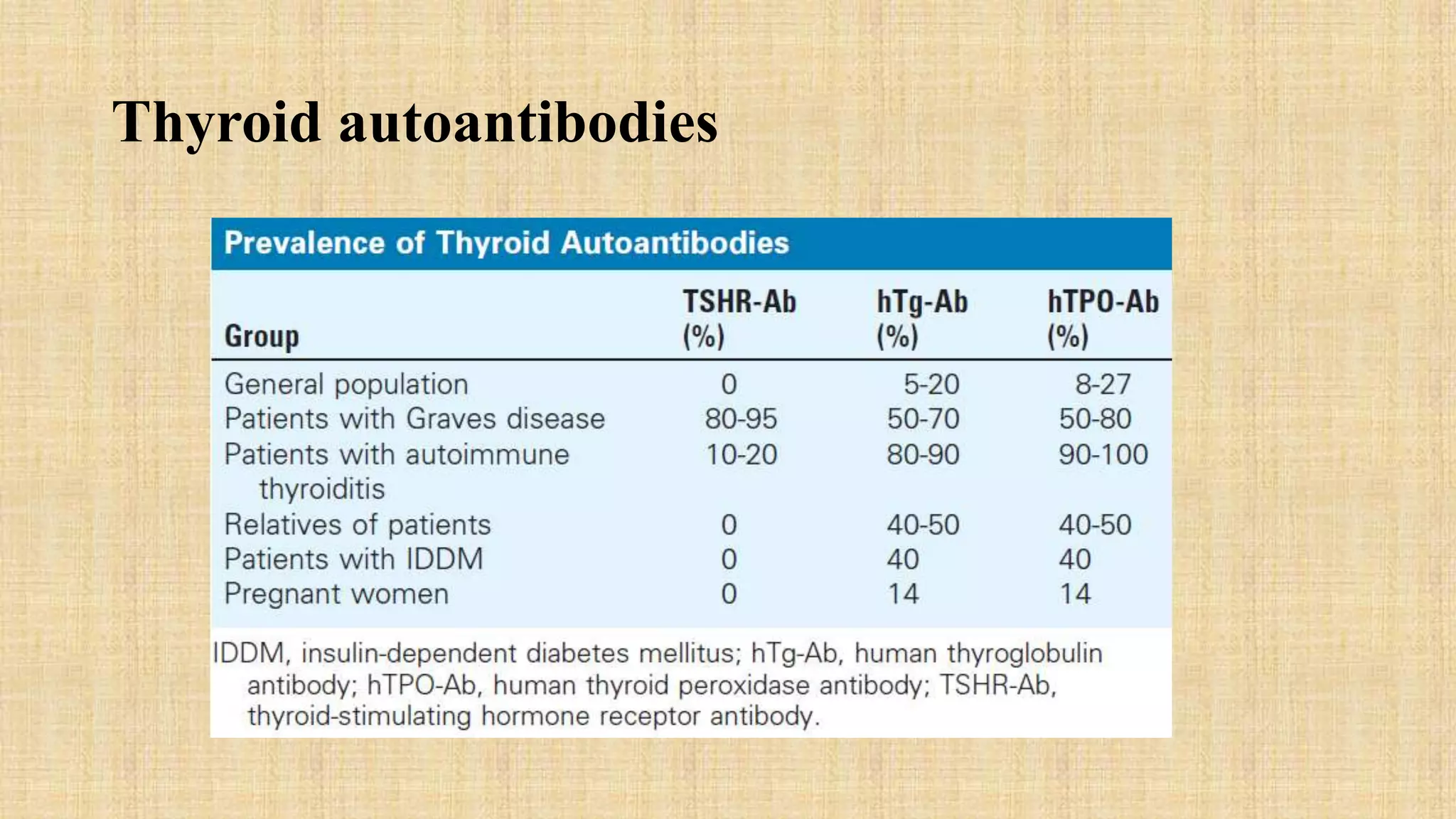
The most comprehensive way to understand the clinical utility of each test is to see them compared side-by-side.
Autoimmune Thyroiditis | Choose the Right Test
This table from ARUP Consult is a high-yield resource that summarizes everything you need to know about the clinical use of these antibodies. I encourage you to study it carefully.
Focus on the table titled 'Antithyroid Antibodies by Biology, Mechanism, Type, Evidence of Tissue Damage, and Clinical Use.' Specifically, compare the 'Clinical use' rows for Graves' Disease and Hashimoto Thyroiditis. Note which antibody is considered 'pathognomonic' for each.
From that table, we can extract the core diagnostic logic:
| Condition | Typical TFTs | Confirmatory Antibody | Key Facts |
|---|---|---|---|
| Hashimoto's Thyroiditis | High TSH, Low T4 | TPOAb | Present in >90% of cases. TgAb are also often present but are less sensitive. |
| Graves' Disease | Low TSH, High T4 | TRAb (or TSI) | Pathognomonic for Graves'. TPOAb are also present in ~80% of cases but are not specific. |
It's also helpful to visualize these conditions not as entirely separate buckets, but as part of a spectrum.

Test your understanding!
You are seeing three different patients in clinic:
- Patient A: A 34-year-old woman with fatigue and weight gain. Labs show TSH 25.2 mU/L (high) and Free T4 0.6 ng/dL (low).
- Patient B: A 28-year-old man with anxiety, palpitations, and a 15-lb weight loss. Labs show TSH <0.01 mU/L (low) and Free T4 3.1 ng/dL (high).
- Patient C: A 45-year-old woman is here for a routine check-up. Her sister was recently diagnosed with Hashimoto's. The patient feels well. Her TSH and Free T4 are normal, but you order antibody tests and find she has high TPOAb titers.
For each patient, what is the most likely diagnosis, and what does the antibody result tell you?
Show answer
- Patient A: The diagnosis is primary hypothyroidism. The high TPOAb would confirm the cause as Hashimoto's thyroiditis. This is the classic pattern.
- Patient B: The diagnosis is primary hyperthyroidism. A positive TRAb/TSI test would confirm the cause as Graves' disease.
- Patient C: This patient has euthyroid autoimmune thyroiditis (or "silent autoimmunity"). She does not have thyroid disease yet, but the presence of TPOAb places her at a significantly higher risk of developing overt hypothyroidism in the future. She should be monitored periodically with TSH testing.
5. Clinical Nuances: When Not to Test and Other Uses
Finally, a few practical points to round out your understanding.
- Repeating Antibody Tests: It is rarely useful to repeat TPOAb tests. The level does not correlate with disease severity or guide levothyroxine dosing. TRAb levels, however, are sometimes trended in Graves' disease, as higher levels can predict a lower chance of remission after treatment.
- The Role of TgAb: While present in Hashimoto's, the primary clinical use for TgAb is in monitoring for recurrence of differentiated thyroid cancer after thyroidectomy. The presence of TgAb can interfere with the measurement of Thyroglobulin (Tg), the tumor marker, so it's always ordered alongside Tg.
- Antibodies Can Persist: Antibodies often remain positive for life, even after the thyroid disorder is successfully treated (e.g., a patient with Graves' who undergoes thyroidectomy will still have positive TRAb for some time).
This resource from the British Thyroid Foundation provides a clear, patient-friendly summary of these key points, which serves as an excellent review.
Read the sections titled 'What is the Thyroid Peroxidase Antibodies (TPOAb) test used for?', 'What are thyroid stimulating antibodies (TRAb)...?', 'What is thyroglobulin...?', and finally the 'Key points' at the end. This will solidify the main takeaways of the lesson.
Conclusion
You can now confidently take the next step after identifying abnormal thyroid function. By pairing the TSH/T4 pattern with the correct antibody test, you can diagnose the specific autoimmune cause, which is fundamental to understanding the patient's condition and natural history.
Key Takeaways:
- Thyroid antibody testing is used to determine the etiology of hypothyroidism or hyperthyroidism.
- TPOAb is the hallmark antibody for Hashimoto's thyroiditis, confirming an autoimmune cause of hypothyroidism.
- TRAb (TSI) is the pathognomonic antibody for Graves' disease, confirming an autoimmune cause of hyperthyroidism.
- It's common for patients with Graves' to also have positive TPO antibodies.
- Positive antibodies with normal TFTs identifies patients at risk for future thyroid disease.
- TgAb is primarily used for thyroid cancer surveillance, not for the initial diagnosis of Hashimoto's unless TPOAb is negative.
Preview of the Next Lesson:
We will now shift gears from the endocrine system to cardiovascular risk. In our next lesson, we will focus on the lipid panel, learning to interpret total cholesterol, LDL, HDL, and triglycerides in cardiovascular risk assessment.