Hello! Welcome back.
In our last lesson, we mastered the laboratory workup for hypoglycemia, focusing on how insulin and C-peptide levels help pinpoint the underlying cause. Today, we shift our focus to another fundamental area of endocrine diagnostics: the thyroid. Thyroid disorders are incredibly common, and understanding how to interpret thyroid function tests (TFTs) is an essential skill for every physician.
This lesson addresses the learning outcome: Interpret TSH and free T4 patterns to diagnose primary hypothyroidism and hyperthyroidism. We will explore the elegant negative feedback system that governs thyroid function and learn to recognize the classic laboratory patterns that emerge when this system is disrupted at the level of the thyroid gland itself.
1. The Foundation: The Hypothalamic-Pituitary-Thyroid (HPT) Axis
To interpret TFTs correctly, you must first understand the hormonal cascade that controls the thyroid gland. This is the Hypothalamic-Pituitary-Thyroid (HPT) axis. It operates on a classic negative feedback loop, which is the key to all interpretation.
- The hypothalamus releases Thyrotropin-Releasing Hormone (TRH).
- TRH travels to the anterior pituitary, stimulating it to release Thyroid-Stimulating Hormone (TSH).
- TSH circulates to the thyroid gland, stimulating it to produce and release thyroid hormones, primarily thyroxine (T4) and, to a lesser extent, triiodothyronine (T3).
- T4 and T3 then circulate and exert negative feedback on both the pituitary and the hypothalamus, reducing the secretion of TSH and TRH.
This feedback loop keeps thyroid hormone levels within a stable, narrow range.
To see a clear visual explanation of this crucial axis, please watch the following segment from the "Thyroid Hormones and Thyroid Function Tests" video by Strong Medicine.
Thyroid Hormones and Thyroid Function Tests
This clip provides an excellent overview of the HPT axis, explaining the roles of TRH, TSH, T4, and T3, and illustrating the critical negative feedback mechanism.
Watch from 06:37 to 09:13. Pay close attention to how circulating thyroid hormones (T4/T3) inhibit the release of TSH from the pituitary.
2. The Key Tests: TSH and Free T4
While several hormones are involved in the HPT axis, clinical diagnosis typically relies on just two main tests: TSH and Free T4 (FT4).
- Thyroid-Stimulating Hormone (TSH): This is the single most important and sensitive screening test for thyroid dysfunction. Because of the negative feedback loop, the pituitary acts as a sensitive sensor for the level of circulating thyroid hormone. Even small changes in T4 levels cause large, inverse changes in the TSH level.
- If T4 is slightly low, the pituitary loses its inhibition and TSH levels rise significantly.
- If T4 is slightly high, the pituitary is suppressed and TSH levels fall dramatically.
- Free T4 (FT4): T4 is the main hormone produced by the thyroid gland. In the blood, most T4 is bound to proteins like thyroxine-binding globulin (TBG). Only a small fraction is "free" or unbound, but this is the biologically active hormone that can enter cells and exert its effects. We measure free T4 because it is not affected by changes in binding protein levels (e.g., in pregnancy or with certain medications), giving a more accurate picture of the patient's true thyroid status.
3. The Classic Patterns: Primary Hypothyroidism and Hyperthyroidism
"Primary" thyroid disease means the problem originates within the thyroid gland itself. Understanding the HPT axis makes interpreting these patterns straightforward.
Primary Hypothyroidism
In primary hypothyroidism, the thyroid gland is failing and cannot produce enough T4.
- The Problem: The thyroid gland is underactive (e.g., due to autoimmune destruction in Hashimoto's disease).
- The Consequence: Low levels of free T4.
- The Pituitary's Response: The pituitary senses the low T4, so the negative feedback is lost. It shouts at the failing thyroid to work harder by releasing a large amount of TSH.
The Lab Pattern: High TSH and Low Free T4.
Primary Hyperthyroidism
In primary hyperthyroidism, the thyroid gland is overactive and produces too much T4, independent of TSH stimulation.
- The Problem: The thyroid gland is overproducing hormone (e.g., due to stimulating antibodies in Graves' disease or a "hot" nodule).
- The Consequence: High levels of free T4 (and/or T3).
- The Pituitary's Response: The pituitary senses the high T4 levels and is strongly inhibited. It stops producing TSH in an attempt to shut down the thyroid.
The Lab Pattern: Low TSH (often undetectable) and High Free T4 (and/or Free T3).
This next video segment concisely summarizes these four diagnostic categories.
Thyroid Hormones and Thyroid Function Tests
Let's return to the Strong Medicine video to see these classic patterns explained.
Watch from 13:54 to 15:12. This section clearly lays out the lab patterns for primary hypothyroidism, primary hyperthyroidism, and the much rarer central (secondary) disorders.
To reinforce these core patterns, here is a summary table:
| Condition | Pathophysiology | Free T4 (FT4) | TSH |
|---|---|---|---|
| Primary Hypothyroidism | Thyroid gland failure | Low | High |
| Primary Hyperthyroidism | Overactive thyroid gland | High | Low |
| Euthyroid (Normal) | Healthy HPT axis | Normal | Normal |
Test your understanding!
A 55-year-old woman presents with fatigue, weight gain, and constipation. Her lab results show a TSH of 25 mU/L (normal range 0.4-4.2 mU/L) and a Free T4 of 0.5 ng/dL (normal range 0.8-1.8 ng/dL).
Which diagnosis do these labs support, and why?
Show answer
Diagnosis: Primary Hypothyroidism.
Reasoning: The free T4 is low, indicating the thyroid gland is not producing enough hormone. The TSH is significantly elevated, which is the pituitary's appropriate compensatory response to the lack of negative feedback from T4. The problem originates in the thyroid gland.
4. A Practical, Step-wise Approach to Interpretation
In clinical practice, TFT interpretation follows a logical algorithm that begins with the TSH.
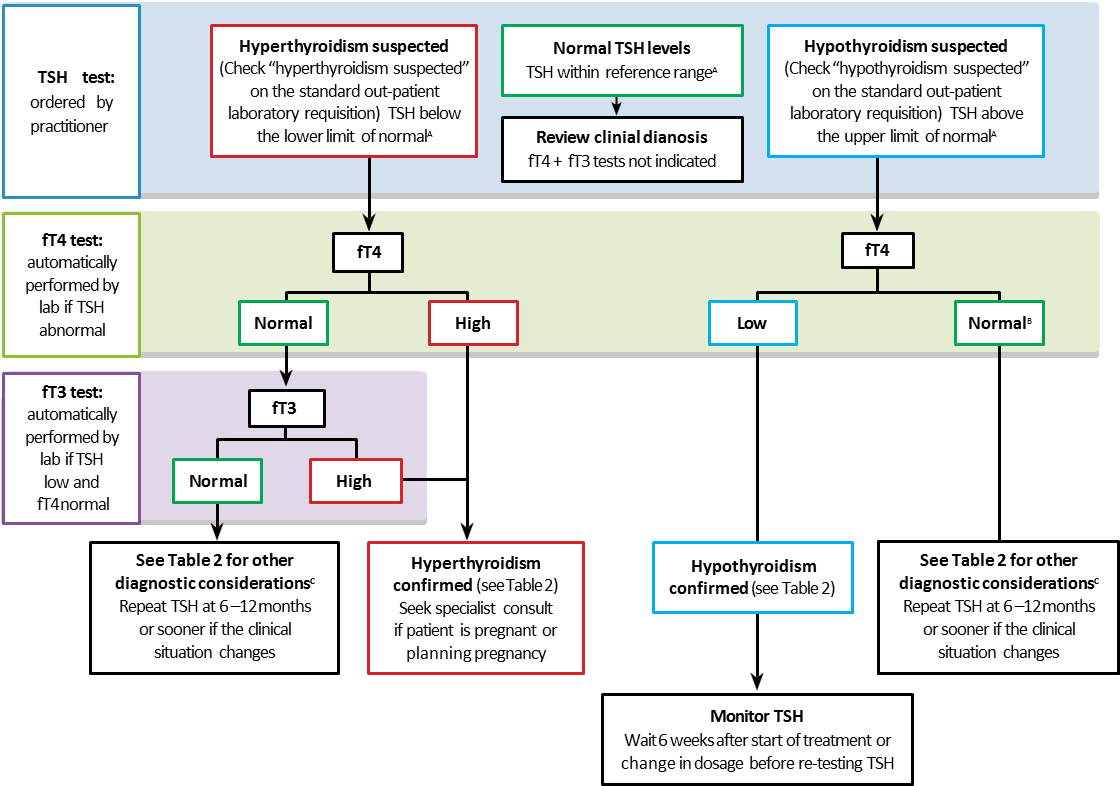
Let's walk through this using a real-world testing strategy. The following document from the UK's National Health Service (NHS) outlines how their labs approach TFTs.
Thyroid Function Testing Strategy
This document, 'Thyroid Function Testing Strategy', shows how labs translate raw numbers into clinical diagnoses. It provides concrete TSH and FT4 values used to define different thyroid states.
Please review the following sections: 'First line thyroid testing' (page 1): Note how TSH is the screening test and what actions are triggered by high or low results. 'Hypothyroidism' (page 4): See the definitions for overt hypothyroidism (TSH > 10, FT4 < 12.1). 'Hyperthyroidism' (page 5): See the definitions for hyperthyroidism (TSH < 0.02, raised FT4 or FT3).
As you can see from the guideline, the process is:
- Measure TSH first. If it's within the normal reference range (e.g., 0.27–4.2 mU/L), the patient is considered euthyroid, and testing stops.
- If TSH is high (e.g., >10 mU/L), the lab automatically adds on a Free T4 test. If the FT4 is low, this confirms overt primary hypothyroidism.
- If TSH is low (e.g., <0.2 mU/L), the lab automatically adds on a Free T4 and often a Free T3. If FT4 and/or FT3 are high, this confirms primary hyperthyroidism.
This stepwise "reflex" testing is efficient and cost-effective.
5. Important Clinical Context: Subclinical Disease
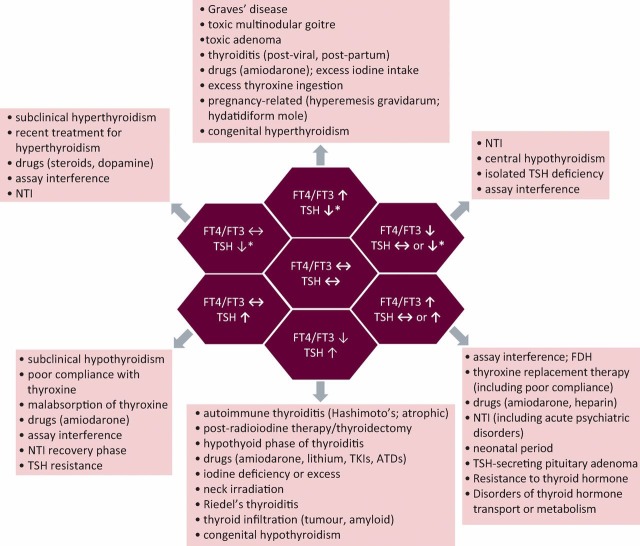
You will frequently encounter lab reports labeled "subclinical" hypothyroidism or hyperthyroidism. This simply refers to a situation where the TSH is abnormal, but the Free T4 is still within the normal range.
- Subclinical Hypothyroidism: High TSH, Normal FT4. (The pituitary is working harder to keep T4 levels normal).
- Subclinical Hyperthyroidism: Low TSH, Normal FT4. (The pituitary is suppressed by thyroid hormone levels that are at the high end of normal for that individual).
While a deep dive into managing these is beyond today's lesson, recognizing the patterns is crucial. They represent mild or early stages of the primary disorders we've discussed.
This image provides a great summary of the different TFT patterns, including the primary and subclinical states we've discussed.
Conclusion
Congratulations! You can now interpret the most common and fundamental patterns in thyroid function testing. By anchoring your understanding in the HPT axis and its negative feedback loop, you can logically deduce the patient's thyroid status from their TSH and Free T4 levels.
Key Takeaways:
- The HPT axis operates on a negative feedback loop: T4/T3 from the thyroid inhibit TSH from the pituitary.
- TSH is the most sensitive screening test for thyroid dysfunction.
- Primary Hypothyroidism is a failing thyroid gland, leading to a low FT4 and a compensatory high TSH.
- Primary Hyperthyroidism is an overactive thyroid gland, leading to a high FT4 and a suppressed low TSH.
- The diagnostic process usually starts with TSH, with FT4 being added based on the TSH result.
Preview of the Next Lesson:
Our discussion so far assumes the patient is otherwise well. But what happens to TFTs when a patient is critically ill with another condition, like sepsis or after major surgery? The HPT axis can be temporarily disrupted, creating confusing lab patterns. In our next lesson, we will learn to recognize the TSH and T4 pattern suggestive of sick euthyroid syndrome in critically ill patients.