Welcome to your second lesson. In our first session, we established a 5-minute warm-up routine to serve as a consistent trigger to start your daily practice. Now that you're warmed up and sitting at the piano, what's next? Simply "playing" for 30 minutes can feel aimless and lead to frustration if you don't see clear progress.
Today, we'll address that by focusing on what gives practice its direction and purpose: setting effective goals. Your learning outcome for this lesson is to be able to set specific, measurable weekly goals for a piece or technique you are working on. This will transform your 30-minute sessions from just "time spent" into focused, productive steps toward playing better.
From Aimless Practice to Purposeful Progress
Many pianists fall into the trap of practicing with a sense of vague urgency, feeling they have a mountain of music to learn but no clear path up it. As one piano professor describes it, this can make practice feel chaotic and lead to anxiety. The key to changing this is to start thinking of your practice not as a chore, but as a project. And every successful project starts with a clear plan.
How I Set Practice Goals - The Piano Prof
This article from "The Piano Prof" introduces the powerful idea of treating practice like project management and distinguishes between two types of goals that are essential for a solid plan.
First, read the introduction to understand the feeling of unfocused practice, from the beginning down to the end of the first section. Then, read the section "Goal-Setting 101: Process vs. Outcome goals." Pay close attention to the definitions of process and outcome goals and the author's conclusion about how combining them is the key to effective practice.
To summarize, your overall goal to practice daily for 30 minutes is a process goal—it's about the habit. But to make that habit effective, you need outcome goals—specific results you want to achieve. A weekly outcome goal gives your daily process a clear target.
Making Your Goals SMART
So, what does a good outcome goal look like? A vague goal like "get better at my new piece" is hard to track. A powerful framework for creating clear, effective goals is the SMART acronym.
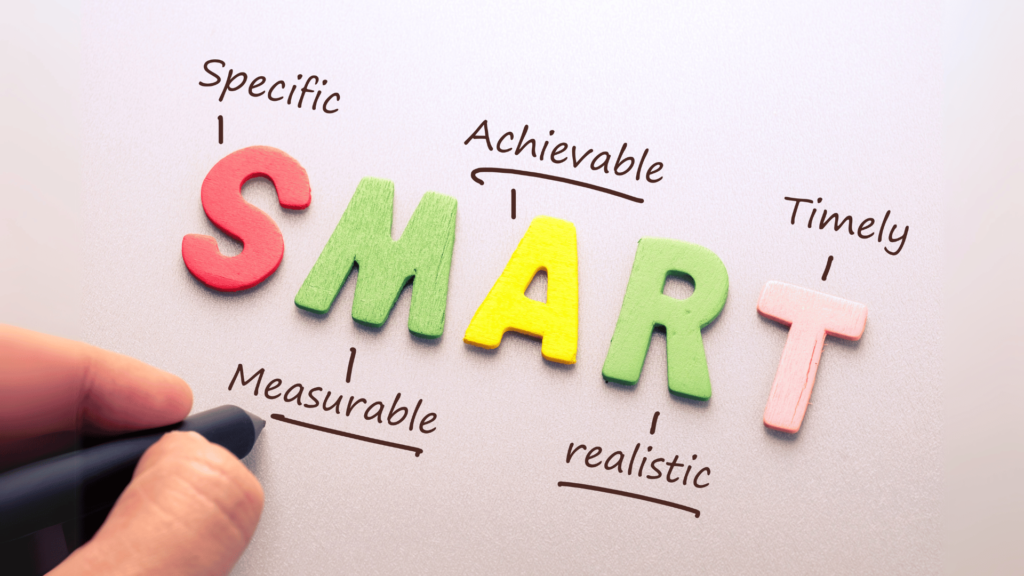
Let's break down what each letter means in the context of piano practice.
Setting SMART Goals for Piano | Piano Marvel
This article from Piano Marvel clearly defines each part of the SMART framework as it applies to piano.
Read the section that breaks down the acronym, from the beginning of the list down to the end of the definition for "Timely." As you read, think about a simple piece you're currently learning.
To make abstract musical progress something you can actually track, you need to define measurable benchmarks.
How to Set Effective Piano Practice Goals
This video from "The Piano Prof" explains how to apply the SMART framework to music, which can often feel hard to measure.
First, watch from the introduction to the SMART framework. Then, pay close attention to the following section, "but you can measure it", where the presenter gives excellent examples of measurable benchmarks, such as note security, memorization, and reaching a specific tempo.
In short, a SMART goal for piano takes a big idea and makes it concrete.
- Instead of: "Learn my new song."
- Try: "By the end of this week (Timely), I will be able to play measures 1 through 8 (Specific) of my new song, hands together, with all the correct notes and rhythms at 60 BPM on the metronome (Measurable)." This is challenging but possible (Achievable) and directly relates to your desire to play more advanced music (Relevant).
Structuring Your Week for Success
Once you have a weekly SMART goal, you can structure your daily practice sessions to build towards it. This is where process and outcome goals work together beautifully. Let's look at a perfect example.
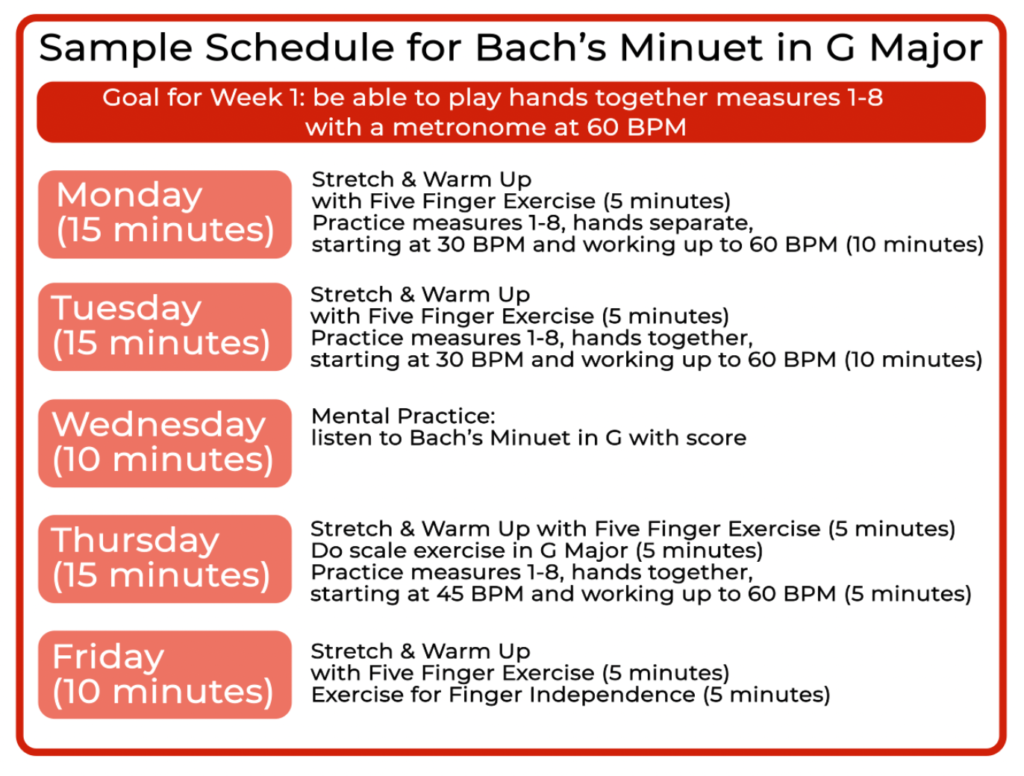
Look closely at this schedule. The outcome goal is stated clearly at the top: "be able to play hands together measures 1-8 with a metronome at 60 BPM." This goal is perfectly SMART.
Then, notice how each day's practice is a process goal designed to get closer to that outcome:
- Monday: The focus is on accuracy, hands separate.
- Tuesday: The challenge increases to hands together.
- Wednesday: A day for mental practice—listening while following the score solidifies understanding without physical strain.
- Thursday: The tempo is pushed slightly, building on the previous days' work.
- Friday: The focus shifts to a related technical skill (finger independence).
This structure ensures that every practice session has a purpose. You're not just "practicing"; you're actively building something.
Your Turn: Set Your First Weekly Goal
Now it's time for you to apply this. Think of a piece you are currently working on or would like to start. It could be from a method book or a simple classical piece. Let's create a SMART goal for it for the upcoming week.
1. Choose Your Focus:
- What piece or technical exercise will you focus on this week? (e.g., Minuet in G, C-Major scale, a Hanon exercise).
2. Define Your Weekly Outcome Goal:
- Use the SMART framework to write down your goal. Be as specific as you can. Here is a template to help you:
By the end of this week, I will be able to play [Specific Section, e.g., 'measures 1-4' or 'the first phrase'] of [Your Piece/Exercise] with [Measurable Criteria, e.g., 'correct notes and fingering, hands together'] at a tempo of [Tempo, e.g., '50 BPM'].
3. Sketch a Daily Plan:
- You don't need a detailed schedule yet, but jot down a few ideas for how you could break this down over a few days. Think about the Bach Minuet example. Could you practice hands separately on day one? Slowly together on day two? Focus on a tricky rhythm on day three?
Writing your goal down is a crucial step. It solidifies your intention and holds you accountable.
How to Set Effective Piano Practice Goals
In this short clip, "The Piano Prof" explains the simple but powerful effect of committing your goals to paper.
Watch the section from "my first tip is to write it down". This reinforces why the exercise you just did is so important for keeping you focused.
Finally, remember to be flexible. Sometimes a goal turns out to be harder than you expected. That’s okay! The purpose of planning isn’t to create a rigid set of rules, but to provide clarity and direction. If you don't meet a goal, take a moment to analyze why and adjust your plan for the next week. This process of planning and reflecting is what builds you into a smarter, more effective musician.
Conclusion
Today you've learned how to move from aimless repetition to purposeful, goal-oriented practice. By defining clear weekly objectives, you give every minute of your 30-minute daily sessions a distinct purpose, making your progress visible and motivating you to stick with your new habit.
Key Takeaways:
- Effective practice requires clear goals, much like a project needs a plan.
- The SMART framework (Specific, Measurable, Achievable, Relevant, Timely) helps you create powerful, actionable goals.
- A weekly outcome goal (the "what") gives direction to your daily process goals (the "how").
- Break down your weekly goal into smaller, manageable daily tasks.
You now have a warm-up routine to get you started and a goal-setting method to give you direction. In the next lesson, we will explore one of the most effective strategies for achieving your daily goals: the small-sections method, which teaches you how to isolate and master difficult passages one chunk at a time.