Welcome to your first lesson! We're kicking off your journey to build a consistent daily practice habit right where every good session should begin: with a warm-up. Your goal is to make practice a regular part of your day, and establishing a simple, repeatable starting ritual is one of the most effective ways to achieve that.
In this lesson, you'll learn how to perform a 5-minute warm-up routine that combines gentle finger stretches with focused scale fragments. This will not only prepare your hands and mind for playing but will also serve as the consistent trigger that starts your daily 30-minute practice session. By the end of our time, you'll have a clear, practical routine you can use immediately.
Preparing Your Body and Hands
Just as an athlete stretches before a workout, a pianist needs to prepare their body for the physical act of playing. This helps prevent strain and gets your muscles ready to work with precision and control. It's not just about your fingers; tension in your shoulders, arms, or back can significantly affect your playing.
First, let's look at some simple stretches you can do before you even touch the keys. The following video demonstrates a few excellent pre-practice movements.
5 Best Piano Warm Ups for Beginners
Watch the beginning of the video "5 Best Piano Warm Ups for Beginners" from the PianoTips channel.
Pay close attention to the stretches demonstrated before sitting down at the piano. The arm circles and the exercise of making a tight fist and then releasing are particularly good for releasing tension.
Now that your arms and hands are beginning to loosen up, let's move to the piano for a gentle finger-stretching exercise. The key here is to stretch gently. You should never feel pain; the goal is to increase flexibility, not to force it.
The article "Easy 5 Minute Piano Warm Up Exercises For Beginners" describes a great exercise for this.
Easy 5 Minute Piano Warm Up Exercises For Beginners
This reading describes a safe way to stretch your fingers at the keyboard.
Please read the section titled "Stretching The Fingers". Focus on the description of the first exercise, where you gently rock between your thumb and pinky. The warning that follows is the most important part—always listen to your body.
Try this rocking motion with both your right and left hands. Start with a comfortable interval, like a 6th (e.g., C to the A above it), and only widen the stretch if it feels easy and comfortable. A few slow, gentle rocks on each hand is all you need.
Waking Up the Fingers: Scale Fragments
With your hands and arms prepared, the next step is to activate the fingers with short, focused exercises. We'll use "scale fragments"—small patterns based on the first few notes of a scale. These are perfect for building coordination and evenness in your touch.
Since you're familiar with the C major scale, we'll start there. The foundational hand position for these exercises is the C Major five-finger position.

Place your hands on the piano as shown in the image. Now, you're ready for a simple but effective warm-up pattern. The next video demonstrates this clearly.
5 Best Piano Warm Ups for Beginners
This clip from the "5 Best Piano Warm Ups for Beginners" video shows a classic five-finger scale warm-up.
Watch the demonstration of "exercise number two". Notice how each finger plays one note of the five-finger position, ascending and then descending. The instruction to play hands together and then shift the entire position up one note is a great way to expand the exercise.
Practice this pattern a few times, first with the right hand, then the left, and then both hands together. Aim for a smooth, even sound, with each note having the same volume.
Once you are comfortable with the basic five-note scale, you can try a slightly more intricate pattern that further develops finger dexterity.
Piano Warm-up Exercises – Free Piano Lessons Online | The Note | Pianote
This article from Pianote provides a fantastic pattern for building finger independence.
In the section "Warm-up exercise #1 – the Finger Pattern", focus on the right-hand pattern described as this sequence. Try playing it slowly with your right hand in the C major five-finger position. Then, do the same for the left-hand pattern. Don't worry about playing with both hands together just yet; focus on making the pattern smooth and even in each hand.
Your 5-Minute Daily Warm-Up Routine
Now, let's assemble these elements into a repeatable 5-minute routine. The goal is to make this the automatic start to every practice session.
Minute 1: Body and Hand Stretches
- 30 seconds: While sitting at the piano, do a few slow neck rolls and shoulder shrugs to release any tension from your day.
- 30 seconds: Perform the fist-clenching and releasing exercise, followed by the gentle thumb-to-pinky rocking stretch on each hand.
Minutes 2-4: Finger Activation with Scale Fragments
- 1 minute: Place your hands in the C Major five-finger position. Play the simple five-note scale (C-D-E-F-G-F-E-D-C) hands separately, then hands together. Repeat three times.
- 2 minutes: Practice the "Finger Pattern" exercise (1-2-3-2-3-4...). Start with your right hand until it feels comfortable, then switch to your left hand. If you feel confident, try moving the pattern up so it starts on D, then E. The focus is on clarity, not speed.
Minute 5: Transition to Practice
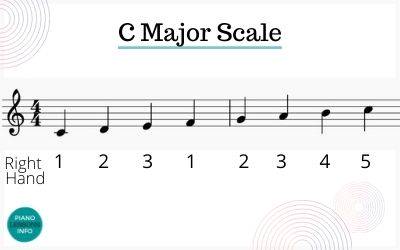
- To conclude your warm-up and bridge into your main practice, play a one-octave C major scale, hands together, ascending and descending. Play it slowly, focusing on a smooth thumb-under crossing and an even tone. This solidifies the key and prepares you for the work ahead.
Conclusion
In this lesson, you've established the foundation for a consistent practice habit. You now have a structured, effective 5-minute warm-up routine that combines essential physical preparation with targeted finger exercises. This routine serves as a powerful trigger, signaling to your mind and body that it's time to focus on making music.
Key Takeaways:
- A consistent warm-up is a crucial first step in building a daily practice habit.
- Warming up involves both off-bench stretches for your body and on-bench exercises for your fingers.
- Scale fragments in a five-finger position are excellent for activating your fingers and building dexterity.
- Your 5-minute routine consists of: (1) Stretches, (2) Finger Activation, and (3) a Transitional Scale.
As you move forward, this warm-up will be the starting point for every session. In our next lesson, we'll build on this foundation by learning how to set specific, measurable weekly goals for your practice, ensuring that every minute you spend at the piano is productive and moves you closer to your musical ambitions.