In our last lesson, we focused on giving your practice sessions direction by setting clear, weekly SMART goals. Now that you have a target, let's zoom in on one of the most powerful strategies for hitting it: how to efficiently conquer the tricky passages that can halt your progress.
Simply playing a piece from start to finish, over and over, is a common but slow way to learn. When you hit a roadblock—a clumsy fingering, a fast run of notes, a confusing rhythm—repeating the entire piece just means you practice the easy parts far more than the parts that actually need work. This can lead to frustration and make your 30-minute sessions feel unproductive.
Today's lesson will equip you with a core technique used by professional musicians to overcome this exact problem. Your learning outcome is to apply the small-sections method to isolate and work on a difficult passage in a piece. This approach will help you practice smarter, not just harder, and make tangible progress toward your weekly goals.
The Power of Focusing on the Details
Expert practice isn't about endless repetition; it's about focused, intelligent problem-solving. The small-sections method, also known as "chunking," is a cornerstone of this approach. It's one of several key strategies you can use to make your practice sessions highly effective.
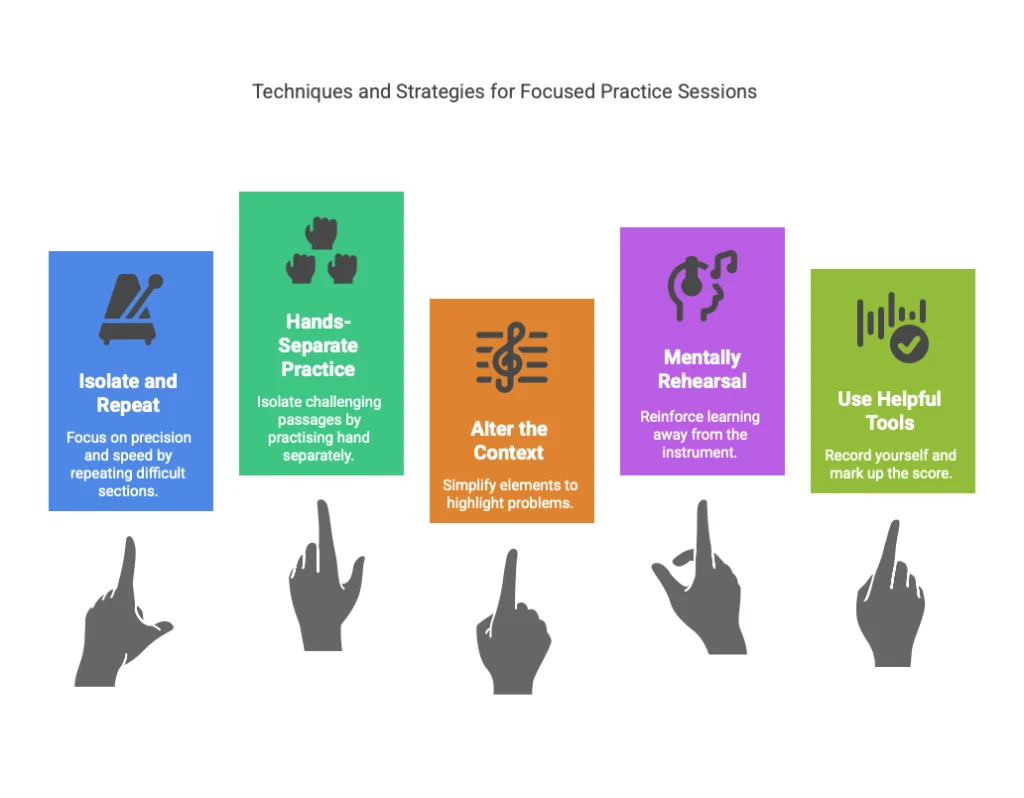
The fundamental idea is simple: instead of trying to tackle a whole difficult phrase at once, you break it down into tiny, manageable pieces.
This article from Ascenda Music provides a clear explanation of what chunking is and why it's so effective for learning music.
Start by reading the section "What is chunking?" to understand the psychological principle behind this technique and how it contrasts with the inefficient habit of always starting from the beginning. Then, read the next section, "How can I use it?", for a basic overview of the process. Pay close attention to the idea that a mistake is an "opportunity" to identify a problem.
As the article points out, the goal is to stop seeing mistakes as failures and start seeing them as signposts pointing directly to the specific notes or movements that need your attention.
A Step-by-Step Guide to the Small-Sections Method
Let's imagine you're working on your piece and you come across a passage that looks something like this:

Your fingers stumble, the rhythm feels off, and you can't seem to play it smoothly. Instead of getting frustrated and going back to the beginning, this is your cue to switch to focused, small-section work.
Step 1: Isolate the Problem Chunk
First, identify the smallest possible unit that is causing the trouble. It might be a full measure, but it's often smaller—perhaps just three or four notes. A great hands-on way to physically and visually isolate this section is the "Post-it Method."
3 Revolutionary Piano Practice Methods
This blog post offers a very practical way to apply the isolation technique using a simple tool.
Read the section titled The Post-it Method. The step-by-step guide shows you exactly how to use Post-it notes to block out everything but the tiny chunk you're working on.
Using sticky notes is a simple but powerful way to force your brain to focus only on the problem area, preventing your eyes (and fingers) from running ahead.
Step 2: Apply the "Absolute Accuracy Rule"
Once you've isolated your chunk, the goal is not to play it at full speed. The goal is to play it perfectly. This means practicing at a tempo so slow that you can guarantee 100% accuracy with the correct notes, fingering, and rhythm.
The Only Way You Should Practice Piano
In this video, Jazer Lee explains a crucial mindset for effective practice, which he calls the "Absolute Accuracy Rule."
First, watch from the beginning to understand the definition of the Absolute Accuracy Rule (AAR). Then, watch his demonstration from the example where he contrasts a good, slow practice of Für Elise with "gambling." Finally, pay close attention to the section from "practice in really, really, small sections". This is where he explains the "seven successful times" rule, a fantastic benchmark for knowing when you've truly learned a chunk.
This idea is critical. Practicing with mistakes, even at a fast tempo, only reinforces those mistakes. By slowing down to the point of perfect execution, you are building the correct muscle memory from the very start. If you make a mistake, you're going too fast. Slow down even more.
Step 3: Connect the Chunks
After you can successfully play one chunk seven times in a row with absolute accuracy, you can move on to the next adjacent chunk and repeat the process. Once you have two or more neighboring chunks mastered, it's time to link them together.
A key tip for this stage is to always include the first note of the next chunk when practicing the current chunk. This trains the transition—the physical movement your hand needs to make to get from one position to the next.
This entire workflow—isolating, practicing slowly, and connecting—is demonstrated wonderfully in the following video.
This Practice Strategy Makes Fast Piano Passages Easier
Dr. Kate Boyd from "The Piano Prof" provides a clear visual demonstration of this entire practice strategy.
Watch the video through. Notice how she: Introduces the idea of breaking down a passage into small sections. Demonstrates practicing just a tiny piece of it very slowly and deliberately. Shows how to add the next piece and connect them. Emphasizes mindful repetition to solidify the learning.
Your Turn: Practice a Difficult Spot
Now, let's put this into practice.
- Take out the sheet music for the piece you set a SMART goal for in our last lesson.
- Within the section you're focusing on this week, identify the single most difficult measure or group of notes.
- Isolate it. Use sticky notes or just your focus to block everything else out.
- Practice it slowly. Apply the "Absolute Accuracy Rule." Find a tempo (it might be incredibly slow!) where you can play it perfectly.
- Repeat it. Try to play it correctly seven times in a row. If you make a mistake, the count resets to zero. This isn't a punishment; it's a diagnostic tool to ensure you're not just getting it right by luck.
- Connect it. Once you've mastered that small chunk, practice it one more time, but add the very first note of the following chunk. Feel the movement required to connect them.
This focused work, even for just 5-10 minutes of your 30-minute session, will produce far better results than 30 minutes of aimless playing.
Conclusion
Today, you've learned one of the most fundamental techniques for efficient piano practice. By isolating difficult passages into small chunks and practicing them with absolute accuracy, you transform frustrating roadblocks into manageable puzzles. This method empowers you to systematically solve problems in your music, leading to smoother, more confident playing.
Key Takeaways:
- Don't just repeat; identify, isolate, and solve problems.
- Break down difficult passages into the smallest possible chunks.
- Practice slowly enough to achieve 100% accuracy (the "Absolute Accuracy Rule"). This builds correct muscle memory.
- Use repetition (like the "seven successful times" rule) to ensure mastery, not luck.
- Once mastered, connect the chunks back together, paying special attention to the transitions.
You now have a method for setting weekly goals and a powerful strategy for working on the difficult spots within those goals. In our next lesson, we will explore how to use a practice log to track your daily sessions. This will help you monitor the progress you're making with these techniques and identify any recurring challenges over time.