Welcome back! In our recent lessons, we've focused on building the essential components of a strong practice routine. You learned how to set specific, weekly SMART goals to give your practice direction, and you've mastered the small-sections method to efficiently work through difficult passages.
These tools help you know what to practice and how to practice it effectively. Now, we'll add the final piece to this foundational module: a system for tracking your efforts and learning from them. Your primary goal is to build a consistent daily practice habit, and today's lesson is designed to give you a powerful tool to achieve just that.
Your learning outcome is to use a practice log to track daily sessions and identify recurring challenges. This isn't about creating more work; it's about making your 30 minutes at the piano more focused, insightful, and motivating. By observing your own process, you can turn practice from a simple routine into a cycle of continuous improvement.
Why Keep a Practice Log?
If you've ever finished a practice session and felt like you didn't make much progress, you're not alone. The solution isn't always more time, but more awareness. A practice log provides that awareness. It’s a written record that helps you plan your work, see your progress, and hold yourself accountable.
Keeping a log turns your practice into a clear, three-step cycle: Plan -> Do -> Reflect.
✍️ How to Keep a PRACTICE JOURNAL (for ALL instruments!)
This video from "The Piano Prof" channel outlines the key benefits of keeping a practice journal. It explains how this simple habit can transform your practice sessions.
Watch the first section of the video, which covers the four main reasons to keep a journal: efficiency, progress tracking, estimating learning time, and accountability. Pay close attention to the point about accountability, as this directly supports your goal of building a consistent daily habit.
As the video explains, a log makes your progress tangible. Instead of feeling like you're not improving, you can look back and see concrete evidence of your work, like the metronome markings you've achieved or the sections you've mastered.
The Anatomy of a Practice Log
A practice log doesn't have to be complicated. It can be a simple notebook, a spreadsheet, or a printable template. The important thing is that it works for you.
Some logs are very simple, focusing on just tracking time and goals.
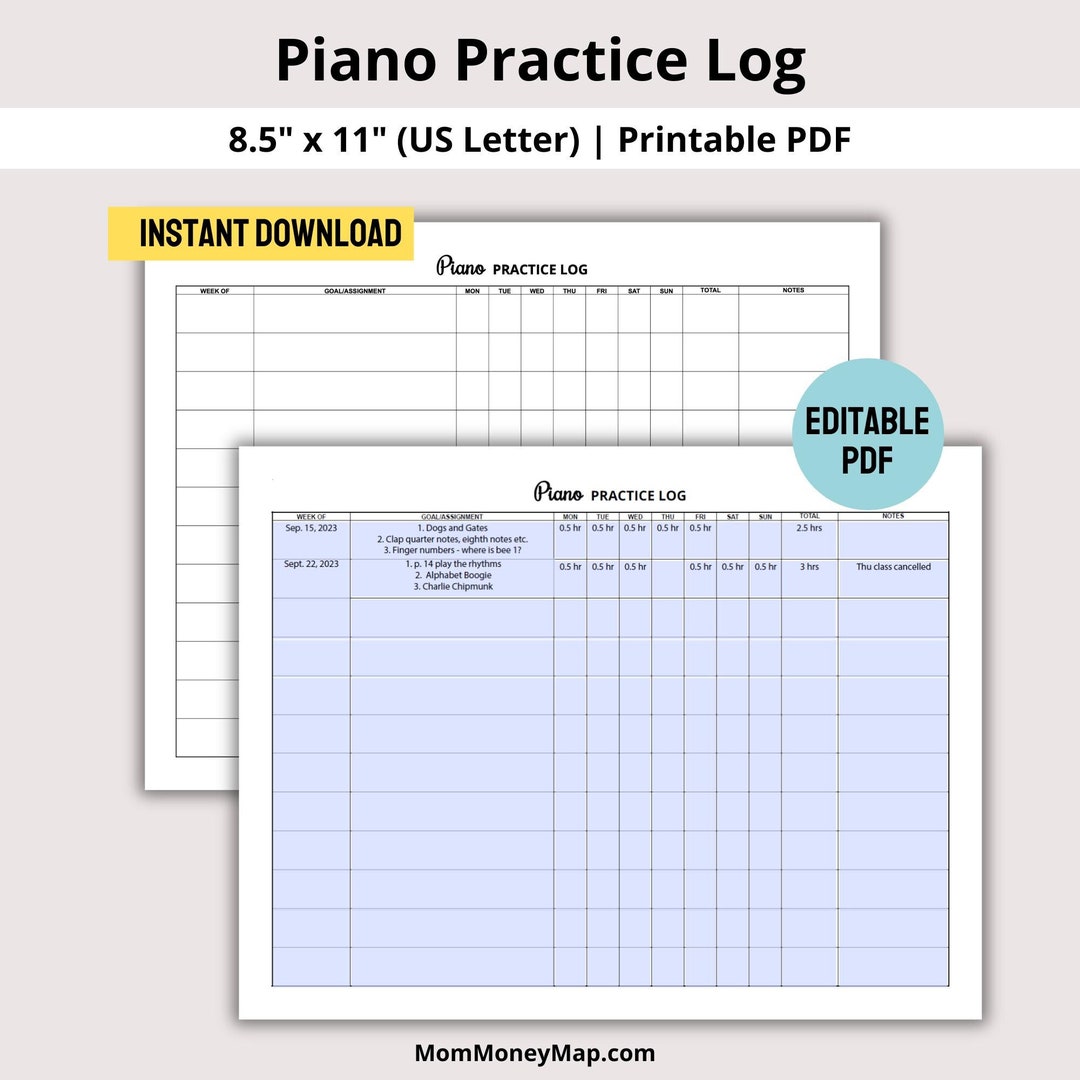
Others are more detailed, prompting you to reflect on your experience. These are often called practice journals.

The most effective system often combines elements of both: planning and tracking (the "log") and thoughtful reflection (the "journal"). Let's break down how you can structure your log around the three phases of your practice session.
Phase 1: Before You Play (The Plan)
The most effective practice sessions start before you even touch the keys. Taking just two minutes to plan can make the entire 30-minute session more productive. This is where you connect your broader weekly goal to a specific, actionable task for today.
Piano Practice Log: The Ultimate Free Practice Tool
This article from South Shore Piano School provides a fantastic, in-depth guide to creating a truly useful practice log. We'll focus on the planning components.
Read the three short sections starting with "Piano Practice Log Planning Part 1" to understand the importance of setting a specific goal for each session. Next, read the section on planning your method. This is where you'll decide how you'll tackle your goal—for example, by using the small-sections method we learned last time. Finally, review the section on planning for obstacles. This is key for proactively identifying and solving recurring challenges.
So, before you begin, your log entry might look like this:
- Today's Goal: Smooth out the two-measure run in my piece, measures 15-16.
- My Plan: Use the small-sections method. Practice each measure separately at 60 bpm until I can play it perfectly 5 times in a row. Then, connect them.
- Potential Obstacle: The thumb-under movement in measure 16 feels clumsy. If I struggle, I will practice just that three-note transition very slowly.
This simple plan gives you a clear mission for your session.
Phase 2: During Practice (The Log)
While you're practicing, you don't need to write extensively. The main goal here is to simply track what you're doing. This can be as easy as noting start and stop times for different activities.
Your log might look like this:
- 5-minute warm-up (scales and finger stretches)
- 15 minutes on measures 15-16 of my piece (reached 70 bpm)
- 10 minutes sight-reading a new simple piece
This simple data, collected over a week, can reveal a lot. You might notice you're spending all your time on one piece and neglecting technique, or vice-versa. The "Piano Prof" video suggests a few key things to track.
✍️ How to Keep a PRACTICE JOURNAL (for ALL instruments!)
Let's return to the "The Piano Prof" video for specific ideas on what to track.
Watch the segment from "what should they include" for a list of concrete items to record in your journal, such as tempo benchmarks, measure numbers you worked on, and technical goals.
Phase 3: After You Play (The Reflection)
This is perhaps the most valuable part of keeping a journal. Taking just 2-3 minutes after your session to reflect solidifies what you've learned and helps you identify those recurring challenges. This is where you ask yourself: "How did it really go?"
This article from Learn Music Together offers excellent prompts for post-practice reflection. It highlights how writing things down helps with memory and progress.
First, read the section Why you should plan to understand the powerful effect reflection has on learning. Then, skip down to the "Music Journal prompts" section and read the first five prompts, from "What is one thing that you can do differently". These questions are a perfect guide for your daily reflection.
Using those prompts, your post-practice reflection could look like this:
- 1. What went well? I successfully connected measures 15 and 16 at 70 bpm without mistakes.
- 2. What was challenging? The rhythm in measure 15 still feels a bit shaky. I kept rushing the eighth notes.
- 3. What mistakes did I make? I played a C instead of a C# twice in measure 16.
- 4. How do I rate my progress? Good progress on the notes and tempo, but the rhythm needs more work.
- 5. What will I do differently tomorrow? I'll start tomorrow's session by clapping the rhythm of measure 15 before I play it. I'll also circle the C# in my score as a reminder.
Notice how this process directly identifies a recurring challenge (the rhythm in measure 15) and creates an actionable plan to fix it.
Your Turn: Start Your Log
Let's put this into action. You don't need a fancy journal to start. A simple notebook is perfect.
For your next practice session:
- Before you play: Take 2 minutes to write down a single, specific goal for your 30-minute session. What one thing do you want to improve?
- During practice: Keep a rough log of how you spend your time. For example: "5 min warm-up, 20 min on Piece X, 5 min sight-reading."
- After you play: Take 3 minutes to answer these questions in your notebook:
- What's one thing I did well today?
- What was the hardest part?
- What will I try tomorrow to address that challenge?
That's it. This simple 5-minute process of planning and reflection is the key to unlocking more consistent and productive practice.
Conclusion
Today, we've added the final tool to your foundational practice toolkit. A practice log is more than just a diary; it's a system for ensuring your practice is focused, reflective, and constantly improving. By consistently applying the Plan -> Do -> Reflect cycle, you make every minute at the piano count and build the momentum needed to achieve your goal of daily practice.
Key Takeaways:
- A practice log builds accountability and makes your progress visible.
- Structure your log around three phases: a brief plan before you start, simple tracking during your session, and a few minutes of reflection after you finish.
- Your plan should include a specific goal, the method you'll use, and any anticipated challenges.
- Your reflection should identify what went well, what was difficult, and what you'll do differently next time.
You now have a complete framework for building a consistent practice habit. In the next module, we will begin applying these habits to the core skills of piano playing, starting with "Strengthening Finger Technique." Our first lesson will introduce you to Hanon-style exercises designed to build speed, strength, and evenness across all your fingers. Your practice log will be the perfect tool to track your progress on these new technical challenges.