Introduction
In our last lesson, we put ourselves in the application's shoes and saw how easily a seemingly harmless dynamic query can be turned into a weapon. By manually constructing queries using string concatenation, you observed how attacker-supplied input like ', ;, and -- gets mixed with legitimate SQL, fundamentally altering the command sent to the database. You now understand the root of the problem: treating user input as trusted code.
Today, we transition from diagnosing the vulnerability to deploying the cure. This lesson focuses on the single most effective defense against SQL injection: parameterized queries, also known as prepared statements. We will directly contrast the insecure method of string concatenation with this secure alternative, using code examples to demonstrate precisely why one fails and the other succeeds. Mastering this distinction is the cornerstone of writing secure database applications.
The Vulnerability: Code and Data Commingled
Let's start with a stark reminder of what happens when an application fails to distinguish between the query's logic and the data it's supposed to handle.
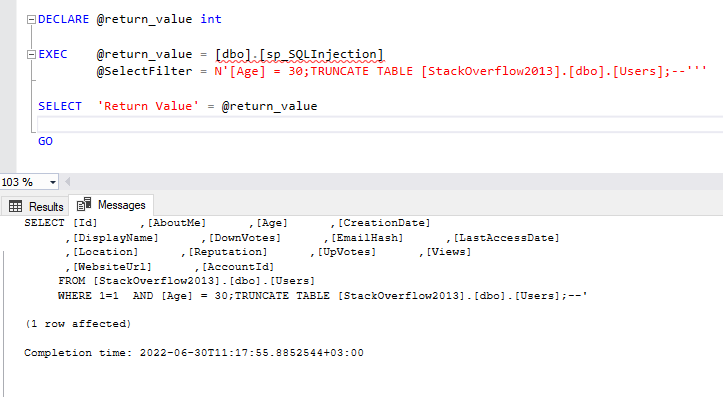
The underlying code that allows this might look deceptively simple in Python:
# INSECURE: User input is formatted directly into the query string
user_input = "30; TRUNCATE TABLE Users;--"
query = f"SELECT * FROM Users WHERE Age = {user_input}"


# The database executes: SELECT * FROM Users WHERE Age = 30; TRUNCATE TABLE Users;--
The database has no way to know that TRUNCATE TABLE Users was not part of your original intent. It receives a single string of commands and executes them. The problem is that the user's input changed the structure of the SQL statement.
The Solution: Separating Code from Data
Parameterized queries solve this problem by enforcing a strict separation between the SQL command (the code) and the values being supplied (the data). This is not just a suggestion; it's a fundamental change in how the application communicates with the database.
The process involves two main steps:
- Prepare: The application first sends a template of the SQL query to the database. This template contains the fixed SQL logic, but uses placeholders (often
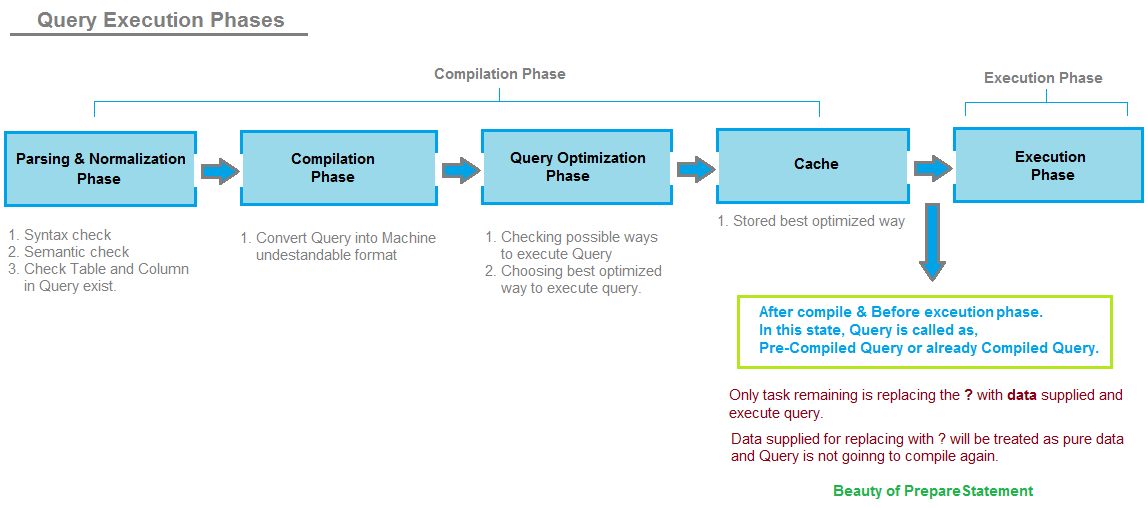
?or a named variable like:username) for any user-supplied values. The database receives this template, parses it, compiles it, and determines its execution plan. At this stage, the structure of the query is locked in. - Execute: In a separate step, the application sends the user's data. The database then binds this data to the placeholders in the already-compiled query template and executes it.
Crucially, the data sent in the second step is never parsed as SQL code. It is treated purely as data. If an attacker submits ' OR '1'='1', the database will literally search for a value that is the string ' OR '1'='1', not execute the boolean logic.
This diagram illustrates the query execution pipeline. With prepared statements, the user data is supplied just before the final execution phase, bypassing the compilation and optimization steps where its structure could have been misinterpreted as code.
Demonstration: From Vulnerable to Secure
Now, let's see this principle in action. The following video demonstrates building a simple Python login system, first insecurely and then securely.
Make SQL Queries Secure in Python
The video "Make SQL Queries Secure in Python" from the NeuralNine channel provides a clear, practical demonstration of fixing an SQL injection vulnerability.
First, watch the demonstration of the insecure login system from this segment. The presenter uses formatted strings to build the query. Observe how an attacker can craft input with OR '1'='1' to bypass authentication and retrieve all records from the database. This should feel very familiar from our previous lesson. Next, watch the fix using prepared statements from this segment. Pay close attention to two key changes: The SQL query now uses ? as placeholders for the name and password. The user input variables (name_input, pass_input) are passed as a separate tuple in the execute method. Notice how the exact same malicious input now results in "Login failed." The database is no longer interpreting the input as code; it's treating it as a literal string value to search for, which correctly fails to find a match.
This before-and-after comparison is the essence of this lesson. The secure version prevents the user from influencing the query's structure, thereby neutralizing the SQL injection threat.
The 'Why' Behind the Fix
To deepen your understanding, let's look at a more formal explanation of how the database server's behavior makes prepared statements secure.
SQL Injection Prevention: Security Simplified
This video from Vickie Li Dev, "SQL Injection Prevention: Security Simplified," explains the mechanics of query execution and why prepared statements are effective.
Please watch the section from the beginning. The key insight here is that when you use prepared statements, you "define all the SQL logic first, compile it, then insert parameters into the query right before execution." The database engine makes a clear distinction between the pre-compiled code and the data that is supplied later.
A Universal Principle with a Caveat
The concept of parameterized queries is not specific to Python. It is the industry-standard best practice across all major programming languages. The following resources provide clear, side-by-side code examples in Java.
What is SQL Injection? Tutorial & Examples | Web Security Academy
This guide from PortSwigger, a leader in web security, provides a concise explanation of how to prevent SQL injection.
Please read the section titled "How to prevent SQL injection". Compare the vulnerable code, which uses string concatenation ("+ input + "), with the secure code that uses PreparedStatement and a ? placeholder. The pattern is identical to what you saw in the Python video.
The OWASP Cheat Sheet Series, a definitive resource for developers and security professionals, reinforces this with further examples.
SQL Injection Prevention - OWASP Cheat Sheet Series
This OWASP cheat sheet is a go-to guide for secure coding practices.
First, look at the insecure Java example, which again uses simple string concatenation. Then, read the introduction to prepared statements as the primary defense. Finally, examine the safe Java example. Note how it explains that if an attacker enters tom' or '1'='1, the query will literally look for a user with that exact, bizarre name, which is the correct and safe behavior.
However, it's crucial to use them correctly. You can't just wrap an insecure concatenated string inside a prepare function. The parameters must be sent separately. The Vickie Li Dev video highlights this common mistake from
Also, be aware that parameterized queries are designed to handle untrusted input as data values. They cannot be used for dynamic parts of the query structure itself, such as table names, column names, or ORDER BY clauses. For those specific cases, the recommended approach is whitelisting: validating that the user input is one of a set of pre-approved, safe values before building the query.
Conclusion
You have now seen the definitive line between vulnerable and secure database code. The difference is not complex, but it is absolute.
Key Takeaways:
- Insecure String Concatenation: Mixes SQL code and user-supplied data into a single string. This allows an attacker's input to be interpreted as code, altering the query's logic.
- Secure Parameterized Queries: Enforce a strict separation. The SQL query template (code) is sent and compiled first. The user input (data) is sent separately and is only ever treated as a literal value, never as executable code.
- Universality: This principle of separating code and data is the standard defense against SQL injection and is available in all modern programming languages.
In the previous lesson, you learned to think like an attacker to construct a malicious query. In this lesson, you've learned to think like a defender to neutralize it. With this complete understanding of the vulnerability and its primary defense, you are now fully prepared to move into the offensive phase. In the next module, we will begin launching a variety of SQL injection attacks against a vulnerable application, putting all of this theory into practice.