Introduction
Welcome to our new module on Collective Risk and Ruin Theory. In our previous module, you mastered the use of copulas to model the aggregate loss distribution for a portfolio of dependent risks, and you learned how to quantify the extreme tail risk using measures like VaR and Expected Shortfall. This lesson begins our exploration of the primary tool insurers use to manage that very tail risk: reinsurance.
Just as individuals and businesses purchase insurance to protect against financial loss, insurance companies purchase reinsurance to protect themselves from unexpectedly large claims or catastrophic events. This lesson will introduce you to the fundamental types of reinsurance agreements. Our goal is to describe the most common arrangements—proportional, excess of loss, and stop-loss—and understand the basic principles governing how they divide risk between the direct insurer and the reinsurer. This conceptual foundation will be essential for the next lesson, where we will begin calculating the financial impact of these contracts.
What is Reinsurance?
At its core, reinsurance is simply "insurance for insurance companies." An insurer, often called the ceding company or cedent, transfers a portion of its risk portfolio to another company, the reinsurer. In exchange for taking on this risk, the reinsurer receives a portion of the insurance premium.
This mechanism is vital for several reasons:
- Risk Spreading: It prevents a single insurer from being overwhelmed by a catastrophic event, such as a major hurricane or earthquake.
- Capacity Increase: It allows an insurer to underwrite more policies or larger risks than its own capital base would otherwise permit.
- Stabilizing Earnings: It smooths the insurer's financial results by mitigating the impact of large, volatile losses.
To begin, let's watch a short video that provides a clear overview of these fundamental concepts.
This video from the P & C Insurance Helpline, "Reinsurance Basics," offers a concise explanation of what reinsurance is and why it's a critical component of the insurance industry.
Please watch the first two minutes of the video, from the beginning to the introduction. Pay close attention to the two main reasons given for why reinsurance is necessary: managing catastrophic losses and covering unique or specialized risks.
The Fundamental Divide: Proportional vs. Non-Proportional
Reinsurance contracts are incredibly flexible, but they generally fall into one of two main categories. This distinction is the most important organizing principle in the world of reinsurance.

This diagram provides a useful roadmap. Reinsurance agreements are first categorized as either proportional or non-proportional. Within these, there are further subtypes that we will explore.
- Proportional Reinsurance: The cedent and the reinsurer share premiums and losses in an agreed-upon proportion. Think of it as the reinsurer taking a fixed percentage "slice" of every policy.
- Non-Proportional Reinsurance: The reinsurer's involvement is not based on a fixed share but is triggered when losses exceed a certain amount. This form is specifically designed to protect against large or catastrophic events.
Let's continue with the "Reinsurance Basics" video to hear this distinction explained.
The video continues by introducing the concepts of proportional and non-proportional reinsurance.
Please watch from this section, where the narrator contrasts the two main types. Focus on the core idea: in proportional, the premium and loss are shared by a percentage; in non-proportional, the reinsurer pays out only after a certain loss threshold is met.
Now, let's delve into the specifics of each category.
Proportional Reinsurance
In proportional reinsurance, the cedent and reinsurer agree on a percentage. The reinsurer receives that percentage of the premium and pays the same percentage of any claims. If is the original loss on a policy and is the proportion retained by the insurer (the cedent), then:
- Insurer's retained loss:
- Reinsurer's share of loss:
The two primary types of proportional reinsurance are Quota Share and Surplus Share.
This video, "Treaty Reinsurance," also from the P & C Insurance Helpline, provides clear, example-driven explanations of both Quota Share and Surplus Share agreements.
Please watch the segment from Proportional Reinsurance. This will walk you through: The general concept of proportional sharing. Quota Share: a straightforward percentage split on a portfolio of risks. Surplus Share: a more nuanced approach where the sharing only applies to risk amounts above the insurer's chosen "retention line."
Let's formalize the definitions from the video:
-
Quota Share: This is the simplest form. The insurer cedes a fixed percentage of every risk within a specific class of business. For example, under a "50% quota share treaty," the reinsurer receives 50% of all premiums and pays 50% of all losses for that class of business.
-
Surplus Share: This arrangement gives the insurer more flexibility. The insurer establishes a "retained line," which is the maximum amount of risk they are willing to keep on a single policy. For any policy with a sum insured that exceeds this line, the "surplus" amount is shared proportionally with the reinsurer up to a certain limit. For example, if the retained line is $100,000 and a $500,000 policy is issued, the insurer keeps the first $100,000 of risk (20%) and cedes the remaining $400,000 (80%) to reinsurers. The premium and any losses on that specific policy would be split 20/80. For a policy of $75,000, the insurer would keep 100% of the risk and premium.
Non-Proportional Reinsurance
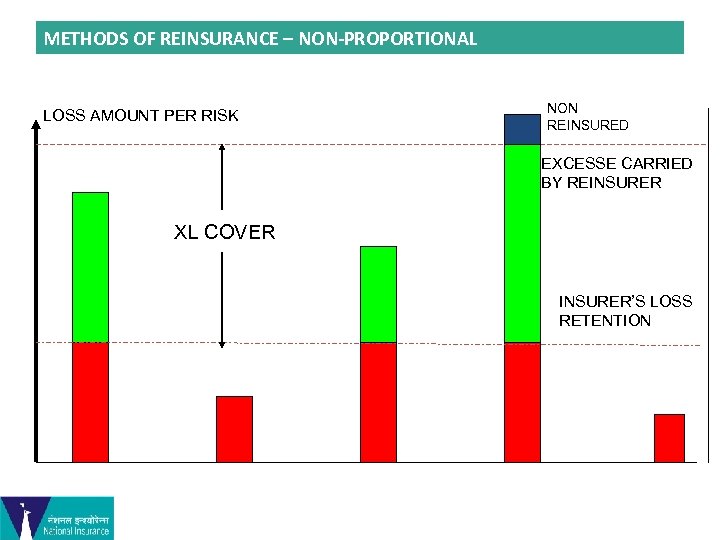
Non-proportional reinsurance, also known as Excess of Loss (XL) reinsurance, does not involve sharing premiums and losses on a percentage basis. Instead, the reinsurer's liability is triggered only when the insurer's loss exceeds a specified amount, known as the retention or deductible. This type of reinsurance is designed to protect the insurer from the severity of losses rather than the frequency.
The mathematical structure is straightforward. If is the loss and is the retention level:
- Insurer's retained loss:
- Reinsurer's share of loss: , often written as
The image below illustrates this concept. For several different loss events (the bars), the insurer pays up to the retention line (red portion). The reinsurer covers the excess amount (green portion), up to the limit of the reinsurance cover.
There are two main applications of this principle: Excess of Loss and Stop-Loss.
Let's return to the "Treaty Reinsurance" video to see how non-proportional reinsurance is structured.
Watch the section from Non-Proportional. This part explains the mechanics of excess of loss, including the key idea of a loss limit that triggers the reinsurer's involvement. It also introduces the distinction between applying this concept on a per-event basis versus an annual aggregate basis.
Let's define the two key types more formally.
-
Excess of Loss (Per Risk or Per Occurrence): This is the most common form of non-proportional reinsurance. The retention applies to each individual risk or each single loss-causing event.
- Per-Risk XL: Protects against a very large single claim, e.g., a major fire at a large factory.
- Per-Occurrence (or Catastrophe) XL: Protects against the accumulation of many individual claims from a single event, e.g., thousands of home insurance claims from a single hurricane.
-
Stop-Loss (or Aggregate XL): This form is fundamentally different because it applies to the insurer's total losses over a period, typically a year. The retention is an aggregate amount. The reinsurer pays if the sum of all claims in the year, , exceeds . This protects the insurer from a high frequency of claims, a high severity of claims, or both. It protects the insurer's overall annual result, which connects directly to the portfolio modeling work we did with copulas.
To solidify your understanding of these non-proportional structures, the following reading provides clear mathematical definitions and highlights a key theoretical point about the value of stop-loss insurance.
Chapter 10 Insurance Portfolio Management including Reinsurance
This chapter from "Loss Data Analytics" details the mathematical structure of different reinsurance treaties.
Please read the following two sections: First, read the main introduction to Section 10.4 Reinsurance. This part defines the two main categories and sets up the notation for how the total risk X is split. Next, read section 10.4.2.1 The Optimality of Stop-Loss Insurance. This section provides the formal definition of a stop-loss contract, showing that the insurer pays \min(X,M) and the reinsurer pays \max(0,X-M). As a statistician, you may find the proposition interesting: it states that for a given expected retained loss, the stop-loss contract minimizes the variance of the insurer's retained claims. This is because it transfers the most extreme tail risk to the reinsurer, making it a very efficient way to manage portfolio volatility.
Conclusion
In this lesson, we have laid the groundwork for understanding how insurers manage their risk through reinsurance. We established the fundamental purpose of reinsurance and distinguished between its two primary forms.
Key Takeaways:
- Reinsurance is a risk transfer mechanism where an insurer (cedent) cedes risk to a reinsurer.
- Proportional Reinsurance involves sharing premiums and losses by a pre-agreed percentage. The main types are Quota Share (a fixed percentage on all policies in a class) and Surplus Share (a proportional split of risk above a retained line).
- Non-Proportional Reinsurance involves the reinsurer paying only when losses exceed a specified monetary retention level. The main types are Excess of Loss (applying to single risks or events) and Stop-Loss (applying to the aggregate annual claims of a portfolio).
Preview of the Next Lesson
Now that you can describe the structure of these common reinsurance arrangements, our next step is to apply them. In the next lesson, you will learn to calculate the insurer's and reinsurer's share of claims under these different structures. We will work through concrete numerical examples to see exactly how a given loss is divided, solidifying your understanding and preparing you for exam-style problems.